Scholarly Article
A Quarter Century of Special Autonomy in Papua: Treating the Symptoms, Leaving the Root Causes Untouched
Contents
Contents
Abstrak
Undang-Undang Nomor 21 Tahun 2001 tentang Otonomi Khusus bagi Provinsi Papua genap berusia 25 tahun pada 21 November 2026. Negara menyebut Otsus sebagai wujud pengakuan dan penghargaan terhadap orang asli Papua, dengan bukti dana lebih dari Rp138 triliun, kenaikan indeks pembangunan manusia, dan jabatan publik bagi orang asli Papua. Artikel ini menguji klaim tersebut terhadap empat akar masalah Papua yang dirumuskan dalam Papua Road Map LIPI: sejarah dan status politik, kekerasan negara dan pelanggaran HAM, kegagalan pembangunan, serta marginalisasi orang asli Papua. Dengan metode kepustakaan atas dokumen hukum, putusan Mahkamah Konstitusi, data BPS dan BPK, serta kajian terdahulu, artikel ini menemukan bahwa Otsus menyentuh secara terbatas akar kegagalan pembangunan dan sebagian akar marginalisasi melalui dana dan afirmasi jabatan. Akar sejarah dan kekerasan tidak tersentuh: Komisi Kebenaran dan Rekonsiliasi serta Pengadilan HAM tidak pernah dibentuk, hak membentuk partai politik dihapus, dan hak MRP atas persetujuan pemekaran dilemahkan pada 2021. Kesenjangan pembangunan tetap lebar; pada 2026 Papua Pegunungan masih menjadi satu-satunya provinsi berkategori pembangunan manusia rendah. Artikel ini berargumen bahwa kegagalan tersebut berakar pada desain Otsus yang diberikan tanpa kesepakatan, memisahkan keamanan dari otonomi, dan menjawab persoalan politik dengan uang. Rekomendasinya mencakup pembentukan KKR dan Pengadilan HAM, pemulihan kewenangan MRP, evaluasi kebijakan keamanan, indikator yang terpilah menurut orang asli Papua, dan dialog Jakarta–Papua.
Kata kunci: otonomi khusus, Papua, akar masalah, Papua Road Map, orang asli Papua, hak asasi manusia
Abstract
Law No. 21 of 2001 on Special Autonomy for Papua Province turns 25 on 21 November 2026. The Indonesian state presents special autonomy (Otsus) as recognition of and respect for indigenous Papuans, citing more than IDR 138 trillion in transfers, rising human development scores, and public offices reserved for indigenous Papuans. This article tests those claims against the four root causes of the Papua conflict identified in LIPI’s Papua Road Map: contested history and political status, state violence and human rights abuses, failed development, and the marginalization of indigenous Papuans. Drawing on legal texts, Constitutional Court decisions, official statistics and audit findings, and prior studies, it finds that Otsus has addressed, to a limited extent, failed development and part of marginalization through funding and affirmative appointments. History and violence remain untouched: the Truth and Reconciliation Commission and the Human Rights Court were never established, the right to form political parties was repealed, and the Papuan People’s Assembly lost its veto over the creation of new provinces in 2021. Development gaps remain wide; in 2026 Highland Papua is still the only province with a low human development score. The article argues that this failure stems from the design of Otsus itself: granted without agreement, separated from security policy, and answering political grievances with money. It recommends establishing the truth commission and human rights court, restoring the Assembly’s authority, reviewing security policy, using indicators disaggregated for indigenous Papuans, and opening a Jakarta–Papua dialogue.
Keywords: special autonomy, Papua, root causes, Papua Road Map, indigenous Papuans, human rights
1. Introduction
On 21 November 2026, Law No. 21 of 2001 on Special Autonomy for Papua Province turns twenty-five. A quarter century is a long time for a policy. An entire generation of Papuans was born, went to school, and began working under that law. They never knew Papua before special autonomy (Otsus), but they grew up with the same stories as their parents: violence that never ended, development that never reached them, and the feeling of being guests on their own land.
The state sees Otsus differently. In official language, it is the state's recognition of, respect for, and appreciation of the basic rights of indigenous Papuans (OAP). In defending the second amendment to the law before the Constitutional Court, Coordinating Minister for Political, Legal, and Security Affairs Mahfud MD said Otsus was designed to strengthen unity and advance Papua as a legitimate part of the Unitary State of the Republic of Indonesia (Constitutional Court of the Republic of Indonesia [MKRI], 2021). The government also points to the figures. Special autonomy funds and additional infrastructure funds transferred from 2002 to 2021 reached IDR 138.65 trillion, not counting IDR 702.3 trillion in regional transfers and village funds (Kurniati, 2021). The Human Development Index (HDI) rose, indigenous Papuans took office as governors and district heads, and the Papuan People's Assembly (MRP) was established.
Those figures and institutions are real. The problem is that the state's measure of success does not match the problem the policy was intended to solve. Otsus did not come about because Papua lacked funds. It arose because demands for independence intensified after Reformasi, particularly after the 2000 Grand Deliberation and Papuan People's Congress. Otsus was Jakarta's political offer to answer those demands without letting Papua go (Chauvel & Bhakti, 2004; McGibbon, 2004). The fair question, then, is not how much money has been sent, but whether the causes of the conflict have been addressed.
Those causes have been carefully mapped. In the Papua Road Map, a team from the Indonesian Institute of Sciences (LIPI) identified four root causes: the contested history of integration and political status; state violence and human rights abuses for which no one has been held accountable; failures of development in education, health, and the local economy; and the marginalization of and discrimination against indigenous Papuans (Widjojo et al., 2009). This formulation came from a state institution itself, not from groups that reject Indonesian rule. That is precisely why it provides a reasonable test.
There is already considerable research on Otsus. Most studies assess it in terms of financial governance, local government capacity, or progress on development indicators (Katharina, 2018; Resosudarmo et al., 2014). That research is important, but it tends to take the framework for granted and ask only whether it has been implemented well. This article takes a different approach. It tests the design of Otsus against those four root causes and traces what happened over twenty-five years to the provisions most closely related to them.
The article's argument is straightforward. Otsus works at the level of symptoms: too little funding, limited services, and too few Papuans in office. There has been progress at that level, though it has been slow and uneven. At the level of root causes—political history, state violence, and marginalization—Otsus has made almost no headway. Provisions that touch the root causes were left dormant, delayed, or repealed. The 2021 amendment and the 2022 creation of new provinces even took back some of the authority originally promised.
This article therefore asks three questions. First, how was Otsus designed and how did it change from 2001 to 2026? Second, how far has it addressed each of Papua's four root causes? Third, why do its design and implementation tend to treat the symptoms while leaving the causes alone? The aim is not merely to catalogue failures, but to show where the design went wrong so that debate about Papua's future does not stop at the size of the budget.
2. Literature Review and Analytical Framework
2.1 Asymmetric autonomy as a way out of conflict
Special autonomy is not an idea unique to Indonesia. In studies of ethnic conflict, territorial autonomy is seen as a middle ground between two poles: a state unwilling to share power and a group demanding separation. Lapidoth (1997) calls autonomy a flexible solution because its terms can be tailored to local conditions. Ghai (2000) stresses that autonomy works only when the group receiving it helps design it, when its powers are guaranteed against easy withdrawal by the centre, and when a mechanism exists to resolve disputes between the centre and the region. Without those conditions, autonomy can easily become a cheaper way for the centre to control the region.
Bertrand (2004, 2007) reads special autonomy in Aceh and Papua as part of Indonesia's “quasi-federal” approach after 1998. The centre is prepared to grant powers and money but retains control over matters it regards as questions of sovereignty: security, symbols, and the interpretation of history. This is where Aceh and Papua differ. Aceh's 2006 autonomy grew out of the Helsinki talks with those who had opposed the state, whereas Papua's 2001 autonomy was drafted without negotiations with groups demanding independence. McGibbon (2004) warned from the outset that this kind of autonomy would ease conflict only if the central government implemented its provisions in earnest and Papuans felt that it belonged to them.
2.2 The four root causes in the Papua Road Map
LIPI produced the Papua Road Map from field studies and discussions with a range of parties in Papua and Jakarta (Widjojo et al., 2009). It sees four root causes as mutually reinforcing. The dispute over history and political status stems from the way Papua was integrated in the 1960s, including the 1969 Act of Free Choice, which many Papuans do not recognize as a free choice. State violence since then has created a memory of suffering (memoria passionis) passed from one generation to the next. Failed development has left Papuans behind in a land of abundant resources. Marginalization takes the form of migration, settler dominance of the economy, and the separatist stigma attached to Papuans.
What matters about the roadmap is what it prescribes. LIPI does not offer a single cure for everything. For marginalization, it proposes recognition and affirmative action. For failed development, it proposes a new, Papuan-centred development model. For violence, it proposes truth-telling and reconciliation. For history and political status, it proposes dialogue between Jakarta and Papua (Widjojo et al., 2009). Money and public office thus address only part of marginalization and failed development. The roots of violence and historical dispute demand something harder: a willingness on the state's part to open up its past.
2.3 Previous assessments of Otsus
Studies of Otsus implementation generally reach similar conclusions. Resosudarmo et al. (2014) found that the surge in funding after 2002 was not matched by improvements in services, especially in the interior. Katharina (2018) assessed Otsus as public policy and found weak implementing regulations, overlapping powers, and ineffective oversight. The International Crisis Group (ICG, 2010) saw a deeper problem: Otsus lost credibility because the centre itself was inconsistent, for example by creating West Papua in 2003 before the MRP, whose approval should have been sought, was even established.
More recent policy reviews record the same underlying problems. KOMPAK's study of Government Regulation No. 107 of 2021 found it difficult to distinguish Papua's special powers from ordinary regional powers and found that Otsus operated without a clear overarching plan (KOMPAK, 2022). Almost all these studies stop at improving governance. This article builds on their findings but asks a more fundamental question: even if Otsus were perfectly governed, would Papua's root problems be resolved?
2.4 Analytical framework
This article distinguishes two levels of the problem. Symptoms can be measured and improved through budgets and programmes, such as the poverty rate, life expectancy, the number of schools, and the number of Papuans in the civil service. Root causes continually produce those symptoms: historical disputes, impunity for state violence, and power relations that leave Papuans at a disadvantage on their own land. Each Otsus instrument—funds, powers, institutions, or affirmative appointments—is tested with two questions: what root cause was it intended to address, and was it actually implemented? Figure 1 illustrates the relationship.
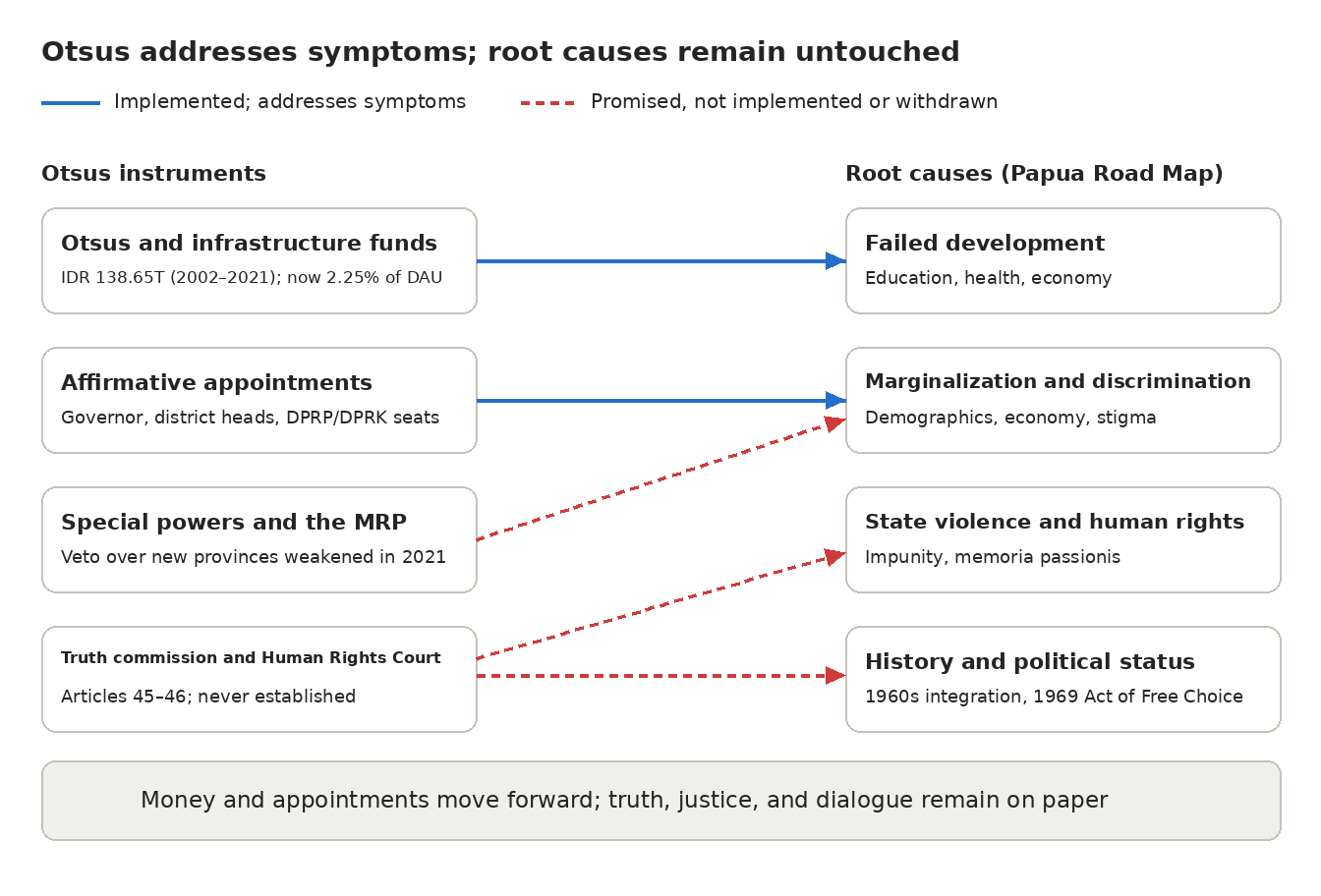
Figure 1. Analytical framework: Otsus instruments and Papua's four root causes
Source: prepared by the author based on Widjojo et al. (2009) and Law No. 21 of 2001, as amended.
Figure 1 shows the pattern discussed in Section 4. Only two connections are actually working, and both lead to root causes that can be addressed with money and public office. The links to violence and history exist in the law but never became reality, while the powers originally intended to protect indigenous Papuans were weakened in 2021.
3. Methods
This is a qualitative study based on documentary research. Its sources fall into four groups. First, legal documents: Laws No. 21 of 2001, No. 35 of 2008, and No. 2 of 2021; Government Regulation No. 77 of 2007 on regional symbols; and Laws No. 14, 15, 16, and 29 of 2022 establishing new provinces. Second, Constitutional Court judgments and hearing records, especially case No. 47/PUU-XIX/2021 brought by the MRP. Third, official data and reports from public bodies, including Statistics Indonesia (BPS), the Audit Board (BPK), the Corruption Eradication Commission (KPK), the House of Representatives (DPR), and studies supported by the National Development Planning Agency (Bappenas). Fourth, academic studies and research reports, supplemented by mainstream media coverage of events and statements by officials not yet recorded in the scholarly literature.
The analysis proceeds in three steps. The first charts the course of Otsus from 2001 to 2026 to identify what was promised, added, and removed. The second tests Otsus against the four root causes identified in the Papua Road Map. For each, the article compares three things: what the law promised, what happened in practice, and how to explain the gap between the two. The third draws out a pattern from those four tests to explain why Otsus tends to work on symptoms.
Government claims are treated as part of the evidence, not rejected from the outset. Each claim of success is taken from official sources and tested against comparable evidence. The BPS figures are the most recent releases available at the time of writing: HDI for 2025 and 2026 and the March 2026 poverty profile. Since BPS does not routinely publish data by ethnic group, comparisons between indigenous Papuans and settlers rely on studies that specifically analyse census or survey data. This limitation is noted where relevant.
4. Findings and Discussion
4.1 The course of Otsus, 2001–2026
Law No. 21 of 2001 was enacted on 21 November 2001, a year and a half after the Second Papuan People's Congress called for a correction of the history of integration. On paper, this was a bold law by the standards of the time. It recognized the basic rights of indigenous Papuans, established the MRP as a body of cultural representation, allocated special funds amounting to 2 percent of the national General Allocation Fund (DAU), allowed regional emblems as cultural symbols, opened the way for political parties in Papua, and mandated a Human Rights Court and a Truth and Reconciliation Commission (KKR). Article 76 required the approval of the MRP and the Papuan Provincial House of Representatives (DPRP) for any provincial division. The law's general explanatory notes even acknowledged that past centralist policies had failed to meet the need for justice and support law enforcement in Papua.
Thereafter, Otsus was shaped largely by delays and interventions from the centre. Table 1 summarizes the main milestones.
Table 1. Milestones in Papua's special autonomy, 2001–2026
| Year | Event | Significance for Otsus |
|---|---|---|
| 2001 | Law 21/2001 enacted (21 November) | Special powers, MRP, funding at 2% of DAU, truth commission, Human Rights Court, political parties, regional symbols |
| 2003 | Presidential Instruction 1/2003 creates West Irian Jaya | The new province is created before the MRP exists |
| 2005 | MRP inaugurated; the Papuan Customary Council (DAP) and demonstrators “return” Otsus to the DPRP | The central institution is established four years later; first open rejection |
| 2007 | Government Regulation 77/2007 bans regional symbols resembling separatist symbols | Space for cultural symbols shrinks |
| 2008 | Law 35/2008 extends special autonomy to West Papua | The 2003 division is subsequently legalized |
| 2010 | MRP deliberations produce 11 recommendations, including “returning” Otsus | An institution created by Otsus itself declares it a failure |
| 2013–2015 | Otsus Plus bill drafted but left out of the 2015 national legislative programme | Papua's proposal for expanded autonomy goes no further in Jakarta |
| 2020 | MRP public hearing in Merauke dispersed; 54 people arrested | Bottom-up evaluation is treated as a security threat |
| 2021 | Law 2/2021 enacted (15 July); Government Regulations 106/2021 and 107/2021 | Funding rises to 2.25% of DAU; right to form political parties repealed; centre can create new provinces without the MRP |
| 2022 | Constitutional Court rejects MRP petition (31 August); four new provinces created | Former Article 76 powers are not restored; Jakarta redraws Papua's map |
| 2026 | Otsus turns 25 (21 November) | — |
Source: compiled from Law 21/2001 as amended; ICG (2010); Kabar24 (2015); Mariani and Aqil (2020); MKRI (2022); Permana (2021); Akbar (2022).
Two patterns emerge from the table. First, whenever Papua tried to use the space that Otsus had opened, the centre closed it again. The 2003 division preceded the MRP. Regional symbols were restricted by government regulation. The Otsus Plus bill was not debated. The MRP's November 2020 evaluation hearing was dispersed and police named more than fifty participants as treason suspects before releasing them for lack of evidence (CNN Indonesia, 2020a, 2020b). Second, major changes came from the centre and moved quickly. The 2021 amendment affected 20 articles, three proposed by the government and seventeen by the DPR (CNN Indonesia, 2021a). Three laws creating new provinces were enacted on 30 June 2022 while the MRP was still seeking a postponement and its judicial review was pending (Anggrainy, 2022; Akbar, 2022).
4.2 The government's claims and how to test them
The government has plenty of arguments for defending Otsus. In 2020, National Development Planning Minister and Bappenas head Suharso Monoarfa described it as an “asymmetric, affirmative, and contextual” measure that had put indigenous Papuans in office as governors, district heads, and mayors, established the MRP, and created new districts to bring services closer (Bisnis.com, 2020). The DPR special committee on the Otsus bill noted that Papua Province's HDI rose from 54.45 in 2010 to 60.84 in 2019, and West Papua's from 59.6 to 64.7 (House of Representatives of the Republic of Indonesia [DPR RI], 2021). In 2024 the Ministry of Home Affairs said Papua's development index had risen by 5.6 percent, with approximately IDR 117 trillion in Otsus funds allocated over the previous ten years (InfoPublik, 2024). When the 2021 amendment was enacted, the government stressed that 20 articles had been updated to strengthen the position of indigenous Papuans (Hukumonline, 2021a). In December 2025, Human Rights Minister Natalius Pigai described the full restoration of Otsus funds, exceeding IDR 12 trillion, as a sign of the President's affection for Papuans (Investortrust, 2025).
The figures in these claims are not wrong. What needs testing is what they prove. Three points stand out.
The first concerns the comparison. HDI rose throughout Indonesia, not just in Papua. In 2026 the national HDI reached 76.59 and, according to BPS, had been rising for several years (InfoPublik, 2026). Papua's rise is therefore not necessarily the result of Otsus. The gap matters more. In 2026 Jakarta's HDI was 85.88 and Highland Papua's 55.25, more than thirty points apart (Journalarta, 2026). Highland Papua remains the only province in Indonesia in the “low” human development category.
The second concerns the relationship between spending and outcomes. In 2014 the BPK calculated that each additional IDR 1 million in Otsus funding raised Papua's HDI by only 0.000001521, almost zero (Jakarta Post, 2014). A study in the DPR's Jurnal Budget also found that HDI failed to rise in proportion to steadily increasing Otsus funds (Muhtarulloh, 2021). In 2025 the KPK assessed that the more than IDR 138.65 trillion spent in the first phase of Otsus had “not yet had a significant” effect on welfare (Corruption Eradication Commission [KPK], 2025).
The third and most fundamental point is that all these claims measure symptoms. No official claim says how many human rights cases were resolved, how many victims obtained redress, or how the historical dispute was discussed. That absence is itself evidence. The next section tests Otsus against each of the four root causes in turn.
4.3 Four tests against the root causes
4.3.1 History and political status
The law's promise. Otsus was never intended to reopen Papua's political status. Yet the law opened three narrow doors. Article 46 mandated a truth commission whose duties included clarifying Papua's history. Article 2 allowed regional emblems as symbols of distinction and culture, while making clear that they were not symbols of sovereignty. Article 28 gave Papua's residents the right to form political parties, widely read as a peaceful channel for political aspirations.
Practice. The three doors closed one by one. The truth commission was never established. Government Regulation No. 77 of 2007 prohibited regional emblems resembling those of separatist organizations, so the Morning Star flag continued to be treated as contraband. Article 28 never produced a local party because the law referred only to “political parties,” not “local political parties” as in the Law on Governing Aceh (Kabar24, 2019). In 2021 that provision was repealed altogether (Permana, 2021). In Aceh, local parties were a bridge that brought former combatants into electoral politics. In Papua, the bridge was dismantled before it could be built.
Analysis. Even the promised opening was constrained from the outset. Article 46 said clarification of history was to be carried out “to consolidate national unity and cohesion” within the Unitary State of the Republic of Indonesia (Law No. 21 of 2001, Article 46(2)). The result was settled before the inquiry began. Yet at the heart of Papua's historical dispute is the question of whether the 1962–1969 process was legitimate. Otsus answered that question with silence and offered money instead. This is the weakness McGibbon (2004) described as inherent to Otsus: it was drafted without negotiating with those who challenge that history and therefore could not count as an agreement to those most in need of persuasion. The Papua Road Map proposes dialogue on this root cause (Widjojo et al., 2009). In twenty-five years, dialogue has never been part of Otsus.
4.3.2 State violence and human rights abuses
The law's promise. Chapter XII of the Otsus law, Articles 45 to 47, contained three promises: representation for the National Human Rights Commission (Komnas HAM) in Papua, a Human Rights Court, and a truth commission. The general explanatory notes described the truth commission as a way to resolve problems from the past. For victims, this was the part of Otsus closest to their lived experience.
Practice. Twenty years later, DPR Otsus Committee chair Komarudin Watubun acknowledged that the 2021 revision had to be an opportunity to implement provisions that had lain dormant for two decades, including the Human Rights Court and the truth commission (Saputro, 2021). The amendment passed without bringing either to life. A common explanation is the Constitutional Court's 2006 decision annulling the national truth commission law, even though Papua's commission has its own legal basis in Article 46. Governor Lukas Enembe tasked Cenderawasih University with drafting a proposal for the commission, but the necessary presidential decree was never issued (Antara, 2019).
During Otsus, only two cases of gross human rights abuses in Papua reached court; both were tried in Makassar, not Papua. In the 2000 Abepura case, two police officers charged on the basis of command responsibility were acquitted in September 2005 (RNZ, 2005). The 2014 Paniai case had only one defendant, a liaison officer with the rank of major. On 8 December 2022 the Makassar Human Rights Court acquitted him too, with two of five judges dissenting (JPNN, 2022). The panel acknowledged that gross human rights abuses occurred but did not determine who was responsible (Republika, 2022). Amnesty International Indonesia director Usman Hamid called the verdict a “parody of justice” (Suryarandika, 2022). Violence, meanwhile, continued. KontraS recorded 60,642 civilian displacements and 732 deaths from armed conflict (Kompas.com, 2023), and by January 2026 the number of internally displaced people had reached 105,878 (Pamungkas, 2026).
Analysis. Otsus treated violence as a matter of the past to be resolved through institutions, then failed to establish those institutions. Meanwhile, the sources of ongoing violence—security operations and troop deployments—lie entirely beyond the scope of Otsus. Security is a central government matter. Consequently, Papua's local governments can use Otsus funds to build a school but cannot prevent it from being used as a security post or deserted by teachers because of conflict. The second root cause has not merely been left alone; it is continually renewed by policies that Otsus cannot touch.
4.3.3 Failed development
The law's promise. This is where Otsus has done the most. Its funds are directed primarily to education and health, alongside additional infrastructure funding. The 2021 revision raised funding to 2.25 percent of DAU, divided it into a block grant and performance-based funds, and created a special body to accelerate development in Papua, chaired by the vice-president (Hukumonline, 2021b).
Practice. There has been progress, and it should be acknowledged. Access to roads, schools, and community health centres has expanded. HDI has risen. But Papua's place on the national map has barely changed, as Table 2 shows.
Table 2. Development indicators in the provinces of Papua compared with national figures
| Region | HDI, 2025 | Life expectancy, 2025 (years) | Poverty, March 2026 (%) |
|---|---|---|---|
| Highland Papua | 54.91 | 67.55 | 26.34 |
| Central Papua | 60.64 | 68.38 | 30.41 |
| West Papua | 68.48 | — | 18.68 |
| South Papua | 69.54 | — | — |
| Southwest Papua | 70.55 | — | — |
| Papua | 74.69 | — | 18.39 |
| National | 75.90 | 74.47 | 8.07 |
| Jakarta | 85.05 | — | — |
Note: — indicates a figure not cited; UHH is the Indonesian abbreviation for life expectancy. Source: compiled from BPS releases as reported by Bisnis.com (2025), Andrianto (2025), Rachman (2025), Good News From Indonesia (2025), GoodStats (2025a, 2026), and Katadata (2026).
Table 2 shows that four of Indonesia's five lowest-HDI provinces are in the Land of Papua. Central Papua has the highest poverty rate in Indonesia, almost four times the national figure. Papua's six provinces rank last in life expectancy (GoodStats, 2025a). At district level, Intan Jaya, Deiyai, Puncak, and Paniai, all highland areas affected by conflict, have poverty rates above 36 percent (GoodStats, 2025b). KOMPAK found that indigenous Papuans were 1.7 to 1.9 times more likely to be poor than non-indigenous residents and that the gap in life expectancy between the two groups was 4.23 years (KOMPAK, 2022). Papua Province's figure of 74.69 also needs to be read with care. After the 2022 division, the province was left with relatively more developed northern areas, so its figure reflects changes in boundaries more than improvements in welfare.
Analysis. Otsus has done the most on this third cause, and it is here that the limits of its approach become clearest. Poverty and underdevelopment are treated as a shortage of money, so the remedy is more money. Yet Papua's map of poverty overlaps with its map of conflict and indigenous territory. The poorest districts are the highland districts most affected by security operations and displacement. Otsus funds cannot reach children whose teachers have left their schools or families who fled and left their gardens behind. The symptoms of failed development are treated, but their causes—violence and exclusion—keep producing new ones.
4.3.4 Marginalization of and discrimination against indigenous Papuans
The law's promise. Otsus contains several affirmative measures: governors and deputy governors must be indigenous Papuans; the MRP advises and gives approval on matters affecting indigenous rights; political recruitment gives priority to indigenous Papuans; and Article 76 gave the MRP and DPRP veto power over provincial division. The 2021 revision added appointed seats for indigenous Papuans in the DPRP and district or municipal legislatures (DPRK).
Practice. Affirmative measures for officeholders do operate at the provincial level, and many district heads are indigenous Papuans. But the indigenous requirement does not apply to district heads and mayors, so the Central Papua MRP still had to take the matter to the Constitutional Court in 2024 (MKRI, 2025). Meanwhile, the population balance continues to change. In 1971 Papuans were estimated to account for 96 percent of the population. The 2010 census put their overall share at about 66 percent, with sharp declines along the coast and in urban areas; in Keerom it was down to about 40 percent (Elmslie, 2010, 2017). Markets, shops, and most urban businesses in Papua are controlled by settlers, while many Papuans remain in the subsistence economy (Widjojo et al., 2009).
The protection afforded by devolved powers also weakened. The 2021 revision added Article 76(2), allowing the central government and DPR to create new provinces without MRP or DPRP approval. MRP chair Timotius Murib called the three laws creating new provinces “Jakarta's wishes, not those of indigenous Papuans” (Akbar, 2022). Usman Hamid explained that the added clause made ineffective a mechanism that had previously required approval from two institutions representing indigenous Papuans (Sidebang, 2022). The MRP went to the Constitutional Court, but its petition was rejected on 31 August 2022, after the new provinces had already been established (MKRI, 2022).
Analysis. Otsus gives Papuans seats but not control over what shapes their collective future: migration, customary land, and territorial boundaries. Moreover, new provinces bring new posts and bureaucracies, opening up jobs for settlers faster than for indigenous Papuans. Affirmative appointments operate at the elite level, while marginalization plays out in demographics and the local economy. The promised recognition turns into symbolic representation at the top, while on the ground Papuans are increasingly a minority in their own towns.
4.4 Cross-cutting issues: dormant promises, leaking funds, silenced voices
4.4.1 The institutions promised and what became of them
The four tests converge on a single pattern: the provisions closest to the root causes are the least likely to be implemented. Table 3 places the promises next to what happened.
Table 3. Promises of the Otsus law and their implementation through 2026
| Provision of Law 21/2001 | Root cause addressed | Status through 2026 |
|---|---|---|
| Otsus funds of 2% of DAU (Article 34) | Failed development | Disbursed; IDR 138.65 trillion including additional infrastructure funds (2002–2021); rose to 2.25% with the 2021 amendment |
| Indigenous Papuan governor and deputy governor (Article 12) | Marginalization | Implemented |
| Papuan People's Assembly (Articles 19–25) | Marginalization | Established in 2005, four years late; powers continue to be contested in the Constitutional Court |
| MRP and DPRP approval for new provinces (Article 76) | Marginalization | Bypassed in 2003; weakened by paragraph (2) in 2021 |
| Regional emblems as cultural symbols (Article 2) | History and identity | Restricted by Government Regulation 77/2007 |
| Right to form political parties (Article 28) | History and political status | Never implemented; repealed in 2021 |
| National Human Rights Commission representation (Article 45) | State violence | In place |
| Human Rights Court in Papua (Article 45) | State violence | Not established; Abepura and Paniai cases tried in Makassar |
| Truth and Reconciliation Commission (Article 46) | State violence; history | Not established |
Source: compiled from Laws 21/2001 and 2/2021; Kurniati (2021); Saputro (2021); Permana (2021); Sidebang (2022); MKRI (2022, 2025).
The pattern is hard to ignore. The provisions for money and appointments work. Those that require the state to open itself up—a court, a truth commission, political parties, and Papuans' veto over their territory—have not been implemented or have been taken back. These are not merely administrative decisions. The first set needs only transfers and the selection of officials. The second needs a presidential decree, a government regulation, or a willingness on the part of the centre to relinquish control, and those decisions never came.
4.4.2 Financial governance: corruption as a symptom, not a cause
No discussion of Otsus is complete without corruption. In 2011 the BPK reported state losses of IDR 4.12 trillion in the use of Papua and West Papua's Otsus funds from 2002 to 2010 (Hukumonline, 2011). It also found IDR 1.85 trillion in Otsus funds held in deposits when they should have funded education and health (Antara, 2011). KOMPAK noted that in 2018 more than half of Papua's districts received disclaimer or adverse audit opinions and that only 527 of some 1,500 BPK recommendations for 2008–2019 had been acted upon (KOMPAK, 2022). In 2022 Mahfud MD acknowledged that the management of Otsus funds “had never been right” (Pratama, 2022).
The corruption narrative, however, must be read with care. In the hands of central officials, it often shifts the entire burden of the failure of Otsus onto Papua's elites. The claim that “the funds were substantial, but were embezzled” suggests that the design was sound and only the implementation was at fault. But weak governance is also a product of the design. Large sums were sent for two decades with no master plan and no clear implementing regulations, while central oversight was substantially tightened only after 2021 (KOMPAK, 2022). Mahfud himself said that all funds sent to Papua since 2001, including ministry spending and transfers, exceeded IDR 1,000 trillion, yet people remained poor (Aminudin, 2022). This includes central ministry and agency spending, not only the funds managed by local governments. In other words, Papua's elites alone cannot be held responsible for the disappointing results. Corruption is a symptom of a system that treats Otsus as a money transfer. Fighting it matters, but it will not touch any of the four root causes.
4.4.3 Participation: evaluated without being heard
Article 77 of the Otsus law says that the people of Papua may propose amendments through the MRP and DPRP. Ahead of the expiry of first-phase Otsus funding in 2021, the MRP acted on this mandate by holding public hearings across customary regions.
The result was that the Merauke hearing was dispersed and participants were arrested on treason accusations, including two MRP members and several of its staff (Mariani & Aqil, 2020). The government and DPR then drafted the amendment. Human rights lawyer Veronica Koman described the resulting law as being “from, by, and for Jakarta” (CNN Indonesia, 2021b).
When the MRP went to court, the Constitutional Court found that it lacked standing to challenge some of the disputed provisions (MKRI, 2022). The institution created by Otsus to protect indigenous Papuan rights proved too weak to defend Otsus itself. This pattern explains why many Papuans do not see Otsus as theirs. They were asked to accept it, but not to shape it.
4.5 Why Otsus treats the symptoms
The discussion points to at least four design flaws that keep Otsus working on symptoms.
First, Otsus is a grant, not an agreement. Ghai's (2000) work suggests three conditions under which autonomy can ease conflict: joint design, guarantees against unilateral withdrawal, and a dispute resolution mechanism. Papua's Otsus meets none of them. It was drafted without negotiating with those demanding independence. It was changed unilaterally in 2021 despite opposition from the MRP, the very institution it had created. When a dispute arose, the only recourse was the Constitutional Court, which ruled after the new provinces had already been created. Autonomy that its giver can withdraw at any time will not win the trust of its recipients.
Second, security is separated from autonomy. The most visible sources of violence—troop deployments and military operations—are entirely in the hands of the centre. Otsus gives Papua authority over schools and health centres but not over the forces operating around them. As long as this remains the case, the second root cause will be continually renewed, and the gains on the third will keep being lost to conflict and displacement.
Third, fiscal logic takes the place of political logic. Whenever Otsus is judged a failure, Jakarta's answer is to increase funds, tighten their oversight, or add provinces. The 2021 revision increased the funds and strengthened central control over their use. The 2022 division added bureaucracy. None of these measures addresses history, impunity, or power relations. Money becomes the state's way of avoiding a harder discussion, and each increase is presented as evidence of its generosity.
Fourth, Papuan voices are treated as a security threat. A cultural flag is criminalized, an evaluation hearing is dispersed on allegations of treason, and opposition to new provinces is read as the voice of a minority being used by separatist groups. Seen this way, criticism of Otsus never informs policy. Instead it becomes a pretext for tighter security, which in turn deepens the second and fourth root causes.
These four flaws reinforce one another. Because there is no agreement on Otsus, the centre feels free to change it. Because security is outside Otsus, violence continues. Because violence continues, development does not reach people. Because development does not reach people, the centre adds money and control. When Papuans protest, the protest is read as a threat. This cycle explains why twenty-five years of Otsus have produced better figures without changing people's lived experience.
5. Conclusions and Recommendations
5.1 Conclusions
A quarter century of special autonomy in Papua has produced two realities that coexist. The first can be measured: hundreds of trillions of rupiah in funding, a rising HDI, indigenous Papuans in public office, and cultural institutions in place. The second is hard to measure but keenly felt: continuing violence, human rights abuses that go untried, a history that cannot be discussed, and Papuans increasingly squeezed out in their own towns. The government's claim that Otsus represents recognition and respect rests entirely on the first reality.
Testing Otsus against the four root causes in the Papua Road Map shows that it has dealt only to a limited extent with failed development and part of marginalization, through funds and affirmative appointments. The roots of the disputes over history and political status and of state violence remain untouched. The instruments designed for them—a truth commission, a Human Rights Court, political parties, and regional emblems—were never established, restricted, or repealed. Protection against marginalization through the MRP and DPRP's veto over new provinces was also withdrawn in 2021.
This is not just a failure of implementation. It is rooted in the design: Otsus was granted without agreement, can be changed unilaterally, separates security from autonomy, answers political grievances with money, and treats Papuan voices as a threat. Improved financial governance, however important, will therefore not solve Papua's problems. Otsus has treated the symptoms with ever larger doses, while leaving the disease alone.
5.2 Recommendations
The recommendations below do not replace the policy as a whole. They propose steps directed at root causes that have long been left untouched.
- Bring the dormant provisions into effect. On the governor's recommendation, the President can promptly issue a decree establishing a Papuan truth commission under Article 46(3) and establish a Human Rights Court in Papua under Article 45. The mandate to clarify history must be open, without a predetermined conclusion.
- Restore the powers that were withdrawn. The requirement for MRP and DPRP approval of new provinces should be restored, and subsequent amendments to the Otsus law should be made only through Article 77 with the approval of the institutions representing indigenous Papuans.
- Bring security into the Otsus discussion. An evaluation of Otsus must cover security policy, the number of troops deployed from outside the regional command, and the effects on displacement. The phased withdrawal of troops from civilian areas and the return of displaced people should become measures of success, on a par with HDI.
- Measure success against the root causes. Otsus indicators should distinguish between indigenous and non-indigenous Papuans and cover resolution of human rights cases, redress for victims, protection of customary land, and the population balance.
- Open the way to dialogue. Dialogue between Jakarta and Papua on an equal footing, as recommended by the Papua Road Map, should be seen as a complement to Otsus, not a threat to it. Without a conversation about history, Otsus will continue to be read as the state's way of avoiding the most important question.
The twenty-fifth anniversary of Otsus should not end with a celebration of figures. It can be a moment for the state to acknowledge that genuine recognition is measured not in the amount of money sent, but in a willingness to listen and make amends.
References
Akbar, N. A. (2022, 30 Juni). Kritik pengesahan pemekaran, MRP: DOB Papua tak libatkan rakyat. Republika. https://news.republika.co.id/berita/rea4g8436/kritik-pengesahan-pemekaran-mrp-dob-papua-tak-libatkan-rakyat
Aminudin, M. (2022, 23 September). Mahfud Md ungkap dana otsus Papua Rp 1000,7 T banyak yang dikorupsi. detikJatim. https://www.detik.com/jatim/berita/d-6308422/mahfud-md-ungkap-dana-otsus-papua-rp-1000-7-t-banyak-yang-dikorupsi
Andrianto, R. (2025, 5 November). BPS: Indeks pembangunan manusia RI capai 75,90 di 2025, naik 0,88 poin. CNBC Indonesia. https://www.cnbcindonesia.com/news/20251105115944-4-682466/bps-indeks-pembangunan-manusia-ri-capai-7590-di-2025-naik-088-poin
Anggrainy, F. C. (2022, 26 April). MRP minta DPR tunda pembahasan pemekaran Papua. detikNews. https://news.detik.com/berita/d-6052257/mrp-minta-dpr-tunda-pembahasan-pemekaran-papua
Antara. (2011, 20 April). Kemdagri dalami temuan BPK soal dana otsus. https://m.antaranews.com/amp/berita/255055/kemdagri-dalami-temuan-bpk-soal-dana-otsus
Antara. (2019). Akademisi Uncen berharap Jokowi merespons pembentukan KKR. https://www.antaranews.com/berita/1134408/akademisi-uncen-berharap-jokowi-merespons-pembentukan-kkr
Bertrand, J. (2004). Nationalism and ethnic conflict in Indonesia. Cambridge University Press.
Bertrand, J. (2007). Indonesia’s quasi-federalist approach: Accommodation amid strong integrationist tendencies. International Journal of Constitutional Law, 5(4), 576–605.
Bisnis.com. (2020, 4 Desember). Pemerintah klaim otsus Papua berhasil turunkan tekan angka kemiskinan. https://ekonomi.bisnis.com/read/20201204/9/1326302/pemerintah-klaim-otsus-papua-berhasil-turunkan-tekan-angka-kemiskinan
Bisnis.com. (2025, 5 November). Indeks pembangunan manusia 2025: Jakarta tertinggi, Papua Pegunungan paling rendah. https://ekonomi.bisnis.com/read/20251105/9/1926396/indeks-pembangunan-manusia-2025-jakarta-tertinggi-papua-pegunungan-paling-rendah
Chauvel, R., & Bhakti, I. N. (2004). The Papua conflict: Jakarta’s perceptions and policies (Policy Studies No. 5). East-West Center Washington.
CNN Indonesia. (2020a, 19 November). Lebih dari 50 orang jadi tersangka makar terkait rapat MRP. https://www.cnnindonesia.com/nasional/20201119114428-12-571798/lebih-dari-50-orang-jadi-tersangka-makar-terkait-rapat-mrp
CNN Indonesia. (2020b, 20 November). Kurang bukti kasus makar, Polri lepas 54 peserta rapat MRP. https://indoleft.org/news/2020-11-20/54-arrested-at-special-autonomy-hearing-released-due-to-lack-of-evidence.html
CNN Indonesia. (2021a, 15 Juli). RUU Otsus Papua disahkan DPR hari ini. https://www.cnnindonesia.com/nasional/20210715082534-32-667913/ruu-otsus-papua-disahkan-dpr-hari-ini
CNN Indonesia. (2021b, 15 Juli). Veronica kritik UU Otsus Papua: Dari, oleh dan untuk Jakarta. https://www.cnnindonesia.com/nasional/20210715135941-20-668254/veronica-kritik-uu-otsus-papua-dari-oleh-dan-untuk-jakarta
Dewan Perwakilan Rakyat Republik Indonesia [DPR RI]. (2021). Laporan kunjungan kerja Panitia Khusus RUU Otsus Papua, 1–5 Mei 2021. Sekretariat Jenderal DPR RI.
Elmslie, J. (2010). West Papuan demographic transition and the 2010 Indonesian census: “Slow motion genocide” or not? (CPACS Working Paper No. 11/1). Centre for Peace and Conflict Studies, University of Sydney.
Elmslie, J. (2017). The great divide: West Papuan demographics revisited; settlers dominate coastal regions but the highlands still overwhelmingly Papuan. The Asia-Pacific Journal: Japan Focus, 15(2).
Ghai, Y. (Ed.). (2000). Autonomy and ethnicity: Negotiating competing claims in multi-ethnic states. Cambridge University Press.
Good News From Indonesia. (2025, 6 November). IPM 2025 meningkat! Cek skor indeks pembangunan manusia di daerahmu. https://www.goodnewsfromindonesia.id/2025/11/06/ipm-2025-meningkat-cek-skor-indeks-pembangunan-manusia-di-daerahmu
GoodStats. (2025a). 10 provinsi dengan umur harapan hidup terendah 2025. https://data.goodstats.id/statistic/10-provinsi-dengan-umur-harapan-hidup-terendah-2025-aXBxp
GoodStats. (2025b). 10 kabupaten/kota dengan persentase penduduk miskin terbanyak 2025. https://data.goodstats.id/statistic/10-kabupatenkota-dengan-persentase-penduduk-miskin-terbanyak-2025-NYvsg
GoodStats. (2026). 10 provinsi dengan persentase penduduk miskin tertinggi pada Maret 2026. https://data.goodstats.id/statistic/10-provinsi-dengan-persentase-penduduk-miskin-tertinggi-pada-maret-2026-C4ybx
Hukumonline. (2011). BPK sinyalir dana otsus Papua dikorupsi. https://www.hukumonline.com/berita/a/bpk-sinyalir-dana-otsus-papua-dikorupsi-lt4db026618bd30/
Hukumonline. (2021a). Revisi UU Otsus, jalur cepat Papua menuju sejahtera. https://www.hukumonline.com/berita/a/revisi-uu-otsus--jalur-cepat-papua-menuju-sejahtera-lt611f0fdc0c35b
Hukumonline. (2021b). UU Otsus Papua bentuk lembaga negara baru. https://www.hukumonline.com/berita/a/uu-otsus-papua-bentuk-lembaga-negara-baru-lt60f3c84fa29e4
InfoPublik. (2024). Kemendagri: Indeks pembangunan di Papua naik 5,6 persen. https://infopublik.id/kategori/nasional-politik-hukum/877814/kemendagri-indeks-pembangunan-di-papua-naik-56-persen
InfoPublik. (2026, 5 November). BPS catat indeks pembangunan manusia Indonesia 2026 meningkat menjadi 76,59. https://infopublik.id/kategori/nasional-sosial-budaya/996086/bps-catat-indeks-pembangunan-manusia-indonesia-2026-meningkat-menjadi-7659
International Crisis Group [ICG]. (2010). Indonesia: The deepening impasse in Papua (Asia Briefing No. 108).
Investortrust. (2025, 17 Desember). Dana otsus kembali penuh, Pigai: Rasa cinta Prabowo ke rakyat Papua. https://investortrust.id/national/88890/dana-otsus-kembali-penuh-pigai-rasa-cinta-prabowo-ke-rakyat-papua
Jakarta Post. (2014, 5 Maret). In Papua, many still live in poverty despite abundant funds. https://www.thejakartapost.com/news/2014/03/05/in-papua-many-still-live-poverty-despite-abundant-funds
Journalarta. (2026, 6 November). IPM Indonesia 2026 naik ke 76,59, Bali dan Kaltim masuk kategori sangat tinggi. https://journalarta.com/news/2026/11/06/ipm-indonesia-2026-naik-ke-7659-bali-dan-kaltim-masuk-kategori-sangat-tinggi/
JPNN. (2022, 10 Desember). Terdakwa kasus Paniai divonis bebas, ini pernyataan sikap PGI. https://m.jpnn.com/news/terdakwa-kasus-paniai-divonis-bebas-ini-pernyataan-sikap-pgi
Kabar24. (2015, 13 Februari). Pemerintah kaji ulang penundaan pembahasan revisi UU Otsus Papua. https://kabar24.bisnis.com/read/20150213/15/402181/pemerintah-kaji-ulang-penundaan-pembahasan-revisi-uu-otsus-papua
Kabar24. (2019, 9 September). Ingin punya partai lokal seperti Aceh, UU Otsus Papua diminta pendapat ke MK. https://kabar24.bisnis.com/read/20190909/15/1146164/ingin-punya-partai-lokal-seperti-aceh-uu-otsus-papua-diminta-pendapat-ke-mk
Katadata. (2026, 7 September). Maret 2026, jumlah penduduk miskin di Papua 165,98 ribu jiwa. https://databoks.katadata.co.id/datapublish/2026/09/07/maret-2026-jumlah-penduduk-miskin-di-papua-165-98-ribu-jiwa
Katharina, R. (2018). Menakar capaian otonomi khusus Papua. Yayasan Pustaka Obor Indonesia.
Komisi Pemberantasan Korupsi [KPK]. (2025). Kolaborasi KPK-GIZ dorong penguatan pengawasan dana otonomi khusus: Wujudkan Papua sehat, cerdas, dan produktif. https://kpk.go.id/id/ruang-informasi/berita/kolaborasi-kpk-giz-dorong-penguatan-pengawasan-dana-otonomi-khusus-wujudkan-papua-sehat-cerdas-dan-produktif
KOMPAK. (2022). Optimalisasi pelaksanaan PP 107 Tahun 2021 [Policy brief]. Kolaborasi Masyarakat dan Pelayanan untuk Kesejahteraan.
Kompas.com. (2023, 22 Februari). KontraS sebut 60.642 warga sipil mengungsi dan 732 tewas akibat konflik. https://nasional.kompas.com/read/2023/02/22/13301631/kontras-sebut-60642-warga-sipil-mengungsi-dan-732-tewas-akibat-konflik
Kurniati, D. (2021, 26 Januari). Dua dekade, dana otsus Papua dan Papua Barat capai ratusan triliun. DDTCNews. https://news.ddtc.co.id/berita/nasional/27261/dua-dekade-dana-otsus-papua-dan-papua-barat-capai-ratusan-triliun
Lapidoth, R. (1997). Autonomy: Flexible solutions to ethnic conflicts. United States Institute of Peace Press.
Mahkamah Konstitusi Republik Indonesia [MKRI]. (2021, 16 November). Mahfud MD: Papua Special Autonomy Law affirms Papua’s legitimacy in NKRI. https://en.mkri.id/news/details/2021-11-16/Mahfud_MD:_Papua_Special_Autonomy_Law_Affirms_Papua’s_Legitimacy_in_NKRI
Mahkamah Konstitusi Republik Indonesia [MKRI]. (2022, 1 September). Court rejects MRP’s petition on Papua Special Autonomy Law. https://en.mkri.id/news/details/2022-09-01/Court_Rejects_MRP’s_Petition_on_Papua_Special_Autonomy_Law
Mahkamah Konstitusi Republik Indonesia [MKRI]. (2025). Summary of decision for case number 110/PUU-XXII/2024 concerning expansion of the authority of the Papuan People’s Assembly. https://en.mkri.id/download/summary/summary_2175_1741656801_872e70ddc204c22d5c84.pdf
Mariani, E., & Aqil, A. M. I. (2020, 18 November). Papua special autonomy evaluation meeting cut short, participants arrested. The Jakarta Post. https://www.thejakartapost.com/news/2020/11/18/papua-special-autonomy-evaluation-meeting-cut-short-participants-arrested.html
McGibbon, R. (2004). Secessionist challenges in Aceh and Papua: Is special autonomy the solution? (Policy Studies No. 10). East-West Center Washington.
Muhtarulloh, F. (2021). Analisis dampak dana otonomi khusus Papua dan Papua Barat terhadap IPM. Jurnal Budget, 6(1). https://ejurnal.dpr.go.id/index.php/jurnalbudget/article/download/76/68
Pamungkas, C. (2026, 9 Februari). Pathways to peace in West Papua: The need for a humanitarian pause and inclusive dialogue. Asia Pacific Solidarity Network. https://www.asia-pacific-solidarity.net/news/2026-02-09/pathways-peace-west-papua-need-humanitarian-pause-and-inclusive-dialogue.html
Peraturan Pemerintah Nomor 77 Tahun 2007 tentang Lambang Daerah.
Permana, R. H. (2021, 17 Juli). RUU Otsus Papua jadi UU, warga Papua tak bisa bikin parpol? detikNews. https://news.detik.com/berita/d-5646835/ruu-otsus-papua-jadi-uu-warga-papua-tak-bisa-bikin-parpol
Pratama, W. (2022, 25 September). Mahfud MD: Pengelolaan dana otsus dari dulu tidak beres. Suara Surabaya. https://www.suarasurabaya.net/?p=584773
Rachman, A. (2025, 5 November). Papua Barat Daya naik kelas, pembangunan manusianya masuk level tinggi. CNBC Indonesia. https://www.cnbcindonesia.com/news/20251105120738-4-682479/papua-barat-daya-naik-kelas-pembangunan-manusianya-masuk-level-tinggi
Republika. (2022, 8 Desember). Terdakwa kasus HAM Paniai dibebaskan, Komnas HAM kecewa. https://news.republika.co.id/berita/rmkprb330/terdakwa-kasus-ham-paniai-dibebaskan-komnas-ham-kecewa
Resosudarmo, B. P., Mollet, J. A., Raya, U. R., & Kaiwai, H. (2014). Development in Papua after special autonomy. Dalam H. Hill (Ed.), Regional dynamics in a decentralized Indonesia (hlm. 433–459). ISEAS.
RNZ. (2005, 9 September). Papua secession campaigners scorn acquittal of Indonesian police officer. https://www.rnz.co.nz/international/pacific-news/157405/papua-secession-campaigners-scorn-acquittal-of-indonesian-police-officer
Saputro, F. A. (2021, 8 Juni). Revisi UU Otsus Papua ditargetkan selesai Juli 2021. Republika. https://news.republika.co.id/berita/quduwr328/revisi-uu-otsus-papua-ditargetkan-selesai-juli-2021
Sidebang, F. (2022, 30 Juni). Amnesty Internasional Indonesia dan MRP kritik pengesahan DOB Papua. Republika. https://news.republika.co.id/berita/rea9nc396/amnesty-internasional-indonesia-dan-mrp-kritik-pengesahan-dob-papua
Suryarandika, R. (2022, 9 Desember). Amnesty: Putusan kasus Paniai parodi keadilan. Republika. https://news.republika.co.id/berita/rmm3sd428/amnesty-putusan-kasus-paniai-parodi-keadilan
Undang-Undang Nomor 21 Tahun 2001 tentang Otonomi Khusus bagi Provinsi Papua.
Undang-Undang Nomor 35 Tahun 2008 tentang Penetapan Peraturan Pemerintah Pengganti Undang-Undang Nomor 1 Tahun 2008 tentang Perubahan atas Undang-Undang Nomor 21 Tahun 2001 tentang Otonomi Khusus bagi Provinsi Papua menjadi Undang-Undang.
Undang-Undang Nomor 2 Tahun 2021 tentang Perubahan Kedua atas Undang-Undang Nomor 21 Tahun 2001 tentang Otonomi Khusus bagi Provinsi Papua.
Undang-Undang Nomor 14 Tahun 2022 tentang Pembentukan Provinsi Papua Selatan.
Undang-Undang Nomor 15 Tahun 2022 tentang Pembentukan Provinsi Papua Tengah.
Undang-Undang Nomor 16 Tahun 2022 tentang Pembentukan Provinsi Papua Pegunungan.
Undang-Undang Nomor 29 Tahun 2022 tentang Pembentukan Provinsi Papua Barat Daya.
Widjojo, M. S., Elisabeth, A., Al Rahab, A., Pamungkas, C., & Dewi, R. (2009). Papua road map: Negotiating the past, improving the present and securing the future. Yayasan Obor Indonesia, LIPI, & TIFA Foundation.
How to cite
Dumupa, Y. (2026). A quarter century of special autonomy in Papua: Treating the symptoms, leaving the root causes untouched [Scholarly article]. Yakobus Dumupa. https://yakobusdumupa.com/kajian/seperempat-abad-otonomi-khusus-papua?lang=en

About the Author
Yakobus Dumupa
Writer, organic intellectual and activist from the Land of Papua, with an educational background in political science, government and anthropology. He served as a member of the Papuan People's Assembly (2012–2016) and as Regent of Dogiyai (2017–2022), and has written dozens of books and hundreds of articles.
Read biography