Scholarly Article
Internally Displaced Persons in Tanah Papua and the Threat of a Lost Generation: A Literature Review of Scale, Impacts, and Policy Gaps (2018–2026)
Abstrak
Sejak Desember 2018, konflik bersenjata di Tanah Papua telah memaksa puluhan ribu orang meninggalkan kampung mereka. Perkiraan jumlah pengungsi internal naik dari sekitar 45.000 jiwa di Nduga dan sekitarnya pada 2019 menjadi lebih dari 122.000 jiwa di berbagai provinsi pada pertengahan 2026. Artikel ini menelaah skala dan karakter pengungsian tersebut, dampaknya terhadap generasi muda orang asli Papua, serta celah dalam kerangka hukum dan respons negara. Penelitian ini merupakan studi kepustakaan atas instrumen hukum, dokumen PBB, laporan lembaga negara, riset gereja, laporan organisasi masyarakat sipil, karya akademik, dan pemberitaan media periode 2018–2026, yang dianalisis dengan analisis isi kualitatif dan triangulasi sumber. Kajian menemukan bahwa data pengungsi tidak pernah disepakati bersama dan selisih antara data negara dan data gereja sangat lebar. Pengungsian berlangsung rata-rata lebih dari tiga tahun dan kerap berulang setelah pemulangan. Dampaknya berlapis: riset gereja tahun 2024 mencatat 97 persen responden kekurangan pangan dan 90 persen kehilangan akses pendidikan, sementara perempuan dan anak menanggung beban terberat. Kerangka hukum nasional belum dirancang untuk pengungsian akibat konflik bersenjata, dan bantuan lebih banyak datang dari gereja dan keluarga daripada dari pemerintah. Kondisi ini mengancam keberlanjutan satu generasi orang asli Papua di wilayah konflik. Artikel ini merekomendasikan pendataan bersama yang independen, regulasi khusus pengungsi internal, penanganan terpadu yang dipimpin sipil, pemulihan layanan pendidikan dan kesehatan, serta akses kemanusiaan yang terbuka.
Kata kunci: pengungsi internal, Papua, konflik bersenjata, generasi yang hilang, solusi berkelanjutan
Abstract
Since December 2018, armed conflict in Tanah Papua has forced tens of thousands of people from their villages. Estimates of internally displaced persons (IDPs) rose from about 45,000 in and around Nduga in 2019 to more than 122,000 across several provinces by mid-2026. This article examines the scale and character of this displacement, its impact on the younger generation of Indigenous Papuans, and gaps in the legal framework and state response. It is a library-based study of legal instruments, UN documents, state agency reports, church research, civil society reports, academic works, and media coverage from 2018 to 2026, analysed through qualitative content analysis and source triangulation. The study finds that IDP figures have never been jointly agreed and that the gap between state and church data is wide. Displacement lasts more than three years on average and often recurs after return. Its impacts are layered: a 2024 church survey found that 97 percent of respondents lacked food and 90 percent had lost access to education, while women and children bear the heaviest burden. The national legal framework was not designed for conflict-induced displacement, and assistance comes more from churches and families than from government. These conditions threaten the continuity of a generation of Indigenous Papuans in conflict areas. The article recommends independent joint data collection, dedicated IDP legislation, a civilian-led integrated response, restored education and health services, and open humanitarian access.
Keywords: internally displaced persons, Papua, armed conflict, lost generation, durable solutions
1. Introduction
1.1 Background
On 2 December 2018, the killing of PT Istaka Karya workers building the Trans Papua road in Nduga Regency triggered a large-scale deployment of security forces (Ombudsman RI, 2019a). Following that incident, thousands of Nduga residents left their villages. Eight months later, the Ombudsman recorded around 45.000 displaced persons from 16 districts, dispersed across regencies surrounding Nduga (Ombudsman RI, 2019b). Almost seven years later, 10.272 Nduga residents were reportedly still living in displacement (iNews, 2026a).
Nduga proved to be only the beginning. Displacement subsequently spread to Intan Jaya, Puncak, Maybrat, Yahukimo, Pegunungan Bintang, Paniai, Tambrauw, Teluk Bintuni, and other areas. The Papua Council of Churches recorded around 60.000 displaced persons in November 2021 (CNN Indonesia, 2021). By the end of 2025, that figure had reached 103.218 (Tempo, 2025), and in July 2026 the Deputy Minister of Human Rights cited a figure of approximately 122.000 displaced persons reported to his ministry (RRI, 2026a). In less than five years, the number of internally displaced persons in Tanah Papua more than doubled.
This crisis has attracted international attention. In March 2022, three UN Special Rapporteurs, including the Special Rapporteur on the human rights of internally displaced persons, expressed concern about mass displacement in Papua and estimated that 60.000 to 100.000 people had been displaced since December 2018 (United Nations, 2022). In 2024, the UN Committee on Economic, Social and Cultural Rights highlighted the alarming health conditions of internally displaced persons and recommended that Indonesia grant access to national and international humanitarian organisations (Committee on Economic, Social and Cultural Rights [CESCR], 2024). The Indonesian government rejected some of these assessments and stated that security deployments were necessary to protect residents from attacks by armed groups (Reuters, 2022).
Behind this debate lies a deeper threat. The National Commission on Human Rights (Komnas HAM) warned that displacement could result in a lost generation in Papua, because displaced persons cannot obtain education and health services while they remain unable to return to their home villages (Okezone, 2026). This warning is the point of departure for this article.
Academic studies of internally displaced persons in Papua remain limited. Most are normative legal studies, such as Ester (2022) on the protection of displaced persons from Nduga. Reports by churches, state institutions, and civil society organisations contain extensive data, but are scattered and rarely synthesised within a conceptual framework. This article seeks to address that gap by compiling, comparing, and analysing the available evidence, then interpreting it through the framework for protecting internally displaced persons and the concept of a lost generation.
1.2 Research Questions
This article addresses three questions:
- What were the scale, distribution, and characteristics of internal displacement in Tanah Papua during 2018–2026?
- How has this displacement affected the younger generation of Indigenous Papuans, particularly with regard to food, health, education, and the protection of women and children?
- What gaps exist in the legal framework and the state's policy response to internally displaced persons in Papua?
1.3 Objectives and Significance
This study aims to map the conditions of internal displacement in Tanah Papua, analyse its impacts on the continuity of generations of Indigenous Papuans, and identify policy gaps. Academically, this article contributes a synthesis of the literature linking data from Papua to international conceptual frameworks on internal displacement. In practical terms, its findings can serve as a reference for central and regional governments, the Papuan People's Assembly, churches, customary institutions, and humanitarian organisations in designing a more integrated response to displacement.
1.4 Structure of the Article
Section 2 presents the literature review and conceptual framework. Section 3 explains the research methods. Section 4 presents the findings and discussion in relation to the three research questions. Section 5 contains the conclusions and recommendations.
2. Literature Review and Conceptual Framework
2.1 Internally Displaced Persons and the UN Guiding Principles
The first international standards on internally displaced persons were the Guiding Principles on Internal Displacement (Guiding Principles on Internal Displacement). This document was submitted to the UN Commission on Human Rights in 1998 by Francis M. Deng, the Representative of the UN Secretary-General on internally displaced persons (United Nations, 1998). According to these principles, internally displaced persons are persons or groups of persons forced to leave their homes or places of residence, particularly as a result of armed conflict, violence, human rights violations, or disasters, who have not crossed an internationally recognised state border.
The distinction from cross-border displaced persons (refugees) is crucial. Internally displaced persons remain within their own country's territory, so primary responsibility for protecting and assisting them rests with national authorities. These principles also affirm that internally displaced persons enjoy the same rights and freedoms as other citizens and must not be discriminated against because of their displaced status (United Nations, 1998). Although not legally binding, these principles were recognised in the 2005 World Summit Outcome and formed the basis of the African Union's 2009 Kampala Convention, the first binding regional instrument on internal displacement.
In Indonesia, the term internally displaced persons is not yet widely used. The public often conflates them with cross-border refugees or victims of natural disasters (Yuliantiningsih, 2008). This terminological confusion affects how the state recognises and responds to displacement resulting from armed conflict.
2.2 Durable Solutions
Displacement does not end when emergency assistance is distributed. The Inter-Agency Standing Committee (IASC) developed its Framework on Durable Solutions in 2010 to explain when and how displacement can be considered resolved (IASC, 2010). This framework applies to displacement caused by armed conflict, generalised violence, human rights violations, and disasters.
Referring to Principle 28 of the Guiding Principles, the IASC framework affirms that competent authorities have the primary duty to establish conditions enabling displaced persons to return voluntarily, safely, and with dignity to their places of origin, or to settle elsewhere in the country. There are three forms of solution: return to the place of origin, integration at the place of displacement, or settlement elsewhere. The framework also warns that allowing displaced persons to remain marginalised without prospects of a solution can impede peace and long-term recovery (IASC, 2010).
2.3 The Concept of a "Lost Generation"
The term "lost generation" (lost generation) became prominent in humanitarian contexts through the No Lost Generation initiative. This initiative was launched in 2013 by UNICEF together with UNHCR, Save the Children, World Vision, and other partners in response to the Syrian crisis (UNHCR, 2014). It operates through three pillars: education, child protection, and adolescents and youth (No Lost Generation, t.t.).
The central idea is that prolonged conflict and displacement harm not only individual children but also the future of an entire generation and its people. Shelter, medicines, and physical reconstruction are insufficient. Comparable investment is needed to restore children's education and heal their psychological wounds so that cycles of violence do not recur. In this article, the concept is used as a lens for interpreting the effects of displacement on Indigenous Papuan children and youth.
2.4 The National Legal Framework
Indonesia does not yet have a dedicated law on internally displaced persons. The principal reference for conflict-induced displacement is Law Number 7 of 2012 on the Handling of Social Conflict. This law regulates conflict management through three stages—prevention, cessation, and post-conflict recovery—based on humanitarian and human rights principles (Undang-Undang Nomor 7 Tahun 2012). Its implementing regulation, Government Regulation Number 2 of 2015, requires the fulfilment of displaced persons' basic needs, including the specific needs of women and children. Post-conflict recovery encompasses reconciliation, rehabilitation, and reconstruction.
Disaster-induced displacement is regulated separately through Law Number 24 of 2007 on Disaster Management and regulations of the National Disaster Management Agency (Ester, 2022). This separation raises a question: can armed conflict between security forces and the West Papua National Liberation Army (TPNPB) be addressed using a "social conflict" framework designed primarily for disputes between community groups? This question is discussed in Section 4.
2.5 The Roots of the Papua Conflict
Displacement is a symptom of a deeper conflict. In the Papua Road Map, the Papua Study Team of the Indonesian Institute of Sciences (LIPI) identified four root causes of the Papua conflict: the history of Papua's integration and political status; human rights violations and state violence; development failures, particularly in education, health, and the people's economy; and the marginalisation of and discrimination against Indigenous Papuans (Widjojo, 2009). This road map proposes shifting conflict resolution from a security approach towards a justice-based approach, with four dimensions: recognition, development, dialogue, and reconciliation.
This framework is important for interpreting displacement. If displacement is treated merely as a side effect of security operations, the response will stop at emergency assistance. If understood as part of these four root problems, displacement actually deepens two of them: development failures and human rights violations.
2.6 Previous Studies
Previous studies of internally displaced persons in Papua can be grouped into four categories.
Legal studies. Ester (2022) examined the protection of internally displaced persons from Nduga from a normative perspective, concluding that their rights are guaranteed under international and national law, but that government protection remains inadequate in practice.
Church research. In September 2024, the Indonesian Bishops' Conference (KWI), the Papua Council of Churches, and the Communion of Churches in Indonesia (PGI) published joint research based on direct interviews with 70 Indigenous Papuan displaced persons in July–August 2024 (Human Rights Monitor, 2024c). This research is one of the few sources presenting quantitative data on displaced persons' living conditions.
Reports by state institutions and civil society. The National Commission on Violence against Women (Komnas Perempuan) published its Papua monitoring report for 2018–2021, specifically addressing displacement and its effects on women (Komnas Perempuan, 2025). The Indonesian Legal Aid Foundation (YLBHI) launched a report on the human rights situation in Papua during 2023–2025 entitled Papua in the Grip of the Military (NU Online, 2025a). Human Rights Monitor has published regular updates on displacement since 2021.
Mental health and reintegration studies. Tay et al. (2015) studied 230 Papuan refugees living in protracted statelessness in Port Moresby, Papua New Guinea, demonstrating links between traumatic events, current life stressors, and mental disorders. Ardiningrum (2026) identified symptoms of post-traumatic stress disorder (PTSD) among victims of the 2019 Wamena unrest, exacerbated by post-conflict conditions such as displacement and economic losses. Pugu et al. (2023) showed that Papuans returning from Papua New Guinea face obstacles to reintegration.
This review shows that no study has yet brought together data on scale, impacts on the younger generation, and policy gaps within a single analytical framework. This is the gap addressed by this article.
2.7 Analytical Framework
Based on the review above, this article develops a simple analytical framework presented in Figure 1. Armed conflict, rooted in Papua's fundamental problems, triggers displacement. When displacement becomes prolonged and recurrent, its effects accumulate across food, health, education, protection, and culture. This accumulation of impacts opens the way towards a lost generation. State and societal responses operate along this pathway: policy gaps prolong displacement, while churches and families mitigate some of its impacts. The entire pathway is interpreted through three lenses: the UN Guiding Principles, the IASC Framework on Durable Solutions, and the concept of a lost generation.
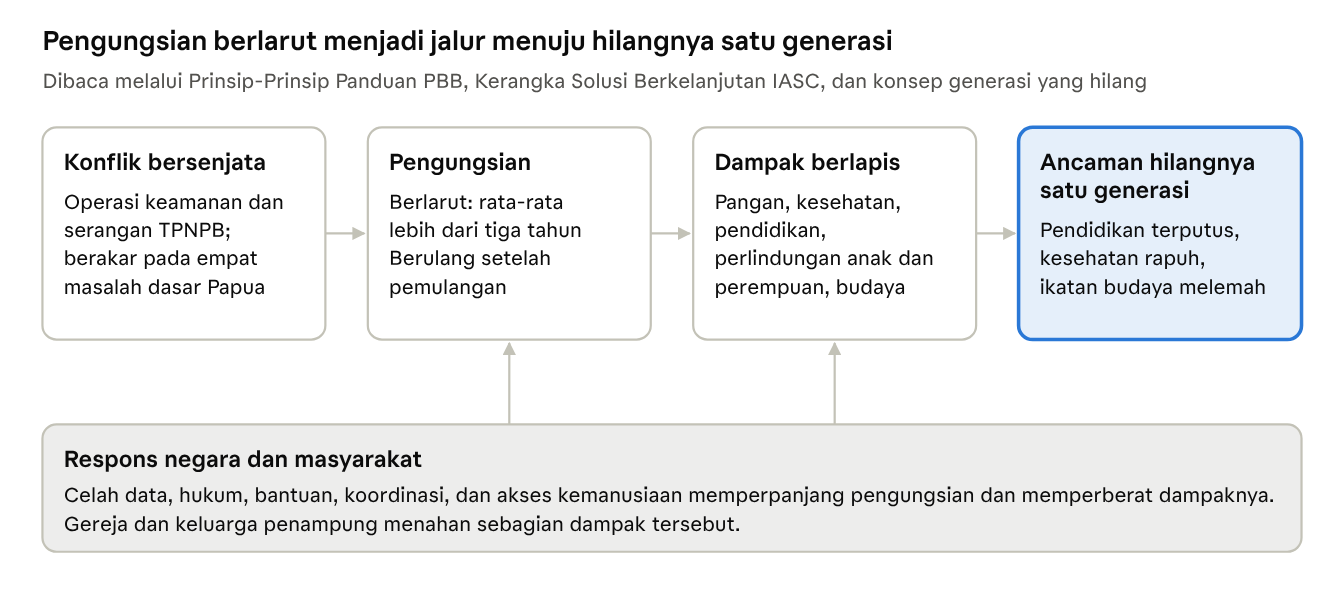
Figure 1. Research analytical framework
Source: Compiled by the author based on the literature review.
3. Research Methods
Research design. This is a qualitative study using an exclusively library-based research method (library research). All data come from published written sources, without field data collection.
Data sources. Data were collected from six groups of sources published during 2018–2026:
- International legal instruments: the UN Guiding Principles on Internal Displacement and the IASC Framework on Durable Solutions.
- Documents of UN bodies: the statement by UN Special Rapporteurs (2022) and the concluding observations of the Human Rights Committee and the Committee on Economic, Social and Cultural Rights (2024).
- National legislation: Law Number 7 of 2012 and Government Regulation Number 2 of 2015.
- Official reports and statements by state institutions: Komnas HAM, Komnas Perempuan, the Ombudsman of the Republic of Indonesia, the Indonesian Child Protection Commission (KPAI), the Ministry of Human Rights, and the Ministry of Social Affairs.
- Church research and reports by civil society organisations, particularly the joint KWI–Papua Council of Churches–PGI research (2024), Human Rights Monitor, and YLBHI.
- Academic works, comprising books, journal articles, undergraduate theses, and reporting by national and local Papuan media.
Source selection criteria. Sources were selected if they (a) addressed conflict-induced internal displacement in Tanah Papua or its conceptual framework; (b) were published during 2018–2026, except for foundational instruments and classic reference works; and (c) clearly identified the origin of their data or their publishing institution.
Analytical techniques. Data were analysed using qualitative content analysis in four stages: (1) grouping the data according to the three research questions; (2) triangulating sources by comparing figures and claims from state institutions, churches, civil society organisations, and UN bodies to assess their consistency; (3) interpreting the findings through the frameworks of the Guiding Principles, durable solutions, a lost generation, and the roots of the Papua conflict; and (4) drawing conclusions and recommendations.
Limitations. As a library-based study, this research depends on the quality and completeness of available sources. Displacement figures come from institutions using different data collection methods, so the figures presented should be understood as estimates. Limited access to conflict areas also means that many reports rely on second-hand information. To reduce bias, this article openly presents differences in data and interpretations across sources.
4. Findings and Discussion
4.1 The Scale of Displacement and Data Problems
The first striking finding of this literature review is the absence of a jointly recognised figure. Table 1 summarises estimates of the number of internally displaced persons in Tanah Papua from various sources.
Table 1. Estimated numbers of internally displaced persons in Tanah Papua, 2019–2026 (ordered from most recent)
| Date | Estimated number | Source |
|---|---|---|
| August 2026 | 125.931 | Church and human rights defenders' data, cited by KNPB (NIT, 2026) |
| July 2026 | ±122.000 | Figure received by the Ministry of Human Rights (RRI, 2026a) |
| June 2026 | 122.931 | Cited by Leri Gwijangge (iNews, 2026a) |
| March 2026 | >107.039 | Human Rights Monitor (2026b) |
| January 2026 | >105.878 | Human Rights Monitor (2026a) |
| December 2025 | 103.218 | Papua Council of Churches (Tempo, 2025) |
| December 2024 | >85.000 | Local media and human rights defenders (Human Rights Monitor, 2025a) |
| September 2024 | >79.867 | Human Rights Monitor (2024c) |
| April 2024 | ±76.919 | Human Rights Monitor (2024a) |
| September 2023 | 76.228 | Human rights defenders in various regencies (Human Rights Monitor, 2023a) |
| March 2022 | 60.000–100.000 | UN Special Rapporteurs (United Nations, 2022) |
| November 2021 | ±60.000 | Papua Council of Churches (CNN Indonesia, 2021) |
| August 2019 | ±45.000 | Ombudsman RI (2019b), Nduga and surrounding areas |
These figures derive from different data collection methods and are not strictly comparable. Nevertheless, the trend is consistent: the number of displaced persons continues to rise, with the largest surge occurring in 2025–2026.
The disparity between state and non-state data is striking. In June 2024, Komnas HAM documented only 454 displaced persons in several districts, while acknowledging that these data were incomplete (Human Rights Monitor, 2025b). During the same period, human rights defenders' data recorded around 76.919 displaced persons (Human Rights Monitor, 2024a). Differences also appear for the same regency. Human rights defenders' data recorded 56.981 displaced persons from Nduga in September 2024 (Human Rights Monitor, 2024c), whereas a figure cited in June 2026 indicated that 10.272 Nduga residents remained displaced (iNews, 2026a). This discrepancy may reflect the return of some displaced persons, or differences in counting methods; neither source explains it. While monitoring displaced persons from Maybrat in July 2023, Komnas HAM also found differences between data held by the regional government, the police, and other parties (Jubi, 2023). Indeed, security personnel have described some reports of displacement as false news (hoaxes), including in Oksop and West Moskona Districts in January 2025 (Human Rights Monitor, 2025c). When the very existence of displaced persons remains contested, they risk becoming invisible in policy planning.
4.2 Distribution of Displacement
Table 2 presents the distribution of displaced persons by regency based on data compiled by Human Rights Monitor in September 2024, the latest available data disaggregated by regency.
Table 2. Distribution of internally displaced persons by regency, as of 15 September 2024
| Regency | Number of displaced persons | Displaced since |
|---|---|---|
| Nduga | 56.981 | December 2018 |
| Intan Jaya | 5.859 | October 2021 |
| Maybrat | 3.435 | September 2021 |
| Puncak (Agandugume and Oneri) | 3.000 | June 2024 |
| Puncak | 2.724 | April 2021 |
| Paniai | 2.500 | April 2024 |
| Pegunungan Bintang (Kiwirok) | 2.252 | October 2021 |
| Yahukimo (Suru-Suru) | 1.971 | November 2021 |
| Yahukimo (Dekai) | 554 | August 2023 |
| Fakfak (Kramongmongga) | 500 | August 2023 |
| Pegunungan Bintang (Serambakon) | 91 | September 2023 |
| Total | >79.867 |
Source: Human Rights Monitor (2024c).
Table 2 shows that Nduga accounted for more than 70 percent of displaced persons in 2024. Displacement subsequently expanded. Komnas HAM recorded displaced persons across Jayapura, Nabire, Mimika, Wamena, Sorong, and Teluk Bintuni (Metro TV, 2026), with the largest increases in Central Papua and Highland Papua Provinces (iNews, 2026b). The Papua Council of Churches identified Intan Jaya as the most heavily affected area in 2025 (Indoleft, 2025). Since 30 March 2025 alone, around 7.000 Intan Jaya residents have been displaced (Human Rights Monitor, 2025b). In June 2025, Jayawijaya Regency experienced its first wave of displacement in a decade (Human Rights Monitor, 2025b).
The violence triggering displacement is also substantial in scale. During the first half of 2026, Komnas HAM recorded 42 incidents of violence and armed conflict that killed 59 people and injured another 50 (Metro TV, 2026). Most fatalities were civilians (iNews, 2026b).
4.3 Characteristics of Displacement: Protracted and Recurrent
Displacement in Papua has two characteristics distinguishing it from displacement caused by natural disasters.
First, it is protracted (protracted). Displaced persons from Nduga have lived in displacement since December 2018, and 10.272 of them had still not returned by June 2026 (iNews, 2026a). The 2024 church research found that respondents had been displaced for more than three years on average, including one to two years moving on foot through forests. Around two-thirds of respondents continued to move or slept outdoors, under tents, or under tarpaulins (Human Rights Monitor, 2024c).
Second, it is recurrent. Displacement in Intan Jaya has continued from 2019 to 2026, with the latest wave triggered by military operations in Agisiga District in May 2026 (Human Rights Monitor, 2026c). The Intan Jaya Regency Government had arranged flights to return displaced persons from Nabire, Paniai, and Timika in August 2023 (Human Rights Monitor, 2023b). Yet new waves of displacement continued to occur. In Jayawijaya, some residents displaced in June 2025 had only recently returned from an earlier displacement (Human Rights Monitor, 2025b). Displaced persons from Maybrat who had returned to their villages likewise lived under a heavy security presence with limited access to government services (Human Rights Monitor, 2024a).
Under the IASC framework, return followed by renewed displacement cannot yet be described as a durable solution. Its primary requirement—long-term safety in the place of origin—has not been met. The church research confirms this: 70 percent of respondents identified the lack of safety in their villages as the main obstacle to returning, and 39 percent stated that they would not return because of threats from the parties to the conflict (Human Rights Monitor, 2024c).
4.4 Causes of Displacement
The sources reviewed agree that displacement is triggered by armed conflict between security forces (the Indonesian National Armed Forces, TNI, and the Indonesian National Police, Polri) and the TPNPB, which the government terms an armed criminal group (KKB). In the church research, all respondents (100 percent) identified armed conflict as the primary cause, and 97 percent cited fear. A further 41 percent reported intimidation by parties to the conflict, and 39 percent stated that their families had been directly threatened (Human Rights Monitor, 2024c).
Differences arise in emphasis. The government and several research institutions emphasise attacks by armed groups as the trigger, viewing the security presence as an effort to protect residents and restore government services (iNews, 2026c). By contrast, churches and human rights organisations emphasise that security operations and troop increases in civilian areas trigger new waves of displacement (Human Rights Monitor, 2026c). YLBHI recorded at least 76.228 people displaced by military operations during 2023–2025 (NU Online, 2025b). A Special Committee of the Regional Representative Council of the Republic of Indonesia also reported that the deployment of additional non-organic troops subjected residents to prolonged security-related trauma (CNN Indonesia, 2026). Human Rights Monitor (2026d) noted a tendency for security personnel to stigmatise Indigenous Papuans as TPNPB supporters or members, increasing displaced persons' vulnerability.
Viewed through the Papua Road Map framework, this debate shows that displacement cannot be separated from the broader roots of the conflict. An approach based solely on security tends to generate cycles of violence and renewed displacement, while human rights violations and development failures—two of the four root problems identified by LIPI—deepen further (Widjojo, 2009).
4.5 Impacts on the Younger Generation
The 2024 church research provides the most comprehensive quantitative account of displaced persons' living difficulties, summarised in Table 3.
Table 3. Principal difficulties reported by internally displaced persons in Papua, 2024
| Difficulty | Percentage of respondents |
|---|---|
| Food shortages | 97% |
| Loss of access to free education | 90% |
| Lack of access to health services | 87% |
| Economic and livelihood problems | 81% |
Source: Joint research by KWI, the Papua Council of Churches, and PGI involving 70 Indigenous Papuan displaced persons, July–August 2024 (Human Rights Monitor, 2024c).
Education. In Nduga, teachers and health workers had been displaced since October 2018, leaving public services virtually paralysed for eight months (Ombudsman RI, 2019a). An emergency school for displaced children was established in Wamena only in March 2019, and even that was driven by volunteers, Protestant ministers, Catholic priests, and churches, primarily so that children could sit examinations (Ombudsman RI, 2019b). The Ombudsman found no official data on how many displaced children were attending school under emergency conditions. Similar patterns remained visible years later. Central Papua Senator Eka Kristina Yeimo stated that many children in Intan Jaya had dropped out because teachers moved to towns to escape the conflict, while local teachers were themselves affected by violence (NU Online, 2025c). In Maybrat, Komnas HAM recorded 378 school-age children whose education had been neglected, while birth certificate ownership in the regency had reached only 54 percent of approximately 11.000 children (KPAI, 2023). The situation was worsened by the use of public facilities as security posts. In February 2025, Komnas HAM condemned the use of schools, district offices, and churches as posts for security forces in Papua (Human Rights Monitor, 2025d).
Food and health. Almost all respondents in the church research reported food shortages (Table 3). The UN Committee on Economic, Social and Cultural Rights described the health conditions of internally displaced persons in Papua as alarming (CESCR, 2024). Human Rights Monitor (2026a) also noted that the militarisation of access to health care in conflict areas left residents fearful and reluctant to seek medical services. Among those displaced from Oksop, Pegunungan Bintang, in December 2024 were 251 children under five, 45 older persons, and 10 pregnant women requiring immediate medical attention (Human Rights Monitor, 2024d).
Deaths during displacement. Mortality data are highly contested. The Ministry of Social Affairs stated that 53 displaced persons from Nduga died between December 2018 and July 2019, including 23 children, and denied reports of more than 130 deaths (Medcom, 2019). A civil society coalition at the time reported around 139 deaths from hunger and poor living conditions (The Jakarta Post, 2019b). Data compiled by Human Rights Monitor indicated that more than 615 displaced persons from Nduga had died by January 2022 (Human Rights Monitor, 2024c). Such large discrepancies demonstrate the weakness of death registration during displacement.
Women and children. Komnas Perempuan considers women and children the groups most affected by armed conflict in Papua, describing this displacement crisis as comparable in some contexts to global humanitarian crises despite receiving almost no national attention (NU Online, 2025a). During 2021–2025, Komnas Perempuan received 75 complaints of violence against women in Papua, approximately 40 percent of which involved state personnel (RRI, 2026c). Komnas HAM also stressed that attention to vulnerable groups, particularly women and children, must be prioritised in the response to displacement (RRI, 2026b).
Mental health. Displacement leaves psychological wounds. In February 2019, the Ministry of Social Affairs sent a team of counsellors to support 210 displaced children from Nduga at Sinakma Church, Wamena (The Jakarta Post, 2019a). A study of victims of the 2019 Wamena unrest found PTSD symptoms exacerbated by displacement and economic losses (Ardiningrum, 2026). Research on Papuan refugees in Port Moresby showed links between traumatic experiences and mental disorders (Tay dkk., 2015). However, no systematic study has yet been identified on the mental health of internally displaced children in Papua's conflict areas.
Culture and identity. For Indigenous Papuans, villages and customary lands are spaces in which language, customary knowledge, and kinship relations are transmitted. Years of displacement separate children from these spaces. The church research shows that 81 percent of displaced persons lost their livelihoods (Human Rights Monitor, 2024c), which for cultivating communities means severed relationships with gardens and land. Long-term impacts on language and customary knowledge have not been specifically studied and constitute an agenda for further research.
Interpreting the findings through the lost-generation lens. Taken together, these impacts provide strong empirical grounds for Komnas HAM's warning about a lost generation in Papua (Okezone, 2026). The No Lost Generation initiative in Syria teaches that shelter and food assistance are insufficient without education, child protection, and psychosocial recovery. In Papua, nine out of ten displaced persons surveyed had lost access to education, and almost all lacked food. If these conditions persist, a generation of Indigenous Papuans in conflict areas will grow up with interrupted education, fragile nutrition and health, untreated psychological wounds, and weakened cultural ties.
4.6 The State Response and Policy Gaps
The state's response to date leaves five gaps: data and recognition, law, assistance, coordination, and humanitarian access.
Data and recognition. Since 2019, the Ministry of Social Affairs has acknowledged difficulties in providing assistance because no reliable data exist on the number of displaced persons (Ombudsman RI, 2019a). Seven years later, the same problem persists. In August 2026, Minister of Human Rights Natalius Pigai asked regional governments, churches, and non-governmental organisations in Central Papua to submit accurate displacement data as a basis for intervention (INP Polri, 2026). Komnas HAM urged stronger data collection, while further assistance distribution still awaited regional government proposals and supporting data (RRI, 2026b). Data are also a matter of trust. The West Papua National Committee (KNPB) rejected plans for government institutions to register displaced persons, fearing that the data would be used for political purposes (NIT, 2026).
Law. Law Number 7 of 2012 was designed for social conflict, particularly disputes between community groups. Displacement in Papua arises from armed conflict involving state security forces as one of the parties. Consequently, displaced Papuans occupy a grey area: they are not fully covered by the disaster framework, nor are they appropriately addressed through the social conflict framework. This law also does not include the concept of durable solutions. This finding is consistent with Ester's (2022) conclusion that protection for displaced persons from Nduga remains inadequate.
Assistance. The church research found that assistance to displaced persons came more often from churches (30 percent of respondents), family or relatives (29 percent), and civil society organisations or solidarity groups (24 percent), while regional government support was very low. Half of respondents had received no assistance after more than three years of displacement (Human Rights Monitor, 2024c). Komnas HAM also found displaced persons who travelled at their own expense and then stayed with family in Nabire and Timika (Republika, 2025b).
Coordination. The response to displacement remains sectoral and sporadic. Merah Pusaka Stratejik Indonesia proposed establishing a Papua Internal Displacement Response Agency (BP2IP) as a cross-sectoral institution addressing the entire displacement cycle, from data collection to reintegration (RMOL, 2026). The Ministry of Human Rights stated that it was coordinating with the TNI and Polri in responding to displacement (RRI, 2026a). This approach raises questions, because displaced persons fleeing security operations may be reluctant to accept assistance distributed through security forces.
Humanitarian access. In 2022, UN Special Rapporteurs expressed alarm at reports that humanitarian assistance for displaced Papuans was being obstructed by the authorities, and called for unhindered humanitarian access and the pursuit of durable solutions (United Nations, 2022). The Indonesian government denied obstructing assistance (Vatican News, 2022). In 2024, the UN Committee on Economic, Social and Cultural Rights again recommended opening access to national and international humanitarian organisations (CESCR, 2024). The UN Human Rights Committee in the same year expressed deep concern about patterns of serious human rights violations involving security forces in Papua (Human Rights Committee, 2024). Human Rights Monitor (2024b) reported that displacement areas such as Pegunungan Bintang and Puncak were almost isolated from media coverage and human rights monitoring. In June 2026, the TPNPB expressed its willingness to guarantee access for neutral humanitarian organisations under the supervision of the International Committee of the Red Cross (Human Rights Monitor, 2026c). Humanitarian access can therefore be negotiated, but requires political will from all parties.
4.7 The Role of Churches and Families
Amid the state's limitations, churches have become the first place of refuge and the largest source of assistance. In 2021, more than 3.000 Intan Jaya residents sought refuge in churches and surrounding areas (CNN Indonesia, 2021). PGI recorded around 950 congregants from three churches in Titigi and Hitadipa displaced in May 2025 (Republika, 2025a). Churches also produce data and research, as shown in Table 1 and Table 3. In December 2024, the Papua Council of Churches and Indigenous priests held an exhibition on displaced persons' situation to attract public attention (Human Rights Monitor, 2024d).
Families and relatives provide a second support system. Displaced persons from Nduga in Wamena generally stay with relatives who are also from Nduga (Ombudsman RI, 2019a). Similar patterns were found among displaced persons in Nabire and Timika (Republika, 2025b). These kinship networks are important social capital, but also bear an economic burden that has never been accounted for in policy.
These findings show that churches and families are not merely supplementary actors. They are the principal actors in responding to displacement and have been working without adequate policy support.
5. Conclusions and Recommendations
5.1 Conclusions
Internal displacement in Tanah Papua has grown from a local crisis in Nduga in late 2018 into a cross-provincial humanitarian crisis that, in 2026, was estimated to involve more than 122.000 people. Nevertheless, no jointly agreed figure exists. The gap between state data and data from churches and civil society is very wide, and the existence of displaced persons in some places has even been denied. This is not merely a technical problem, because unrecorded groups can easily be overlooked by policy.
Displacement in Papua is also not a short-lived event. Displaced persons live in displacement for more than three years on average, many continue moving or live outdoors, and return is frequently followed by new waves of displacement. As long as safety in home villages remains unguaranteed, durable solutions as formulated by the IASC cannot be said to have been achieved.
The most troubling impacts fall on the younger generation. Almost all displaced persons surveyed lacked food, nine out of ten had lost access to education, and women and children bore the heaviest burden. Psychological wounds and children's separation from their land and villages remain unaddressed. Taken together, these impacts provide strong empirical grounds for warnings about the threat of a lost generation of Indigenous Papuans.
The state's response continues to leave gaps in data, law, assistance, coordination, and humanitarian access. Law Number 7 of 2012 was not designed for displacement resulting from protracted armed conflict, and half of the displaced persons surveyed reported never receiving assistance. Churches and host families have borne the greatest burden to date.
Finally, displacement cannot be separated from the roots of the Papua conflict. As long as conflict management relies on a security approach, displacement will continue to recur, while human rights violations and development failures—two of the four root problems identified by LIPI—will deepen.
5.2 Recommendations
- Independent joint data collection. The government, Komnas HAM, churches, and civil society organisations need to agree on a transparent displacement data collection mechanism trusted by all parties, with data disaggregated by age, sex, and specific needs.
- Dedicated regulations on internally displaced persons. Regulations should be developed adopting the UN Guiding Principles and the concept of durable solutions, or at least implementing regulations explicitly covering displacement caused by armed conflict.
- A civilian-led integrated response mechanism. The displacement response should be coordinated by a cross-sectoral civilian institution, with the role of security forces limited to ensuring security, so that displaced persons are not reluctant to accept assistance.
- Education, health, and psychosocial recovery as principal pillars. Emergency schools, support teachers, mobile health services, special protection for women and children, and psychosocial support should be provided at displacement sites, drawing lessons from the No Lost Generation approach. Educational and health facilities must not be used as security posts.
- Churches and host families as formal partners. The roles of churches and host families should be recognised and supported through budget allocations, including through Special Autonomy Funds.
- Neutral humanitarian access. All parties should grant neutral humanitarian agencies access to displacement areas, as recommended by UN bodies.
- Addressing the roots of the conflict. The response to displacement should be situated within a broader conflict-resolution agenda, including dialogue and the justice-based approach proposed by the Papua Road Map.
- Further research. Field research is needed on displaced children's education, nutrition, and mental health, as well as the effects of protracted displacement on language and customary knowledge.
References
Ardiningrum, G. R. (2026). Gambaran post traumatic stress disorder dan strategi coping pada korban konflik sosial di Papua [Skripsi, UIN Sunan Kalijaga Yogyakarta]. https://digilib.uin-suka.ac.id/id/eprint/78108/
CNN Indonesia. (2021, 26 November). Dewan Gereja Papua: 60 ribu orang mengungsi akibat konflik bersenjata. https://www.cnnindonesia.com/nasional/20211126114005-20-726387/dewan-gereja-papua-60-ribu-orang-mengungsi-akibat-konflik-bersenjata
CNN Indonesia. (2026, 5 Agustus). Pansus DPD RI ungkap kondisi pengungsi di Puncak Papua imbas konflik. https://cnnindonesia.com/nasional/20260804161356-12-1388537/pansus-dpd-ri-ungkap-kondisi-pengungsi-di-puncak-papua-imbas-konflik
Committee on Economic, Social and Cultural Rights. (2024). Concluding observations on the second periodic report of Indonesia (E/C.12/IDN/CO/2). United Nations. https://digitallibrary.un.org/record/4041426
Ester, J. (2022). Pengaturan dan perlindungan terhadap pengungsi internal Nduga Papua [Skripsi, Universitas Gadjah Mada]. https://etd.repository.ugm.ac.id/penelitian/detail/207184
Human Rights Committee. (2024). Concluding observations on the second periodic report of Indonesia (CCPR/C/IDN/CO/2). United Nations. https://digitallibrary.un.org/record/4045908
Human Rights Monitor. (2023a, 6 Oktober). IDP update, October 2023: Recent displacement in Yahukimo, Pegunungan Bintang and Fakfak regencies. https://humanrightsmonitor.org/?p=5192
Human Rights Monitor. (2023b). Maybrat: Two years after displacement IDPs are still in need of attention. https://humanrightsmonitor.org/?p=4805
Human Rights Monitor. (2024a). IDP update April 2024: New internal displacements in Paniai. https://humanrightsmonitor.org/reports/idp-update-april-2024-new-internal-displacements-in-paniai/
Human Rights Monitor. (2024b). IDP update June 2024: Urgent call for humanitarian access to conflict areas. https://humanrightsmonitor.org/news/idp-update-june-2024-urgent-call-for-humanitarian-access-to-conflict-areas/
Human Rights Monitor. (2024c). IDP update September 2024: New research on IDPs in West Papua underlines urgent need for government action. https://humanrightsmonitor.org/reports/idp-update-september-2024-new-research-on-idps-in-west-papua-underlines-urgent-need-for-government-action/
Human Rights Monitor. (2024d). IDP update December 2024: Security raids trigger new displacements in Nduga, Intan Jaya, Tambrauw and Pegunungan Bintang. https://humanrightsmonitor.org/news/idp-update-december-2024-security-raids-trigger-new-displacements-in-tambrauw-and-pegunungan-bintang/
Human Rights Monitor. (2025a). Annual report 2024: Human rights and conflict in West Papua. https://humanrightsmonitor.org/reports/annual-report-2024-human-rights-and-conflict-in-west-papua/
Human Rights Monitor. (2025b). IDP update June'25: Humanitarian crisis in West Papua reaches new dimensions. https://humanrightsmonitor.org/news/idp-update-june25-humanitarian-crisis-in-west-papua-reaches-new-dimensions/
Human Rights Monitor. (2025c). IDP update March'25: Increasing military presence triggers new displacements and fear among returning IDPs. https://humanrightsmonitor.org/news/idp-update-march25-increasing-military-presence-triggers-new-displacements-and-fear-among-returning-idps/
Human Rights Monitor. (2025d). Komnas HAM condemns the use of public facilities by Indonesian military in West Papua. https://humanrightsmonitor.org/news/komnas-ham-condemns-the-use-of-public-facilities-by-indonesian-military-in-west-papua/
Human Rights Monitor. (2026a). IDP update January 2026: Humanitarian crisis deteriorates as indigenous communities bear brunt of expanding security operations. https://humanrightsmonitor.org/reports/idp-update-january-2026-humanitarian-crisis-deteriorates-as-indigenous-communities-bear-brunt-of-expanding-security-operations/
Human Rights Monitor. (2026b). Papua Monitor Q1 2026: No de-escalation as military operations drive new displacement. https://humanrightsmonitor.org/reports/papua-monitor-q1-2026-no-de-escalation-as-military-operations-drive-new-displacement/
Human Rights Monitor. (2026c). IDP update June'26: Government neglect drives West Papua's spiraling displacement emergency. https://humanrightsmonitor.org/reports/idp-update-june26-government-neglect-drives-west-papuas-spiraling-displacement-emergency/
Human Rights Monitor. (2026d). IDP update March'26: More military trigger new displacements and dampen the prospects of return. https://humanrightsmonitor.org/reports/idp-update-march26-more-military-trigger-new-displacements-and-dampen-the-prospects-of-return/
Indoleft. (2025, 21 November). Papuan Council of Churches records 103,218 refugees in Papua (Terjemahan dari Jubi). https://www.indoleft.org/news/2025-11-21/papuan-council-of-churches-records-103218-refugees-in-papua.html
iNews. (2026a, 22 Juni). 7 tahun warga mengungsi, Leri Gwijangge desak pemerintah akhiri krisis kemanusiaan di Nduga. RCTI+. https://www.rctiplus.com/news/detail/nasional/5412038/7-tahun-warga-mengungsi--leri-gwijangge-desak-pemerintah-akhiri-krisis-kemanusiaan-di-nduga
iNews. (2026b, 16 Juli). Komnas HAM catat 59 orang tewas dalam konflik Papua Januari–Juni 2026, mayoritas warga sipil. RCTI+. https://www.rctiplus.com/news/detail/inews/5430065/komnas-ham-catat-59-orang-tewas-dalam-konflik-papua-januari-juni-2026--mayoritas-warga-sipil
iNews. (2026c, 15 Juli). Pemerintah diminta percepat penanganan pengungsi konflik Papua dan tindak tegas KKB. RCTI+. https://www.rctiplus.com/news/detail/nasional/5429504/pemerintah-diminta-percepat-penanganan-pengungsi-konflik-papua-dan-tindak-tegas-kkb
INP Polri. (2026, 18 Agustus). Pigai urged local govt. to compile valid data for refugees in Central Papua. https://inp.polri.go.id/artikel/pigai-urged-local-govt-to-compile-valid-data-for-refugees-in-central-papua
Inter-Agency Standing Committee. (2010). IASC framework on durable solutions for internally displaced persons. Brookings–Bern Project on Internal Displacement. https://www.brookings.edu/articles/iasc-framework-on-durable-solutions-for-internally-displaced-persons/
Jubi. (2023, Oktober). [Komnas HAM bertemu Menteri Dalam Negeri membahas kasus Walesi dan pengungsi Maybrat, 11 Oktober 2023]. https://en.jubi.id/?p=18562
Komisi Nasional Anti Kekerasan terhadap Perempuan [Komnas Perempuan]. (2025). Potret perempuan dalam konflik Papua: Belum berkesudahan (pengungsian, rasisme dan perempuan pembela HAM). Laporan pemantauan Papua 2018–2021. https://komnasperempuan.go.id/download-file/1309
Komisi Perlindungan Anak Indonesia [KPAI]. (2023, 7 Desember). Situasi anak-anak pasca konflik Maybrat. https://kpai.go.id/?p=19263
Medcom. (2019, 30 Juli). Terdata 53 pengungsi Nduga-Papua meninggal. https://www.medcom.id/nasional/daerah/aNrQaDPK-terdata-53-orang-pengungsi-nduga-papua-meninggal
Metro TV. (2026, 12 September). Komnas HAM temui KSP bahas konflik Papua. https://www.metrotvnews.com/read/kM6C4neR-komnas-ham-temui-ksp-bahas-konflik-papua
NIT. (2026, 27 Agustus). West Papua National Committee stands against Indonesia's registration of internally-displaced Papuans. https://nit.com.au/27-08-2026/26155/west-papua-national-committee-stands-against-indonesias-registration-of-internally-displaced-papuans
No Lost Generation. (t.t.). What we do. https://nolostgeneration.org/what-we-do
NU Online. (2025a, 16 Desember). Komnas Perempuan: Pendekatan militer perburuk situasi perempuan di Papua. https://nu.or.id/nasional/komnas-perempuan-pendekatan-militer-perburuk-situasi-perempuan-di-papua-9mSIg
NU Online. (2025b, 16 Desember). YLBHI: Operasi militer di Papua berlangsung sejak 1961 dan tak pernah benar-benar berakhir. https://nu.or.id/nasional/ylbhi-operasi-militer-di-papua-berlangsung-sejak-1961-dan-tak-pernah-benar-benar-berakhir-jsGsE
NU Online. (2025c, 16 Desember). Senator sebut konflik bersenjata picu krisis pendidikan di Papua. https://nu.or.id/nasional/senator-sebut-konflik-bersenjata-picu-krisis-pendidikan-di-papua-O4j4K
Okezone. (2026, 3 September). Komnas HAM soroti ancaman "hilangnya generasi" akibat konflik di Papua. RCTI+. https://www.rctiplus.com/news/detail/okezone/5465275/komnas-ham-soroti-ancaman---039-hilangnya-generasi--039--akibat-konflik-di-papua
Ombudsman Republik Indonesia [Ombudsman RI]. (2019a, 29 Agustus). Ombudsman: Layanan publik di Nduga 8 bulan tak berfungsi baik. https://ombudsman.go.id/news/r/ombudsman-layanan-publik-di-nduga-8-bulan-tak-berfungsi-baik
Ombudsman Republik Indonesia [Ombudsman RI]. (2019b, 29 Agustus). Investigasi Ombudsman RI terkait pelayanan publik pengungsi di Nduga, Papua. https://ombudsman.go.id/pers/r/---investigasi-ombudsman-ri-terkait-pelayanan-publik-pengungsi-di-nduga-papua
Peraturan Pemerintah Republik Indonesia Nomor 2 Tahun 2015 tentang Peraturan Pelaksanaan Undang-Undang Nomor 7 Tahun 2012 tentang Penanganan Konflik Sosial. https://peraturan.go.id/files/pp2-2015bt.pdf
Pugu, M. R., Buiney, M. E., Wambrauw, M. S. F., Renyoet, C. C., Sanggenafa, M., & Korwa, J. R. V. (2023). Surviving in the post-repatriation era: Challenges and opportunities for Papuan refugees after returning from Papua New Guinea. Jurnal Ilmiah Hubungan Internasional, 19(1), 79–93. https://doi.org/10.26593/jihi.v19i1.5650.79-93
Republika. (2025a, 20 Mei). Gereja: 950 warga Papua Tengah mengungsi akibat konflik TNI dan OPM. https://news.republika.co.id/berita/swk4t9393/gereja-950-warga-papua-tengah-mengungsi-akibat-konflik-tni-dan-opm
Republika. (2025b, 9 Juni). 60 ribu warga Papua mengungsi, Komnas HAM: Mereka gunakan dana pribadi hingga dana desa. https://news.republika.co.id/berita/sxkljv487/60-ribu-warga-papua-mengungsi-komnas-ham-mereka-gunakan-dana-pribadi-hingga-dana-desa
Reuters. (2022, 2 Maret). Indonesia rejects UN calls to probe abuses in Papua. BusinessLive. https://www.businesslive.co.za/bd/world/asia/2022-03-02-indonesia-rejects-un-calls-to-probe-abuses-in-papua/
RMOL. (2026, 4 Oktober). MPSI dorong badan khusus tangani pengungsi internal Papua. https://rmol.id/read/2026/10/04/723814/mpsi-dorong-badan-khusus-tangani-pengungsi-internal-papua
RRI. (2026a, 8 Juli). Wamen HAM: Konflik Papua sebabkan 122 ribu warga mengungsi. https://rri.co.id/nasional/2552425/wamen-ham-konflik-papua-sebabkan-122-ribu-warga-mengungsi
RRI. (2026b, 11 Agustus). Komnas HAM urges stronger support for displaced residents in Central Papua. https://rri.co.id/en/national/2642901/komnas-ham-urges-stronger-support-for-displaced-residents-in-central-papua
RRI. (2026c, 19 Juni). Komnas Perempuan highlights women's vulnerability in Papua conflict. https://rri.co.id/en/national/2505413/komnas-perempuan-highlights-womens-vulnerability-in-papua-conflict
Tay, A. K., Rees, S., Chen, J., Kareth, M., Lahe, S., Kitau, R., David, K., Sonoling, J., & Silove, D. (2015). Associations of conflict-related trauma and ongoing stressors with the mental health and functioning of West Papuan refugees in Port Moresby, Papua New Guinea (PNG). PLoS ONE, 10(4), Artikel e0125178. https://doi.org/10.1371/journal.pone.0125178
Tempo. (2025, 15 Desember). Dewan Gereja: 103.218 orang mengungsi imbas konflik dan operasi militer di Papua. https://www.tempo.co/politik/dewan-gereja-103-218-orang-mengungsi-imbas-konflik-dan-operasi-militer-di-papua-2099176
The Jakarta Post. (2019a, 23 Februari). Social Affairs Ministry deploys counsellors to Papua after conflict. https://www.thejakartapost.com/news/2019/02/23/social-affairs-ministry-deploys-counsellors-to-papua-after-conflict
The Jakarta Post. (2019b, 22 Juli). Govt distributes aid to conflict-hit residents of Papua. https://www.thejakartapost.com/news/2019/07/22/govt-distributes-aid-to-conflict-hit-residents-of-papua.html
Undang-Undang Republik Indonesia Nomor 7 Tahun 2012 tentang Penanganan Konflik Sosial. https://peraturan.bpk.go.id/Details/39049/uu-no-7-tahun-2012
UNHCR. (2014, 7 Januari). Urgent call for massive investment to prevent lost generation of Syrian children [Siaran pers]. https://www.unhcr.org/ie/node/16242
United Nations. (1998). Guiding principles on internal displacement (U.N. Doc. E/CN.4/1998/53/Add.2). https://www.unhcr.org/sites/default/files/legacy-pdf/47949b212.pdf
United Nations. (2022, 1 Maret). Indonesia: UN experts sound alarm on serious Papua abuses, call for urgent aid [Siaran pers Pelapor Khusus PBB; diterbitkan ulang oleh PINA]. https://pina.com.fj/2022/03/02/un-experts-sound-alarm-on-serious-papua-abuses-call-for-urgent-aid/
Vatican News. (2022, 3 Maret). UN experts call for probe into rights abuses in Indonesia's east. https://www.vaticannews.va/en/world/news/2022-03/indonesia-un-experts-rights-abuse-papua-west-papua.html
Widjojo, M. S. (Ed.). (2009). Papua road map: Negotiating the past, improving the present and securing the future. LIPI, Yayasan TIFA, dan Yayasan Pustaka Obor Indonesia.
Yuliantiningsih, A. (2008). Perlindungan terhadap pengungsi domestik menurut hukum humaniter dan hak asasi manusia. Jurnal Dinamika Hukum, 8(3), 190–198. https://dinamikahukum.fh.unsoed.ac.id/index.php/JDH/article/download/73/225