Scholarly Article
Defining Indigenous Papuans: A Colonial Project Disguised as Affirmative Action
Contents
Contents
Abstrak
Istilah “Orang Asli Papua” (OAP) lahir bersama Otonomi Khusus 2001 dan sejak itu dipahami luas sebagai perlindungan. Kajian kepustakaan ini menggugat pemahaman tersebut. Dengan kerangka “mendefinisikan untuk menguasai” dari Mahmood Mamdani dan analisis sejarah perbandingan atas dua belas kasus di lima benua sejak abad ke-16, kajian ini menunjukkan bahwa praktik negara yang menetapkan siapa yang “asli”, mencatatnya menurut keturunan, mengujinya melalui lembaga resmi, lalu mengaitkannya dengan hak dan dana adalah perangkat lama kekuasaan kolonial. Praktik itu berulang di kelima benua, hampir selalu atas nama perlindungan. Indonesia, yang menghentikan pemakaian istilah pribumi dan nonpribumi pada 1998, justru menghidupkan logika yang sama khusus di Papua melalui definisi yang disusun menurut kepentingan negara, bukan fakta, pemilahan keturunan dalam data kependudukan, dan uji keaslian. Praktik itu juga tidak sejalan dengan Konvensi Penghapusan Diskriminasi Rasial dan Deklarasi PBB tentang Hak-Hak Masyarakat Adat yang diakui Indonesia. Akibatnya, masyarakat adat kehilangan wewenang menentukan anggotanya dan orang Papua dipilah menurut kadar keaslian. Kajian ini menegaskan suku-suku asli Melanesia sebagai pemilik Tanah Papua dan merekomendasikan agar keaslian ditentukan menurut adat.
Kata kunci: Orang Asli Papua, otonomi khusus, klasifikasi kolonial, identitas masyarakat adat, Papua
Abstract
The term “Orang Asli Papua” (Indigenous Papuan, OAP) was born with the 2001 Special Autonomy Law and has since been widely read as protection. This library-based study challenges that reading. Drawing on Mahmood Mamdani’s “define and rule” framework and a comparative historical analysis of twelve cases on five continents since the sixteenth century, it shows that a state deciding who is “native”, registering people by descent, testing them through official bodies, and tying the category to rights and funds is an old instrument of colonial rule. It recurred on all five continents, almost always in the name of protection. Indonesia, which stopped using the terms pribumi and nonpribumi in 1998, revived the same logic specifically in Papua through a definition built on state interests rather than facts, descent-based sorting in population data, and authenticity tests. The practice is also inconsistent with the Racial Discrimination Convention and the UN Declaration on the Rights of Indigenous Peoples endorsed by Indonesia. As a result, customary communities lose the power to determine their members and Papuans are sorted by degrees of authenticity. The study affirms the Melanesian indigenous tribes as owners of the Land of Papua and recommends that indigeneity be decided by custom.
Keywords: Indigenous Papuans, special autonomy, colonial classification, indigenous identity, Papua
1. Introduction
Ahead of the 2024 gubernatorial election, a team from the Papuan People’s Assembly (MRP) travelled to Bade Village in Mappi Regency. Their task was not to gather local aspirations, but to verify whether a gubernatorial candidate was genuinely an indigenous Papuan. Another team was sent to the home village of another candidate. The findings of these investigations were then set out in a decree that constituted one of the requirements for nomination at the General Elections Commission (Antara Papua Barat, 2024b). In the neighbouring province of Southwest Papua, the MRP declared one pair of candidates ineligible because they were deemed not to be indigenous Papuans through the male line of descent (RMOL, 2024). In West Papua, the customary council rejected an MRP decision declaring a deputy gubernatorial candidate to be an indigenous Papuan (Antara Papua Barat, 2024c).
Such scenes are rarely questioned. For many Papuans, verification of indigeneity is considered reasonable, even necessary, because Special Autonomy is intended to protect those who have been marginalised for decades. The term “Indigenous Papuans” (hereafter OAP), which emerged with Law No. 21 of 2001, was accepted as a victory: at last, the state acknowledged that this land had owners. In September 2026, when the Ministry of Home Affairs convened a meeting to “align understandings” of the definition of OAP, the unease that arose likewise took the form primarily of concern that the definition would be blurred or narrowed, rather than questions about why the state needed to define it at all (Investortrust, 2026; Katadata, 2026). The Ministry initially dismissed the plan as a hoax and affirmed that the statutory definition remained unchanged (Akurat, 2026a), but a few days later the Minister of Home Affairs explained why the definition still needed clarification (Katadata, 2026).
This study instead poses that rarely asked question. World history shows that colonial powers have repeatedly followed the same path: determining who is “indigenous”, counting and registering them according to blood or descent, appointing officials to assess their authenticity, and then making that category a gateway to rights, office, land, and funds. Almost invariably, this path has been pursued in the name of protection, development, or redress. Mahmood Mamdani (2012) calls this mode of governing define and rule: defining in order to dominate.
This study proceeds from three propositions. First, the state’s definition of indigenous populations is a colonial project that has long been implemented in various parts of the world. Second, Indonesia continues and implements that project in Papua through the concept of OAP. Third, Papuans become victims of that project precisely because it is wrapped in a positive narrative that obscures its harmful aspects. To test these three propositions, this study addresses four questions. Where and how had the definition of indigenous populations been implemented before Papua? Which elements of that pattern are present in the concept and practice of OAP? What harms do Papuans bear? And why does the positive narrative surrounding OAP not erase its colonial character?
This study makes three contributions. First, it situates the concept of OAP within the global history of colonial classification, something rarely undertaken in studies of Special Autonomy, which generally focus on funding, institutions, or government performance. Second, it examines the concept of OAP against legal standards that bind Indonesia itself, so that its critique rests not on political preferences but on norms that the state has accepted. Third, it directly confronts the strongest arguments advanced by defenders of the concept of OAP, rather than ignoring them.
It is important to clarify at the outset what this study does not claim. This study does not assert that Papuan identity is a colonial creation, nor does it question the fact that indigenous Papuans belong to the Melanesian racial group. On the contrary, this study affirms that the Land of Papua belongs to the indigenous peoples of the Melanesian racial group. Papuans have inhabited the Land of Papua for tens of thousands of years, living in hundreds of tribes and customary communities that recognise their members through descent, clan, and genealogy, long before any state arrived. What is at issue is a definition formulated not on the basis of that fact, but on the basis of state interests, together with the state’s authority to take over the determination of that identity, formulate it within uniform legal categories, and use it as an instrument of regulation. Therein, this study argues, lies its colonial character.
2. Theoretical Framework
2.1 Defining in Order to Rule
Mamdani (2012) traces a turning point in the way Britain governed its colonies in the late nineteenth century. Following major crises, including the rebellion in India, colonial thinkers influenced by Sir Henry Maine abandoned the ideal of “civilising” colonised populations to resemble their colonisers. Instead, they introduced a new approach: defining and managing difference. Colonised populations were viewed as bound by geography and custom, rather than by history and law, and this view became the basis of administrative practice. Mamdani notes that similar reforms took place in India, British Malaya, and the Dutch East Indies, and were subsequently translated into “native administration” in the African colonies (Mamdani, 2012).
The core of Mamdani’s argument is that “native” is not merely a cultural label, but a political identity created by law. Colonial power drew a line between settlers and natives, then drew further lines among natives according to tribe. Through censuses, land laws, and legal categories, previously fluid identities were frozen into boxes that determined who could own land and who could hold power (Mamdani, 2012). What made this approach effective was that it did not appear to be oppression. It presented itself as respect for custom and diversity.
Patrick Wolfe (2006) adds a dimension important to territories experiencing settler colonialism, namely colonialism that comes to settle and take control of land. According to Wolfe, this form of colonialism is driven by a “logic of elimination”: Indigenous populations must be removed from their land, but this removal does not always take the form of killing. It can occur through assimilation, displacement, and descent rules that continually diminish the number of recognised Indigenous people. Wolfe emphasises that colonial invasion is a structure, not an event: it operates continuously through law and administration. Within this framework, blood quantum calculations imposed on American Indians in the United States are not merely a matter of identity, but an instrument directly linked to access to land (Wolfe, 2006).
2.2 Censuses, Registers, and Identity Boxes
Benedict Anderson (2006) adds the technical dimension. In his chapter on the census, map, and museum, he shows that the colonial state thought through a classificatory grid that could be applied to anything under its control. According to Anderson, the innovation of census-makers from the 1870s onwards lay not in the creation of ethnic and racial classifications, but in their systematic enumeration. Once counted, these categories underpinned the bureaucracies of education, law, health, and policing, and were inherited by postcolonial states (Anderson, 2006). Charles Hirschman (1986, 1987) demonstrates the same phenomenon in Malaya: racial categories in censuses changed over time, and what are now regarded as firm boundaries between groups are in fact by-products of British colonialism in the late nineteenth and early twentieth centuries.
Tania Murray Li (2000) brings this debate to Indonesia. She notes that the Suharto regime maintained that Indonesia had no Indigenous peoples, or that all Indonesians were equally indigenous. Following reformasi, a “tribal slot” opened up in law and policy, and groups had to adapt themselves to occupy it. Li’s questions are relevant to Papua: who designs this slot, who is permitted to occupy it, and with what consequences (Li, 2000).
2.3 The Right to Determine One’s Own Identity
International law on Indigenous peoples provides a clear benchmark. Article 33 of the United Nations Declaration on the Rights of Indigenous Peoples (UNDRIP) states that Indigenous peoples have the right to determine their own identity or membership in accordance with their customs and traditions (Perserikatan Bangsa-Bangsa, 2007). ILO Convention No. 169 affirms that self-identification is a fundamental criterion for determining which groups are covered (International Labour Organization, 1989). The Declaration was adopted without a definition of who Indigenous peoples are and rests on self-identification. This self-identification is collective: Article 9 states that Indigenous peoples and individuals have the right to belong to an Indigenous community or nation in accordance with the traditions and customs of that community or nation, such that membership rules are those of the community, not the state. Ravi de Costa (2014) notes that the concept of status in Canada has parallels in the administrative practices of many countries, and that Indigenous peoples’ struggles in recent decades have encouraged states to move towards identity determination by Indigenous peoples themselves. Indonesia voted in favour when the Declaration was adopted by the UN General Assembly on 13 September 2007 (Perserikatan Bangsa-Bangsa, 2007).
A more binding benchmark comes from the International Convention on the Elimination of All Forms of Racial Discrimination (ICERD), which Indonesia ratified through Law No. 29 of 1999 and which forms the basis of Law No. 40 of 2008 on the Elimination of Racial and Ethnic Discrimination. The UN Committee on the Elimination of Racial Discrimination, in General Recommendation No. 8, holds that the identification of an individual as a member of a particular racial or ethnic group should, unless there is strong justification to the contrary, be based on self-identification by the individual concerned (Committee on the Elimination of Racial Discrimination [CERD], 1990). Article 1(4) of ICERD permits special measures to advance disadvantaged groups, but subject to two conditions: such measures must not lead to the maintenance of separate rights for different racial groups, and must not continue after their objectives have been achieved (Perserikatan Bangsa-Bangsa, 1965). General Recommendation No. 32 affirms the temporary nature of these special measures and distinguishes them from permanent rights, such as the rights of Indigenous peoples (CERD, 2009).
Against these benchmarks, the central question of this study can be formulated precisely: within the concept of OAP, who has the final say on who is Papuan, Indigenous communities or the state?
3. Methods
This study is library-based research employing juridical-historical and comparative approaches. The legal materials include Law Number 21 of 2001 and Law Number 2 of 2021 on Special Autonomy for Papua, their implementing regulations, Constitutional Court decisions concerning OAP status, Presidential Instruction Number 26 of 1998, Article 163 of the Indische Staatsregeling, and international instruments concerning Indigenous peoples. The non-legal materials include academic literature on colonialism and population classification, official documents from the comparator countries, and media reporting on OAP data collection, MRP verification, and the controversy over the definition in 2026. Data were collected up to 28 November 2026.
The comparative cases were selected according to four criteria. First, the state or colonial power itself established categories of native or Indigenous inhabitants. Second, these categories were formulated on the basis of descent, blood, race, or way of life. Third, these categories were linked to rights, obligations, land, or resources. Fourth, these policies were justified on seemingly positive grounds, such as protection, restoration, development, or respect for customary practices. To demonstrate that this pattern is global and long-standing, cases were drawn from all five continents and from a period spanning the sixteenth century to the end of the twentieth century.
The term “colonial project” is used in this study in an analytical sense, not as an insult. A policy is described as continuing a colonial project if it contains elements that have repeatedly characterised the definition of Indigenous inhabitants by colonial powers, as formulated in Section 4.6. This study does not assess the intentions of policymakers. An apparatus of governance can operate according to a colonial logic even when it is designed and implemented by well-intentioned people, including members of the group being defined.
This study has limitations. Each comparative case has a different context, and the levels of violence are not the same. Comparing Papua with apartheid or Rwanda does not mean equating the degree of suffering. What is compared is the logic and apparatus of governance: who defines, according to what criteria, for what purposes, and with what consequences.
4. Traces of the Colonial Project across Five Continents
This section traces twelve cases of state definitions of indigenous populations across five continents, from the sixteenth century to the late twentieth century. Figure 1 arranges these cases by time and continent, and places Papua at the end of the same timeline.
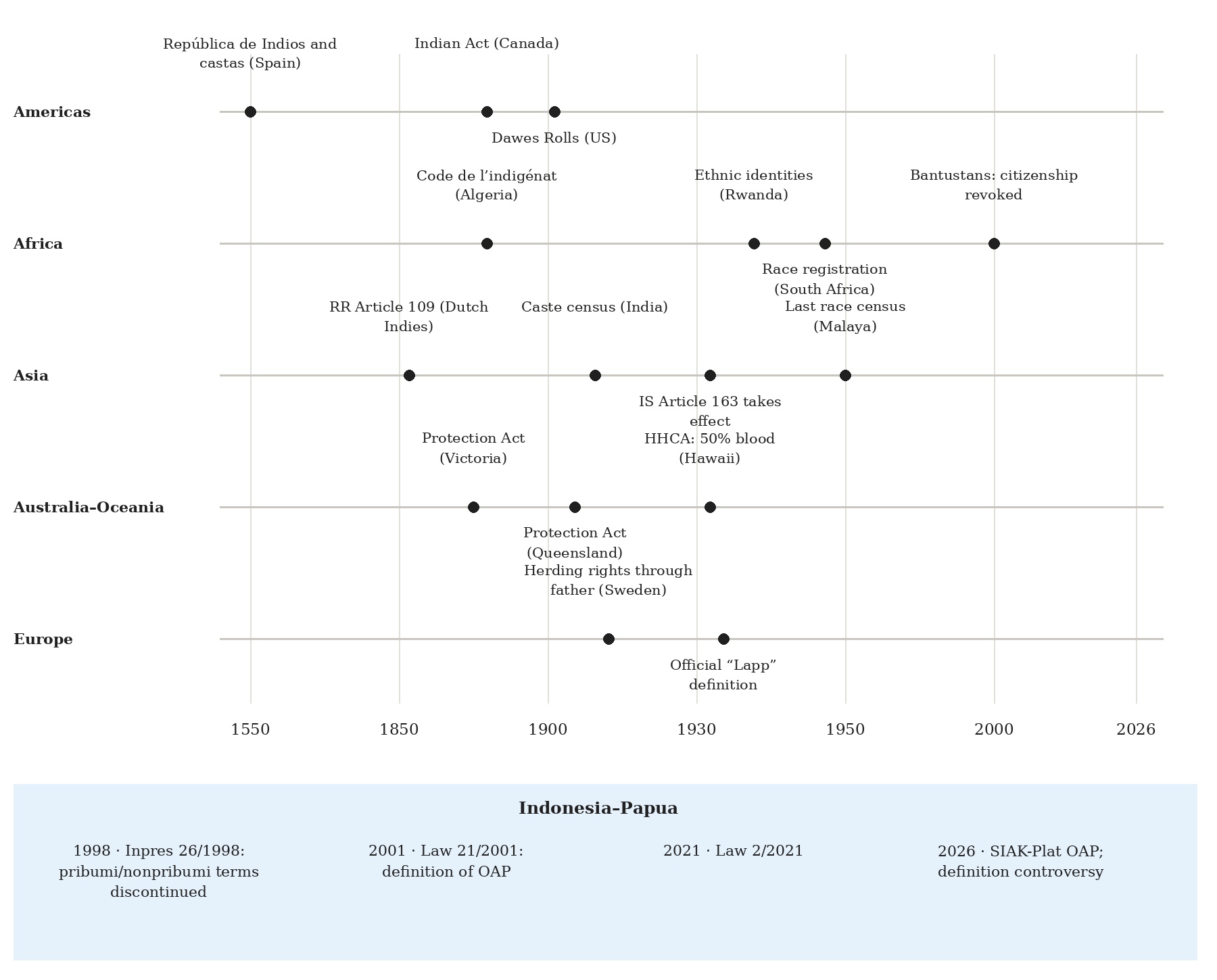
Figure 1. Timeline of state definitions of indigenous populations across five continents and in Papua, from the sixteenth century to 2026
Source: compiled by the author from the sources discussed in sections 4 and 5.
4.1 The Americas
In the Americas, the definition of indigenous populations had been taking place since the sixteenth century. The Spanish Crown divided its colonial world into two “republics”: the República de Españoles for Spaniards and their descendants, and the República de Indios for indigenous people, most of whom lived in indigenous communities. Children of mixed marriages were classified into new legal categories called castas (Martínez, 2008). Eighteenth-century casta paintings depicted more than a dozen mixed categories arranged hierarchically according to ancestry and “purity of blood”, with Spaniards at the top (Katzew, 2004). Indians were positioned as people whom the Crown was obliged to protect and guide, yet at the same time they were required to pay tribute per head and provide labour, obligations not imposed on the mestizo category (Martínez, 2008). Protection and exploitation operated within the same category.
Three centuries later, in North America, Canada enacted the Indian Act 1876. The Act established who held “Indian” status according to federal government criteria. Indigenous communities (bands) did not control who acquired or lost status; that power remained in government hands. Consequently, someone could hold status without belonging to a community, or vice versa (The Canadian Encyclopedia, n.d.). Status rules were also established by the government, rather than communities: for more than a hundred years, status women who married non-status men lost their status, as did their children, regardless of their own communities’ rules (Lawrence, 2003). The “blood quantum” criteria underlying this definition gave rise to racist notions of “full-blood” and “mixed-blood” Indians, which differed entirely from the ways indigenous communities determined membership through loyalty, shared ways of life, and relationships with the land (Lawrence, 2003). Lawrence also emphasises that this regulation of indigenous identity became central to the process of colonisation in Canada and the United States, because it was this classification system that enabled settler governments to determine who was “Indian” and control access to indigenous land.
In the United States, the Dawes Act 1887 divided the communal lands of indigenous nations into individual allotments. To this end, the Dawes Commission compiled membership rolls recording each person’s name, age, sex, and “degree of Indian blood” (National Archives and Records Administration, n.d.). Among the Cherokee, for example, each person on the rolls was assigned a blood quantum fraction beginning at 4/4 and halving with each generation (Sturm, 2002). Allotments belonging to those of half blood or more were restricted so that they could not be freely transferred, on the assumption that their owners were easily persuaded to relinquish their land (Oklahoma Historical Society, n.d.). Blood quantum, in other words, became a measure of a person’s capacity to manage their own property. The rolls compiled more than a century ago are still used by the federal government to issue Certificates of Degree of Indian Blood.
4.2 Africa
France in Algeria took a more overt approach. Since the Second Empire, French law had distinguished Europeans from “natives” (indigènes): Algeria’s Muslim population was treated as French subjects, not citizens. In 1881, the Code de l’indigénat reinforced this distinction through special sanctions applicable only to indigenous people, while also regulating the continuing dispossession of their land (Manceron, 2003). These sanctions were imposed by administrative officials without judicial proceedings, while subjects lost most of their freedoms and political rights. From 1887, this regime was extended to other French colonies, and it was only abolished towards the end of the Second World War, between 1944 and 1946 (Merle, 2002). A single legal category, indigène, sufficed to separate citizens from subjects throughout the empire.
In Rwanda, Belgium introduced identity documents recording Hutu, Tutsi, or Twa categories in the early 1930s as a means of controlling the population. After independence, this classification was retained, and during the 1994 genocide identity cards were used to distinguish Hutu from Tutsi (Longman, 2001). Archival research shows that, during the colonial period, these documents took the form of identity booklets used primarily to ensure tax payments, and ethnic category was only one of many details recorded in them (Vervust, 2012). Precisely therein lies the lesson: categories originating as routine administrative matters can become instruments of extermination once inherited by a postcolonial state.
South Africa perfected this apparatus. The Population Registration Act 1950 required every resident to be classified and registered according to race. A special racial classification office was established, and classification was conducted using criteria of physical appearance, general acceptance, and social standing. A person’s social rights, political rights, education, and economic position were determined by the category in which they were registered (Posel, 2001). On this classification, the apartheid regime built the Bantustans. The 1959 Act on Bantu “self-government” transformed reserves into “homelands” for particular ethnic groups, and the 1970 Act made black people citizens of their ethnic homelands, thereby stripping them of South African citizenship (Encyclopaedia Britannica, n.d.). The Bantustans comprised only around 13 per cent of the land for approximately 75 per cent of the population, yet the government justified them as benevolent “separate development” (Michigan State University, n.d.). These homelands were administered by black elites who collaborated with the apartheid government (Encyclopaedia Britannica, n.d.).
4.3 Asia
The archipelago now known as Indonesia experienced this project first-hand. Article 109 of the Regeringsreglement 1854, subsequently carried forward by Article 163 of the Indische Staatsregeling, which took effect on 1 January 1926, divided the population of the Dutch East Indies into three categories: Europeans, Foreign Orientals, and Natives (Inlanders) (Winarta, 2008). This division was structured according to criteria of descent and race, and the European category even included Japanese people, demonstrating that the category was a political decision rather than a biological fact. Fasseur (1994) describes this racial classification as both the cornerstone and the stumbling block of the late colonial state: it formed the basis for differences in law, rights, and treatment for each category, while its boundaries were continually debated and altered according to the government’s needs.
In India, the British conducted regular comprehensive censuses from 1871 to 1941. The 1901 census, led by Herbert Hope Risley, formally applied the caste system to the entire Hindu population of British India. Risley viewed caste as a racial hierarchy and collected anthropometric data to align it with his theory of seven Indian racial types (Dirks, 2001). Dirks (2001) shows that caste as understood in modern India was largely shaped by the knowledge requirements of colonial administration, rather than simply being an inherited tradition recorded as it stood. Categories created to meet the colonisers’ needs remain alive in Indian politics to this day.
In Malaya, racial categories in colonial censuses changed repeatedly, until the final colonial census of 1957 narrowed them down to four: Malay, Chinese, Indian, and Others (Hirschman, 1987). After independence, these inherited colonial categories were not abolished. They were transformed into a division between Bumiputra and non-Bumiputra that determined who was entitled to various state privileges (Singapore Management University, 2016). The Malayan case is important because it demonstrates how colonial categories can assume the guise of affirmative action categories in the hands of a postcolonial state without losing their underlying logic.
4.4 Australia and Oceania
Australia provides the starkest example of oppression calling itself protection. Victoria enacted legislation for the “Protection and Management of the Aboriginal Natives” in 1869. Its 1886 amendment changed the definition of Aboriginal people to exclude “mixed-blood” people (half-castes), thereby initiating their expulsion from missions and reserves (Find & Connect, n.d.). Consequently, many residents of missions and reserves were forced to leave their homes and were separated from their families (Broome, 2005). “Mixed-blood” boys aged 13 were apprenticed to pastoral stations, while girls were employed as domestic servants (Human Rights and Equal Opportunity Commission, 1997).
Queensland followed in 1897 with legislation whose long title spoke of the “better protection and care” of Aboriginal and mixed-blood people. The Act defined a “half-caste” as the child of an Aboriginal mother and a non-Aboriginal father, and authorised the Chief Protector to determine who was deemed to require the Act’s “control or protection” (Human Rights and Equal Opportunity Commission, 1997). Under this Act and its successors up to the 1970s, the Queensland government controlled the wages and savings of employed Aboriginal people (Kidd, 2006). Similar legislation was enacted in other states and became the basis for the forcible separation of Aboriginal children from their parents, later known as the Stolen Generations (Human Rights and Equal Opportunity Commission, 1997).
In Hawaii, after the kingdom was overthrown and the islands were annexed by the United States, Congress enacted the Hawaiian Homes Commission Act in 1921. The Act provided land for the “rehabilitation” of native Hawaiians. However, “native Hawaiian” was defined as a descendant of not less than one-half part of the blood of the races inhabiting the islands before 1778 (Hawaiian Homes Commission Act, 1921). Prince Kūhiō, Hawaii’s delegate to Congress who championed the Act, had in fact sought a blood quantum threshold of not less than 1/32, but Congress set it at one-half (Kauanui, 2008). J. Kēhaulani Kauanui (2008) shows that this logic of blood became a means of undermining Kanaka Maoli sovereignty: each mixed marriage “diluted” the number of Hawaiians recognised by the state, thereby reducing Hawaiians to a racial minority.
4.5 Europe
Colonialism did not occur only overseas. Sweden treated the Sámi in the north according to the same logic. A series of Reindeer Grazing Acts from 1886 onwards determined who was permitted to herd reindeer. The 1898 revision granted this right to Sámi whose fathers or grandfathers had herded reindeer as a full-time occupation, and the 1928 Act contained the first official definition of “Lapp”, restricted to those entitled to herd (Lantto & Mörkenstam, 2008). This policy rested on the ideology that “Lapps must remain Lapps”: the Sámi were deemed to require protection through separation from the surrounding society. Consequently, only reindeer herders were recognised as Sámi, leaving most Sámi without recognition of their indigenous rights (Lantto & Mörkenstam, 2008). To this day, only around ten per cent of Sámi in Sweden belong to a sameby, a reindeer-herding association through which these rights are exercised (Minority Rights Group International, 2018).
4.6 Recurring Patterns
These twelve cases demonstrate that state definitions of indigenous populations were not sporadic occurrences, but an instrument used repeatedly over almost five centuries by powers differing in language, religion, and legal system (see Figure 1 again).
Table 1 summarises the elements of each case. This comparison reveals five elements that are almost always present together. First, the state, rather than the community, establishes the definition. Second, the criteria are structured according to the interests of the authorities, rather than the community’s own rules, and are usually formulated in the language of blood, fractions of ancestry, race, or a fixed way of life. Third, there is an apparatus for recording and testing: rolls, censuses, cards, or special officials who assess authenticity. Fourth, the category is linked to rights, obligations, land, or funds. Fifth, the entire arrangement is justified in benevolent language: protection, rehabilitation, self-government, or development.
These cases also reveal four recurring consequences. Official categories tend to reduce the number of recognised people, because each generation and each mixed marriage becomes a reason for removing people from the rolls. These categories divide communities according to degrees of authenticity, leading members of the same community to scrutinise one another. Communities lose the authority to determine their own membership, because the final word shifts to a government office. And most importantly, categories originating with the intention of protecting people prove readily usable for the opposite purpose, as occurred in Rwanda, Australia, and Hawaii.
Table 1. Definitions of indigenous populations by colonial powers across five continents
| Case | Period | Criteria | Official justification | Consequences |
|---|---|---|---|---|
| Spain in the Americas: República de Indios and castas | Sixteenth–nineteenth centuries | Descent and intermixture | Protection and guidance of Indians | Tribute per head and compulsory labour; more than a dozen hierarchical categories |
| Canada: Indian Act | 1876–present | Blood quantum and descent | Protection and assimilation | State determines status; women marrying out lose status |
| United States: Dawes Rolls | 1887–1907 | Degree of Indian blood | Progress through private ownership | Communal land divided; rolls still used |
| France in Algeria: Code de l’indigénat | 1881–1944 | Indigène status | Order and governance | Sanctions without trial; land appropriated |
| Belgium in Rwanda: identity documents | 1930s– 1994 | Hutu, Tutsi, Twa categories | Administration and taxation | Used to identify victims of the 1994 genocide |
| South Africa: racial registration and Bantustans | 1950–1991 | Appearance, acceptance, standing | “Separate development” and self-government | Rights determined by category; citizenship revoked |
| The Netherlands in the Indies: Article 163 IS | 1854– 1940s | Descent and race | Legal order | Access denied to Natives |
| Britain in India: caste censuses | 1871–1941 | Caste as race | Administrative knowledge | Caste standardised in politics |
| Britain in Malaya: racial censuses | 1891–1957 | Race in censuses | Administrative knowledge | Became the basis for Bumiputra and non-Bumiputra |
| Australia: protection legislation | 1869– 1970s | Full blood and “mixed blood” | Protection and care | Expulsion, separation of children, control of wages |
| United States in Hawaii: HHCA | 1921–present | Minimum blood quantum of 50 per cent | Rehabilitation of the indigenous population | Number recognised declines |
| Sweden: reindeer grazing legislation | 1886–1971 | Occupation and herding lineage | Protection of Sámi culture | Majority of Sámi lose recognition |
Source: compiled by the author from Martínez (2008), The Canadian Encyclopedia (n.d.), National Archives and Records Administration (n.d.), Manceron (2003), Longman (2001), Posel (2001), Winarta (2008), Dirks (2001), Hirschman (1987), Human Rights and Equal Opportunity Commission (1997), Kauanui (2008), Lantto and Mörkenstam (2008), and other sources cited in section 4.
5. Indonesia Continues: From Inlander to Indigenous Papuans
5.1 Papua before 2001
The definition of Papuans by external powers did not begin in 2001. As part of the Dutch East Indies, the indigenous inhabitants of Nieuw-Guinea belonged to the native category under Article 163 of the Indische Staatsregeling.
After Papua came under Indonesia, the state viewed Papuans through the lens of backwardness. On the basis of Presidential Decree Number 75 of 1969, the government established a village community development task force in Irian Jaya, and one of its programmes was to replace the koteka with modern clothing through Operation Koteka from 1971 to 1974 (Kadir, 2024). To this day, many people regard the koteka as a symbol of backwardness, and wearing it in public spaces has instead become a form of resistance to the imposition of the dominant culture (Kadir, 2024). Li (2000) notes that during the New Order, development efforts targeted groups deemed remote or backward. In policy language, Papuans became the targets of “guidance”.
The concept of Indigenous Papuans (OAP) in 2001 replaced that vocabulary. Papuans were no longer called backward, but indigenous. Yet only the vocabulary changed. The authority to classify, name, and determine who belonged to which category remained in the hands of the state.
5.2 A Legacy Abandoned throughout the Country, except in Papua
Indonesia inherited Article 163 of the Indische Staatsregeling and, for decades, also inherited the practice of distinguishing between “indigenous” and “non-indigenous” people. Following the May 1998 riots, President B. J. Habibie issued Presidential Instruction Number 26 of 1998, ordering that the terms indigenous and non-indigenous no longer be used in any formulation and implementation of policies, programme planning, or execution of government activities (Instruksi Presiden Nomor 26 Tahun 1998). This policy was viewed as a step towards breaking with a discriminatory colonial legacy.
Three years later, the same state enacted the Papua Special Autonomy Law, which made the distinction between the “indigenous” and the “non-indigenous” the axis of policy in one region. This paradox is rarely discussed. For Indonesia as a whole, the state discontinued distinctions between citizens according to indigeneity for the sake of equal rights and unity. For Papua, the state instead made this distinction mandatory, recorded it, and tested it. The logic of the Inlander buried in Jakarta was resurrected in Jayapura, Manokwari, and Merauke.
The paradox becomes sharper when the dates are juxtaposed. On 9 November 2001, the People’s Consultative Assembly adopted the Third Amendment to the 1945 Constitution, which removed the provision that “the President shall be an indigenous Indonesian” and replaced it with a requirement of citizenship from birth (Undang-Undang Dasar Negara Republik Indonesia Tahun 1945). This change was understood as the removal of a racial distinction from the requirements for the highest office of state, because the requirement to be an “indigenous Indonesian” could prevent citizens of Chinese or Arab descent from becoming president (Detik, 2016). Twelve days later, on 21 November 2001, the Papua Special Autonomy Law was promulgated with the requirement that governors and deputy governors be “indigenous Papuans”. In the same month, the state removed the indigeneity requirement for the presidency and imposed an indigeneity requirement for the office of governor in Papua. This paradox does not mean that reserving the office of governor for indigenous Papuans is illegitimate. As the owners of the Land of Papua, indigenous Papuans are entitled to that position as a right of indigenous peoples. What is at issue is the logic of a state that uses indigeneity according to its needs, while retaining for itself the authority to determine who is indigenous.
Five years later, Law Number 12 of 2006 on Citizenship interpreted “people of the indigenous Indonesian nation” not according to race or descent, but as Indonesians who had been citizens from birth and had never voluntarily accepted another citizenship (Undang-Undang Nomor 12 Tahun 2006). At the national level, the word “indigenous” was detached from descent. In Papua, the word “indigenous” was instead made a condition for rights and office, recorded and tested by the state.
The state’s position in international forums adds to the paradox. In the Universal Periodic Review of the UN Human Rights Council in 2012, the government stated that, given its demographic composition, Indonesia did not recognise the domestic application of the concept of indigenous peoples as defined in UNDRIP (REDD-Monitor, 2012). In 2025, UN human rights experts still noted that Indonesia continued to refuse formal recognition to self-identifying indigenous peoples (JURIST, 2025). The state, in other words, rejects the right of indigenous peoples to define themselves, yet retains the right to define who is an indigenous Papuan.
5.3 The Melanesian Fact and Definition According to State Interests
Law Number 21 of 2001, and subsequently Law Number 2 of 2021, defines OAP as “a person originating from the Melanesian racial grouping comprising the indigenous tribes of Papua Province and/or a person accepted and recognised as an Indigenous Papuan by the Indigenous Peoples of Papua” (Undang-Undang Nomor 2 Tahun 2021, Article 1, point 22). The 2021 law defines “Papua Province” as the provinces in the Land of Papua granted special autonomy. The preamble to the 2001 law states that the indigenous inhabitants of Papua Province constitute one grouping of the Melanesian race that forms part of the ethnic groups of Indonesia, possessing their own diversity of cultures, histories, customs, and languages (Undang-Undang Nomor 21 Tahun 2001).
The statutory formulation differs from the facts recognised in customary practice. According to the customs and culture accepted by the Papuan people across generations, indigenous Papuans are people whose father and mother, or whose father, originate from the Melanesian racial grouping comprising the indigenous tribes of the Land of Papua. Outside this, a person is not an indigenous Papuan. This criterion rests on the patrilineal kinship system followed by most indigenous Papuan communities, including the Mee, Dani, Biak, and Maybrat (Mansoben, 1995), which traces descent, clan affiliation, and inheritance rights through the father’s side (Dewandaru et al., 2020; Nauw et al., 2025). Mansoben (1995) also notes the existence of a small minority of communities with bilateral tendencies or which sometimes trace descent through the mother’s side, but these exceptions do not invalidate the rule of paternal descent followed by the majority of tribes in the Land of Papua. Through the father’s clan, a person is connected to a tribe, customary land, and rights that others do not possess. This criterion requires no law, laboratory, or form, because every community knows who its children are. Compared with these customary facts, the state’s formulation differs in three respects: it does not mention paternal descent, so each institution interprets the criterion of descent in its own way; through the phrase “and/or”, it opens a route for people whose fathers are not from an indigenous tribe to acquire OAP status through recognition; and it transfers decisions about indigeneity to state institutions.
That indigenous Papuans are part of the Melanesian racial grouping is a fact. This fact is recorded in descent, language, culture, and the long history of habitation in the Land of Papua, and is known to every indigenous community through clans and genealogies. Archaeological evidence indicates that humans have inhabited the island of Papua (New Guinea), including its highlands, since around 49,000 years ago (Summerhayes et al., 2010). The ancestors of Papua’s indigenous tribes, in other words, inhabited this land for tens of thousands of years, long before any external power arrived. Melanesians themselves use the name as a shared identity and a basis for solidarity (Kabutaulaka, 2015). This fact also carries a consequence that needs to be emphasised: the Land of Papua belongs to the indigenous tribes originating from the Melanesian racial grouping, and therefore no other racial group can claim ownership of it. International law supports this consequence. UNDRIP recognises the rights of indigenous peoples to the lands, territories, and resources they have traditionally owned, occupied, or used (Article 26), as well as the right to belong to an indigenous community or nation in accordance with that community’s traditions and customs (Article 9) (Perserikatan Bangsa-Bangsa, 2007).
The problem is that the definition of OAP formulated by the state rests not on this fact, but on interests. At least four interests are apparent. First, the interest of integration: the preamble to the 2001 law positions the Melanesian grouping as “part of the ethnic groups of Indonesia”, so that recognition of Papuans simultaneously becomes a means of attaching them to the state framework. Second, political interests: the phrase “and/or accepted and recognised” opens a route for people who are not of Papuan Melanesian descent to acquire OAP status, and makes indigeneity a subject of dispute ahead of regional head elections. Third, budgetary interests: the Minister of Home Affairs himself stated that a definition was needed to ensure that special autonomy funds reached their intended recipients (Katadata, 2026). Fourth, the interest of surveillance: the definition becomes the basis for recording Papuans in state databases, as elaborated in the following section. What remains unrecognised is precisely the most important consequence of the Melanesian fact: collective ownership of customary territories, encompassing land, forests, rivers, lakes, seas, air, and natural wealth above and below the ground. As one example, at a time when the OAP definition was being used to distribute funds, almost 500,000 hectares of forest area in Papua were released, and their customary owners protested against the release (Mongabay Indonesia, 2026). This pattern is the same as the colonial pattern described in section 4: official categories are devised not to reflect social realities, but to serve the needs of those in power, as with Article 163 of the Indische Staatsregeling or South Africa’s Population Registration Act.
The 2026 controversy shows how far the debate over definition has moved from facts already recognised in customary practice, even among defenders of Papuans. Minister of Human Rights Natalius Pigai firmly rejected the Ministry of Home Affairs’ plan, but his reasoning was that indigeneity throughout the world could only be determined by scientific testing in a laboratory, namely DNA testing, and not by a political definition (AFU.ID, 2026a). Rejecting the state’s definition by handing it over to a laboratory merely transfers power from bureaucrats to geneticists. Both take decisions out of the hands of indigenous communities.
5.4 The Registration Machine
Once a category has been established, the state begins to count. In recent years, regional governments in several provinces of the Land of Papua have collected OAP data through the Population Administration Information System (SIAK). In West Papua, data collection is conducted using the SIAK-Plat OAP application, which groups OAP into three categories of descent: an indigenous Papuan father and mother, an indigenous Papuan father and a non-Papuan mother, and a non-Papuan father and an indigenous Papuan mother (RRI, 2026). Previously, West Papua used a clan-based approach to enter OAP data into SIAK (Antara Papua Barat, n.d.). Regencies have developed their own systems, such as SIRIOS in Merauke and Sioraja in Raja Ampat, in line with the Timika Agreement of 1 June 2026, which emphasises disaggregated data collection distinguishing OAP from non-OAP (InfoPublik, 2026a, 2026b).
The three categories of descent in SIAK-Plat OAP are essentially a new version of blood fractions. People whose parents are both indigenous Papuans are recorded differently from those whose fathers alone are indigenous Papuans, even though, according to custom, both are equally indigenous Papuans. The third category, children of indigenous Papuan mothers and non-Papuan fathers, is instead recorded as OAP, although according to patrilineal customary criteria they are not indigenous Papuans. In other words, the state database uses its own criteria, which do not derive from custom. This mechanism accords with the logic of the Dawes Rolls, which recorded 4/4, 1/2, and 1/4, or the Hawaiian logic that drew the line at 50 per cent. The government may not intend to differentiate rights according to these categories. Yet history in America and Hawaii shows that once fractions of descent are recorded in state databases, these categories become available for use by whoever holds power in the future.
The figures produced by registration are likewise not a reflection of reality, but a reflection of the state’s capacity to record. In May 2026, the Directorate General of Population and Civil Registration recorded 2,296,846 active OAP who had registered for electronic identity cards (Akurat, 2026b). In Highland Papua, a region whose population is predominantly Papuan, only 21,854 active OAP were recorded out of a total population of 1,488,300 (CNN Indonesia, 2026). The Deputy Minister of Home Affairs himself acknowledged that these figures could not serve as a basis for concluding that OAP had become a minority, because many Papuans beyond the mountains and along riverbanks had not yet been registered, partly because they feared being spied upon (IDN Times, 2026; CNN Indonesia, 2026). This acknowledgement in fact reinforces the central argument of Anderson (2006): the census does not merely record groups, but creates groups as the state sees them. Papuans who are not recorded do not, administratively, exist.
5.5 Testing Indigeneity
The third element of the colonial pattern, officials who test indigeneity, is present in the role of the Papuan People’s Assembly (MRP) in regional head elections. The Special Autonomy Law requires governors and deputy governors to be OAP, and the Constitutional Court, in Decision Number 41/PUU-XXII/2024, affirmed that only OAP may stand as candidates for governor and deputy governor in the Papuan provinces (Putusan MK Nomor 41/PUU-XXII/2024). The MRP is authorised to provide consideration and approval regarding candidates’ OAP status.
In practice, the criteria used vary. The West Papuan People’s Assembly uses anthropological considerations, ownership of customary territories, and tribal histories (Antara Papua Barat, 2024a). The Southwest Papua MRP assesses indigeneity through the male line of descent (RMOL, 2024). In South Papua, the losing parties alleged that two pairs of candidates were not OAP because they had never undergone customary initiation ceremonies (Antara, 2024). Tito Karnavian himself acknowledged these differences: some require both parents, some accept the father or mother alone, and others accept children adopted under customary law (Okezone, 2026). This variety of criteria arises not from a single customary criterion that generally traces indigeneity through paternal descent, but from each state institution’s interpretation of the statutory formulation. The state mandates tests of indigeneity without uniform criteria, so the outcome depends on who conducts the test.
Nor does this testing of indigeneity give indigenous communities the final say. In 2024, a decision by the Southwest Papua MRP declaring one pair of candidates not to be OAP was disregarded by the General Elections Commission (KPU), which nevertheless confirmed the pair as contestants, guided by Constitutional Court Decision Number 29/PUU-IX/2011, according to which the OAP requirement is met where there is consideration or recognition from an indigenous tribe declaring its acceptance of the candidate concerned (Akurat, 2024). Here, the recognition clause was used to override the criterion of paternal descent. Conversely, a decision by the West Papuan People’s Assembly declaring a candidate to be OAP was rejected by the Papuan Customary Council for the Bomberay Region and the Mairasi Grand Tribal Customary Council (Antara Papua Barat, 2024c). In both cases, a person’s status as a Papuan was contested by state institutions, while indigenous communities were merely one of the parties voicing an opinion and did not have the final say.
5.6 Categories as a Gateway to Funds
The fourth element, the linkage between categories and resources, is most clearly evident in the 2026 controversy. When explaining the plan to formulate a definition, the Minister of Home Affairs stated that a definition was needed because special autonomy funds were intended only for OAP. Law Number 2 of 2021 increased special autonomy funds to 2.5 per cent of the national General Allocation Fund, and a definition was required to ensure that those funds reached their intended recipients (Katadata, 2026). The Minister of Human Rights, who initially opposed the proposal strongly, subsequently accepted it after it was explained that the term was intended to clarify the recipients of special autonomy funds (AFU.ID, 2026b). The government also stated that the OAP database would be used for a welfare census in cooperation with Statistics Indonesia (Merdeka, 2026).
At this point, the concept of OAP has shifted far from its original meaning as recognition of the owners of the land. It has become an eligibility criterion for recipients of funds, just as a blood quantum of 50 per cent became a criterion for recipients of plots in Hawaii, or Indian status became a criterion for recipients of benefits in Canada. Table 2 shows the parallels between the elements of the colonial pattern and OAP practices.
Table 2. Elements of the colonial pattern in the concept and practice of Indigenous Papuans
| Element of the colonial pattern | Comparative example | Practice in Papua |
|---|---|---|
| The state establishes the definition | Canada’s Indian Act; Hawaii’s HHCA | Definition of OAP in Law 21/2001 and Law 2/2021; 2026 Ministry of Home Affairs meeting |
| Criteria according to the interests of those in power | Article 163 IS; Dawes blood quantum | Statutory formulation of descent without paternal lineage; three categories of descent in SIAK-Plat OAP |
| Registration and testing | Indian caste census; South African racial classification office; Chief Protector in Queensland | OAP data collection through SIAK; MRP factual verification; disputes at the KPU and the Constitutional Court |
| Categories linked to resources | Dawes allotments; HHCA lands | Special autonomy funds amounting to 2.5 per cent of the General Allocation Fund; eligibility requirements for regional head positions |
| Justification through positive language | “Protection” in Australia; “restoration” in Hawaii | Affirmative action, protection of fundamental rights, and “reaching the intended recipients” |
Source: the author’s analysis based on Undang-Undang Nomor 2 Tahun 2021, Katadata (2026), RRI (2026), Antara Papua Barat (2024a), RMOL (2024), and the cases in Table 1.
Figure 2 summarises how this apparatus operates as a machine with four stages: defining, recording, testing, and distributing. At each stage, practices in Papua have their counterparts in colonial history.
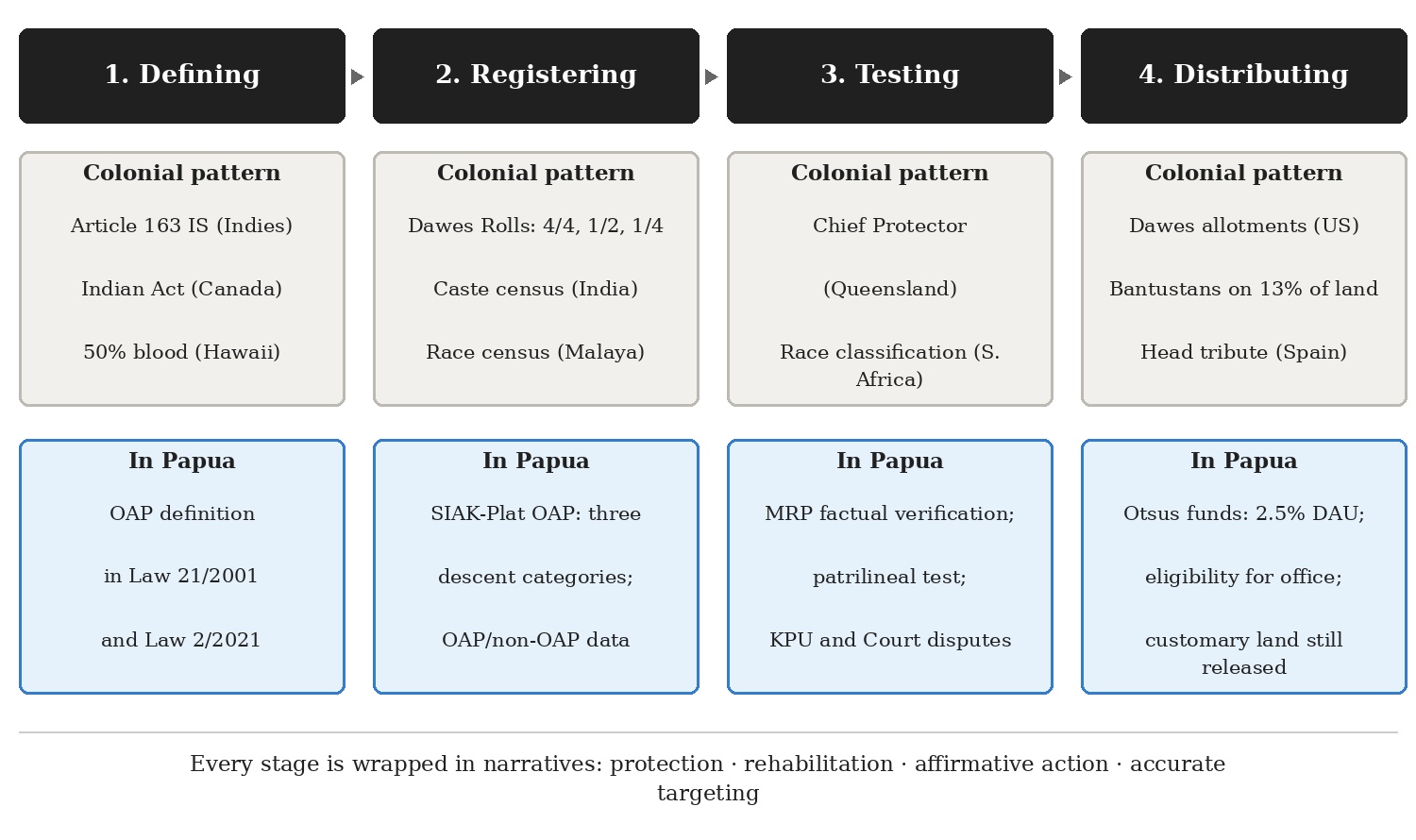
Figure 2. The definition machine: four stages of the colonial pattern and their counterparts in Papua
Source: compiled by the author based on the analysis in sections 4 and 5.
6. Papuans as Victims
6.1 The Authority of Indigenous Communities Is Taken Over
The first and most fundamental harm is the loss of indigenous communities’ authority to determine who their members are. Under customary law, indigenous status derives from descent, primarily through the paternal line, and each community recognises its children through clans, genealogies, and customary lands. This knowledge is safeguarded by hundreds of tribes, each with its own elders and customary institutions. When the state formulates a single definition, records it in SIAK, and entrusts its verification to the MRP, the KPU, and the Constitutional Court, decisions about membership move from customary houses to government offices. Article 33 of UNDRIP states that the right to determine identity and membership belongs to indigenous peoples themselves. The concept of OAP, in its implementation, reverses this principle.
The 2024 West Papua case shows that state institutions’ decisions about a person’s indigenous status can contradict the assessment of a customary council. The 2024 Southwest Papua case shows that even the MRP, an institution described as the cultural representation of Papuans, can be disregarded by electoral administrators. In both cases, indigenous communities do not have the final say on who is an indigenous Papuan.
6.2 Classified According to Degrees of Indigenous Status
The second harm is the division of Papuans according to degrees of indigenous status. The three descent categories in SIAK-Plat OAP create a hierarchy: those whose parents are both indigenous, those whose father is indigenous, and those whose mother is indigenous. The first and second levels are not recognised in customary law, because both are equally indigenous Papuans. The third category likewise does not originate in customary law, because, according to the paternal line, the child is not an indigenous Papuan. Consequently, indigenous status is no longer determined by customary law, but by a field in a database: the state can place people who are equally indigenous under customary law into a hierarchy, while also recording as OAP people who are not OAP under customary law. Coupled with tests of indigenous status whose criteria differ across MRPs, Papuans continue to be classified according to criteria that are not their own.
Kauanui (2008) explains the long-term consequences of this logic in Hawaii: each mixed marriage “dilutes” the number of people recognised, so that, from generation to generation, the legally recognised indigenous population continues to shrink, regardless of how many people actually live as Hawaiians. Changes in Papua’s population composition since Special Autonomy, resulting from migration and mixed marriages, have already become a subject of public debate (RMOL, 2026). If indigenous status is measured according to fractions of descent recorded by the state, it is only a matter of time before the number of state-recognised OAP shrinks on paper, and that decline is then used as evidence that Papuans are indeed a minority in their own land.
6.3 Conflict Among Papuans
The third harm is conflict among Papuans themselves. Regional head elections are now frequently accompanied by legal challenges over who is indigenous. In South Papua, a pair of candidates challenged their opponents before the Constitutional Court on the grounds that they were not OAP, and the challenge was declared inadmissible (Antara, 2025). In West Papua, the customary council confronted the West Papuan People’s Assembly. In Southwest Papua, the MRP confronted the KPU and reported it to the Election Supervisory Agency and the Election Organisers’ Honour Council (Akurat, 2024). Papuans’ political energy is consumed by testing one another’s indigenous status, while major decisions about land, the sea, and natural resources are made elsewhere.
Within Mamdani’s (2012) framework, this is one of the principal outcomes of define and rule: state-created categories redirect conflict from relations between rulers and the ruled towards conflict among the ruled. In Rwanda, the consequences were catastrophic. In Papua, the consequences are not yet as severe, but the logic points in the same direction.
6.4 Money Without Power over Customary Territories
The fourth harm is that the OAP category opens the door to funding, but not to power over customary territories, which encompass land, forests, rivers, lakes, the sea, air, and natural resources both above and within the earth. The release of forest areas is just one example. While special autonomy funds were being disbursed in the name of OAP, the Ministry of Forestry, through Ministerial Decree Number 591 of 2025, released almost 500 thousand hectares of forest areas in Papua, and customary rights holders were forced to protest through their legal representatives (Mongabay Indonesia, 2026). This pattern parallels the Bantustans in South Africa, where black people were granted “self-government” on 13 per cent of the land, and Hawaii, where land for “rehabilitation” was provided only to those who met the blood quantum threshold. The indigenous category provides access to funding on a scale determined by the state, while control over territories and their natural resources remains in the hands of the state.
Even special autonomy funding is uncertain. In the Draft State Budget for 2027, Papua’s special autonomy funding is planned at Rp16.8 trillion, down from Rp20.4 trillion in 2022 (Katadata, 2026). The category used to distribute these shrinking funds remains in place, complete with its entire apparatus of registration and verification.
7. Dismantling the Positive Narratives
The concept of OAP persists not because it is imposed through violence, but because it is accepted as something good. To expose its guise, the four most frequently advanced positive narratives must be confronted one by one.
7.1 “This is affirmative action”
The first narrative maintains that the definition of OAP is necessary for affirmative action: without a clear category, Papuans cannot be granted the privileges they need. This argument has a basis that must be acknowledged. Deborah Posel (2001), in her study of South Africa, notes that the racial categories that once underpinned apartheid discrimination subsequently became the basis for redress, because without those categories it was difficult to repair the damage they had caused.
However, affirmative action does not require the state to formulate its own definition and test the authenticity of individuals. Affirmative action can be implemented by entrusting the determination of membership to indigenous communities, with the state simply respecting the lists compiled by those communities. What happens in Papua is precisely the opposite: the state formulates its own criteria, records fractions of ancestry, and challenges community decisions. The case of Hawaii illustrates the danger of this kind of affirmative action. The 1921 Act was described as a programme of “rehabilitation”, but the 50 per cent blood threshold set by Congress meant that, from generation to generation, the programme excluded increasing numbers of the Hawaiians it was intended to rehabilitate (Kauanui, 2008). Malaya illustrates another danger: colonial categories transformed into categories for affirmative action instead perpetuate the racial divisions created by the colonisers.
The law binding on Indonesia itself sharpens this rebuttal in the form of a dilemma. If OAP rights are understood as special measures or affirmative action, then Article 1(4) of ICERD applies: those measures must be temporary and must not result in separate rights for different racial groups. The concept of OAP meets neither condition, because it attaches to ancestry indefinitely and forms the basis for separate political rights, such as the eligibility requirement for the office of governor. Conversely, if OAP rights are understood as permanent indigenous peoples’ rights, as distinguished in General Recommendation No. 32 (CERD, 2009), then Article 33 of UNDRIP applies: indigenous peoples themselves determine their identity and membership, rather than the state through legislation and bodies that test authenticity. The concept of OAP currently in force takes the aspect most favourable to the state from each framework: the permanent nature of indigenous peoples’ rights, but with definition and testing by the state. Under either framework, the way the state defines and tests OAP fails the test. This dilemma must not be read as a reason to abolish the rights of indigenous Papuans. On the contrary, it demonstrates that the proper basis for those rights is permanent indigenous peoples’ rights, rather than temporary affirmative action, and that, consequently, the determination of who is an indigenous Papuan must rest with customary authority. Table 3 summarises this assessment.
Table 3. The concept and practice of Indigenous Papuans assessed against standards recognised by Indonesia
| Standard | Core substance | OAP practice | Assessment |
|---|---|---|---|
| Article 28I(2) of the 1945 Constitution; Law 40/2008 | Everyone has the right to be free from discriminatory treatment on any grounds; racial and ethnic discrimination is eliminated | Classification of Papuans according to fractions of ancestry in state data | Not aligned |
| Article 1(4) of ICERD; Law 29/1999 (if OAP is interpreted as affirmative action) | Special measures are permitted if temporary and do not maintain separate rights | A permanent category, attached to ancestry, that becomes a requirement for office | Does not meet the conditions |
| Article 9 of UNDRIP; CERD, General Recommendation No. 8 | Membership follows community traditions and customs, without unilateral determination by the state | Authenticity is tested by the MRP, KPU, and Constitutional Court; SIAK categories do not follow customary practice | In conflict |
| Article 33 of UNDRIP (if OAP is interpreted as indigenous peoples’ rights) | Indigenous peoples determine their identity and membership | Definition derives from legislation; community decisions may be disregarded | In conflict |
| Presidential Instruction 26/1998; Article 6 of the Constitution (2001); Law 12/2006 | The state abandons distinctions between citizens according to indigenous origin | Indigenous origin continues to be used, recorded, and tested by the state specifically in Papua | Inconsistent |
Source: the author’s analysis based on the 1945 Constitution of the Republic of Indonesia, United Nations (1965, 2007), CERD (1990, 2009), Presidential Instruction No. 26 of 1998, and Law No. 12 of 2006.
7.2 “This is protection”
The second narrative maintains that the definition of OAP protects Papuans from marginalisation by migrants. The language of protection is, in fact, the language most characteristic of colonial projects. The laws that expelled mixed-descent Aboriginal people from their homes and separated children from their parents in Australia were called protection laws, and the officials who implemented them were called Chief Protectors. Swedish policies that excluded the majority of Sámi from recognition were justified as a way of protecting Sámi culture from outside influences. The Spanish Crown referred to Indians as protected persons while collecting tribute from them. The lesson is not that every policy of protection is necessarily evil, but that the label of protection proves nothing. What matters is who holds control. As long as the state determines who is protected, using criteria formulated by the state, that protection also means control.
7.3 “This was drafted by Papuans themselves”
The third narrative is the most difficult to refute, because it does have a historical basis. The Special Autonomy Law emerged in response to demands for independence that intensified after 1998, when Team 100 met President Habibie, followed by the Grand Assembly and the Second Papua Congress in 2000 (Suryawan, 2012). The bill was drafted by a team established by the rector of Cenderawasih University, discussed in forums in Jayapura, and unanimously supported by the Papua Regional House of Representatives (Inside Indonesia, n.d.). The protection of the basic rights of Papua’s indigenous population was indeed one of the principal points formulated by the Assistance Team established by the provincial government (Solossa, 2005; Muttaqin, n.d.). The figures involved emphasised that the law had been drafted by Papuans themselves in accordance with their wishes (Antara Papua, 2021).
These facts do not erase the colonial character of the concept of OAP, for three reasons. First, not all Papuans accepted the law from the outset. Critics note that the draft initiated by academics was immediately rejected by some Papuans, but was nevertheless imposed by the government together with academic institutions and local elites (Suara Papua, n.d.). In 2005, several customary leaders, together with thousands of Papuans, even symbolically returned Special Autonomy to the central government (NU Online, 2005). Second, the draft from Papua is not the law in force. The final say rests with the House of Representatives and the central government, and twenty years later, the 2021 revision and the Ministry of Home Affairs meetings in 2026 demonstrate that its interpretation and implementation remain controlled by Jakarta. Hawaii provides an apt comparison: Prince Kūhiō, the Hawaiian figure who championed the 1921 Act, wanted a blood quantum threshold of 1/32, but Congress set it at one-half (Kauanui, 2008). The involvement of indigenous figures in drafting does not mean that indigenous people have the final say.
Third, the involvement of indigenous elites is a common feature, rather than an exception, in colonial projects. The Bantustans in South Africa were administered by black elites who collaborated with the apartheid government. The indigenous administration studied by Mamdani in Africa relied on tribal chiefs appointed and empowered by colonial authorities. Li (2000) shows that better-educated and more economically advantaged groups are usually the quickest to occupy the “tribal slot” provided by the state. The fact that some Papuans participate in formulating and implementing the concept of OAP is entirely consistent with that pattern.
7.4 “Without a definition, funds are misdirected”
The fourth narrative is technocratic: without an accurate definition and data, special autonomy funds will benefit people who are not OAP. Concerns about misdirected funds are indeed real. But this problem need not be resolved through categories of ancestry formulated and recorded by the state. Lists of indigenous Papuans can be compiled by each indigenous community on the basis of clans and genealogies, according to lines of descent recognised by customary practice, and then respected by the state as the basis for disbursement. This approach is consistent with Article 33 of UNDRIP and with the direction of change in many countries noted by de Costa (2014). The choice to continue using categories of ancestry in SIAK demonstrates that what is being maintained is not merely accurate targeting, but state control over the definition.
Table 4 summarises these four narratives, what they conceal, and their parallels in colonial history.
Table 4. Positive narratives about the definition of Indigenous Papuans and their concealed aspects
| Positive narrative | What is concealed | Historical parallel |
|---|---|---|
| Affirmative action for Papuans | The state formulates its own criteria and records fractions of ancestry | “Rehabilitation” with a 50 per cent blood threshold in Hawaii |
| Protection from marginalisation | Protection means state control over who is protected | Aboriginal protection laws; “Lapps must remain Lapps” |
| Drafted by Papuans themselves | The final say rests with the House of Representatives and the central government; local elites act as implementers | Kūhiō and the US Congress; Bantustan elites |
| Ensuring that funds reach their intended recipients | Control over the definition is maintained; customary territories remain under state control | Dawes allotments; Bantustans on 13 per cent of the land |
Source: the author’s analysis based on the discussion in sections 4 to 7.
8. Conclusions and Recommendations
8.1 Conclusions
This study yields three conclusions that align with the three propositions set out at the beginning and simultaneously answer the four research questions.
First, the state definition of indigenous populations is a long-standing and widespread colonial project. Before Papua, this apparatus had already been employed by Spain in the Americas from the sixteenth century onwards, Canada and the United States against indigenous nations, France in Algeria, Belgium in Rwanda, South Africa during apartheid, the Netherlands in the Indies, Britain in India and Malaya, Australia against Aboriginal people, the United States in Hawaii, and Sweden against the Sámi. Its elements recur: the state establishes the definition, the criteria are formulated according to the interests of those in power rather than community rules, there are mechanisms for registration and testing, categories are linked to resources, and all of this is justified through the language of protection.
Second, Indonesia continues this project in Papua. The state that discontinued the use of the terms indigenous and non-indigenous throughout the country in 1998 has instead made the distinction between indigenous and non-indigenous the axis of policy in Papua. The statutory definition of OAP, the three categories of descent in SIAK, verification of indigeneity by the MRP, and the use of the OAP category as a gateway to special autonomy funding are direct equivalents of the colonial mechanisms discussed. What is colonial is not the fact that indigenous Papuans are of the Melanesian race, but rather a definition formulated according to the interests of state integration, politics, budgeting, and surveillance, which is made into an instrument for testing individuals and separated from rights to customary territories. Assessed against the standards recognised by Indonesia itself, namely the 1945 Constitution, ICERD, and UNDRIP, the state's approach to defining and testing OAP fails, whether understood as affirmative action or as the rights of indigenous peoples. The rights of indigenous Papuans themselves are legitimate, and their appropriate foundation is the right of indigenous peoples to identity, customary territories, and governance in their own lands.
Third, Papuans become victims of this project. Indigenous communities lose the authority to determine their membership. Papuans are classified according to degrees of indigeneity using state criteria that are sometimes narrower and sometimes broader than customary criteria. Conflicts over indigeneity drain Papuans' political energy. And the category that opens the door to funding does not open the door to power over customary territories and their natural resources, which continue to be relinquished and controlled by the state. These adverse aspects remain obscured because they are wrapped in narratives of affirmative action, protection, participation, and accurate targeting—narratives that, in colonial history, have in fact been the most common wrapping.
8.2 Recommendations
On the basis of these conclusions, this study proposes the following seven recommendations:
-
The DPR and the government need to reformulate the definition of OAP in the Special Autonomy Law according to customary criteria, namely persons whose father and mother, or whose father, originate from the Melanesian racial group comprising the indigenous peoples of the Land of Papua, entrust its assessment to customary institutions, and affirm that the Land of Papua belongs to the indigenous peoples of Papua, so that no other racial group can claim ownership of it. Thus, the law would merely recognise customary facts and rules, rather than create a definition according to state interests.
-
The determination of who is an indigenous Papuan and who is a member of an indigenous community must be returned entirely to the indigenous community concerned, in accordance with its customary rules, which generally trace indigeneity through the paternal line, in line with Article 33 of UNDRIP (Perserikatan Bangsa-Bangsa, 2007) and the principle of collective self-identification in ILO Convention 169 (International Labour Organization, 1989). The state need only record and respect the community's decisions.
-
The Ministry of Home Affairs and local governments need to discontinue the recording of fractions of descent in SIAK and similar data collection systems, because such categories risk being used to reduce the number of recognised Papuans and divide Papuans according to degrees of indigeneity.
-
The role of the MRP in regional head elections needs to be changed from testing indigeneity to guaranteeing that the decisions of indigenous communities are respected, so that the MRP stands alongside communities, rather than above them.
-
Affirmative action needs to be directed towards the collective rights of indigenous peoples over the entirety of their customary territories, namely land, forests, rivers, lakes, seas, air, and natural resources, including free, prior and informed consent before any relinquishment, granting of permits, or use of customary territories, rather than merely towards funding whose amount is determined by the central government.
-
Universities, churches, customary councils, and civil society organisations in Papua need to initiate public discussions about the history of colonial classification, so that Papuans can assess the concept of OAP for themselves with comprehensive knowledge.
-
The Indonesian government needs to ratify ILO Convention 169 and make the principle of self-determination of identity a guide for every policy concerning indigenous peoples, both in Papua and throughout Indonesia.
Papuans do not need the state to tell them who they are. They already know, and knew long before any state arrived bearing forms. What they need is a state that stops taking over the answer to that question.
References
AFU.ID. (2026a, 12 September). Polemik panas Natalius Pigai vs Kemendagri soal penentuan definisi administratif Orang Asli Papua (OAP). https://afu.id/nasional/polemik-panas-natalius-pigai-vs-kemendagri-soal-penentuan-definisi-administratif-orang-asli-papua-oap
AFU.ID. (2026b, 12 September). Clear dapat penjelasan dari Mendagri Tito Karnavian, Menteri HAM Natalius Pigai tak lanjutkan polemik definisi Orang Asli Papua (OAP). https://afu.id/nasional/clear-dapat-penjelasan-dari-mendagri-tito-karnavian-menteri-ham-natalius-pigai-tak-lanjutkan-polemik-definisi-orang-asli-papua-oap
Akurat. (2024). Laporan MRP PBD diterima, Bawaslu segera panggil Mochammad Afifuddin dan Idham Kholik. https://www.akurat.co/politik/1305154712/laporan-mrp-pbd-diterima-bawaslu-segera-panggil-mochammad-afifuddin-dan-idham-kholik
Akurat. (2026a). Kemendagri: Rencana pendefinisian ulang OAP itu hoaks. https://akurat.co/nasional/889910/kemendagri-rencana-pendefinisian-ulang-oap-itu-hoaks
Akurat. (2026b). Pemerintah bantah anggapan orang asli Papua jadi minoritas. https://akurat.co/daerah/860735/pemerintah-bantah-anggapan-orang-asli-papua-jadi-minoritas
Anderson, B. (2006). Imagined communities: Reflections on the origin and spread of nationalism (Edisi revisi). Verso.
Antara. (2024). MK diminta diskualifikasi dua paslon Pilkada Papsel diduga bukan OAP. https://www.antaranews.com/berita/4588510/mk-diminta-diskualifikasi-dua-paslon-pilkada-papsel-diduga-bukan-oap
Antara. (2025). Sengketa Pilkada Papua Selatan soal polemik OAP kandas. https://www.antaranews.com/berita/4628597/sengketa-pilkada-papua-selatan-soal-polemik-oap-kandas
Antara Papua. (2021). Tokoh: Kemajuan di Papua 20 tahun hasil kebijakan Otsus. https://papua.antaranews.com/berita/643442/tokoh-kemajuan-di-papua-20-tahun-hasil-kebijakan-otsus
Antara Papua Barat. (2024a). MRPB nyatakan DoaMu penuhi syarat cagub-cawagub asli Papua. https://papuabarat.antaranews.com/berita/51423/mrpb-nyatakan-doamu-penuhi-syarat-cagub-cawagub-asli-papua
Antara Papua Barat. (2024b). MRP: Dua paslon gubernur-wagub benar-benar asli Papua. https://papuabarat.antaranews.com/berita/51771/mrp-dua-paslon-gubernur-wagub-benar-benar-asli-papua
Antara Papua Barat. (2024c). KPU sebut syarat keaslian cawagub orang Papua dari MRPB sudah final. https://papuabarat.antaranews.com/berita/52135/kpu-sebut-syarat-keaslian-cawagub-orang-papua-dari-mrpb-sudah-final
Antara Papua Barat. (t.t.). Dukcapil Papua Barat target pendataan OAP rampung pada Maret 2025. https://papuabarat.antaranews.com/berita/55975/dukcapil-papua-barat-target-pendataan-oap-rampung-pada-maret-2025
Broome, R. (2005). Aboriginal Victorians: A history since 1800. Allen & Unwin.
CNN Indonesia. (2026, 28 Mei). Wamen Ribka ungkap tantangan rekam KTP jutaan OAP: Takut dimata-matain. https://cnnindonesia.com/nasional/20260528151833-20-1363132/wamen-ribka-ungkap-tantangan-rekam-ktp-jutaan-oap-takut-dimata-matain
Committee on the Elimination of Racial Discrimination. (1990). General recommendation VIII concerning the interpretation and application of article 1, paragraphs 1 and 4 of the Convention (A/45/18). https://hrlibrary.umn.edu/gencomm/genrviii.htm
Committee on the Elimination of Racial Discrimination. (2009). General recommendation no. 32: The meaning and scope of special measures in the International Convention on the Elimination of All Forms of Racial Discrimination (CERD/C/GC/32). https://digitallibrary.un.org/record/667786
de Costa, R. (2014). Descent, culture, and self-determination: States and the definition of indigenous peoples. aboriginal policy studies, 3(3), 55–85. https://doi.org/10.5663/aps.v3i3.22227
Detik. (2016). Presiden Indonesia asli? [Kolom]. https://news.detik.com/kolom/d-3319583/presiden-indonesia-asli
Dewandaru, H. K., Prananingtyas, P., & Prasetyo, M. H. (2020). Pelaksanaan pembagian waris dalam sistem kewarisan patrilineal menurut masyarakat Timika, Papua. Notarius, 13(2), 493–503. https://doi.org/10.14710/nts.v13i2.30884
Dirks, N. B. (2001). Castes of mind: Colonialism and the making of modern India. Princeton University Press.
Encyclopaedia Britannica. (t.t.). Bantustan. https://www.britannica.com/place/Bantustan
Fasseur, C. (1994). Cornerstone and stumbling block: Racial classification and the late colonial state in Indonesia. Dalam R. Cribb (Ed.), The late colonial state in Indonesia: Political and economic foundations of the Netherlands Indies, 1880–1942 (hlm. 31–56). KITLV Press.
Find & Connect. (t.t.). The Aborigines Protection Act 1886 (1887–1890). https://findandconnect.gov.au/guide/vic/E000432
Hawaiian Homes Commission Act, 1920, ch. 42, 42 Stat. 108 (1921). https://doi.gov/sites/doi.gov/files/uploads/Act-of-July-9-1921-42-Stat-108.pdf
Hirschman, C. (1986). The making of race in colonial Malaya: Political economy and racial ideology. Sociological Forum, 1(2), 330–361. https://doi.org/10.1007/BF01115742
Hirschman, C. (1987). The meaning and measurement of ethnicity in Malaysia: An analysis of census classifications. The Journal of Asian Studies, 46(3), 555–582.
Human Rights and Equal Opportunity Commission. (1997). Bringing them home: Report of the National Inquiry into the Separation of Aboriginal and Torres Strait Islander Children from Their Families. https://humanrights.gov.au/our-work/projects/bringing-them-home-chapter-4
IDN Times. (2026). Wamendagri klarifikasi soal beda jumlah OAP di SIAK dengan DKB. https://www.idntimes.com/news/indonesia/wamendagri-klarifikasi-soal-beda-jumlah-oap-di-siak-dengan-dkb-00-jkxzp-j9jpry
InfoPublik. (2026a). Capaian pendataan SIRIOS 29,8 persen, Bupati Merauke tekankan validitas data. https://infopublik.id/kategori/nusantara/991709/capaian-pendataan-sirios-298-persen-bupati-merauke-tekankan-validitas-data
InfoPublik. (2026b, 19 November). Pemkab Raja Ampat kembangkan Sioraja untuk perkuat pendataan OAP. https://infopublik.id/kategori/nusantara/997983/pemkab-raja-ampat-kembangkan-sioraja-untuk-perkuat-pendataan-oap
Inside Indonesia. (t.t.). Inside the special autonomy bill. https://www.insideindonesia.org/archive/articles/inside-the-special-autonomy-bill-2400
International Labour Organization. (1989). Indigenous and Tribal Peoples Convention, 1989 (No. 169). https://un.arizona.edu/convention-no-169-concerning-indigenous-and-tribal-peoples-independent-countries-1989
Investortrust. (2026). Wacana perihal orang asli Papua. https://investortrust.id/national/115961/wacana-perihal-orang-asli-papua
JURIST. (2025, November). Human rights experts urge Indonesia to formally recognize Indigenous peoples' rights. https://www.jurist.org/news/2025/11/human-rights-experts-call-for-indonesia-to-formally-recognize-its-indigenous-peoples/
Kabutaulaka, T. (2015). Re-presenting Melanesia: Ignoble savages and Melanesian alter-natives. The Contemporary Pacific, 27(1), 110–145. https://doi.org/10.1353/cp.2015.0027
Kadir, A. (2024). Wearing koteka in public spaces: A symbol of the hardened cultural identity in Papua. Dalam Proceedings of the 2nd International Conference on Democracy and Social Transformation (ICON-DEMOST 2023). Atlantis Press. https://doi.org/10.2991/978-2-38476-174-6_7
Katadata. (2026, 14 September). Mendagri jelaskan alasan rencana pendefinisian orang asli Papua. https://katadata.co.id/berita/nasional/6aa7c8795868e/mendagri-jelaskan-alasan-rencana-pendefinisian-orang-asli-papua
Katzew, I. (2004). Casta painting: Images of race in eighteenth-century Mexico. Yale University Press.
Kauanui, J. K. (2008). Hawaiian blood: Colonialism and the politics of sovereignty and indigeneity. Duke University Press.
Kidd, R. (2006). Trustees on trial: Recovering the stolen wages. Aboriginal Studies Press.
Lantto, P., & Mörkenstam, U. (2008). Sami rights and Sami challenges: The modernization process and the Swedish Sami movement, 1886–2006. Scandinavian Journal of History, 33(1), 26–51.
Lawrence, B. (2003). Gender, race, and the regulation of Native identity in Canada and the United States: An overview. Hypatia, 18(2), 3–31. https://muse.jhu.edu/article/44188
Li, T. M. (2000). Articulating indigenous identity in Indonesia: Resource politics and the tribal slot. Comparative Studies in Society and History, 42(1), 149–179. https://doi.org/10.1017/S0010417500002632
Longman, T. (2001). Identity cards, ethnic self-perception, and genocide in Rwanda. Dalam J. Caplan & J. Torpey (Ed.), Documenting individual identity: The development of state practices in the modern world (hlm. 345–357). Princeton University Press.
Mamdani, M. (2012). Define and rule: Native as political identity. Harvard University Press.
Manceron, G. (2003). Marianne et les colonies: Une introduction à l’histoire coloniale de la France. La Découverte.
Mansoben, J. R. (1995). Sistem politik tradisional di Irian Jaya (Seri LIPI-RUL No. 5). Lembaga Ilmu Pengetahuan Indonesia dan Rijksuniversiteit Leiden. https://papuaerfgoed.org/sites/default/files/collectie/files/2004-01/Mansoben_1995_Sistem.pdf
Martínez, M. E. (2008). Genealogical fictions: Limpieza de sangre, religion, and gender in colonial Mexico. Stanford University Press.
Merdeka. (2026). Wamendagri Ribka Haluk: Data OAP jadi dasar kebijakan kesejahteraan hingga penyaluran dana Otsus Papua. https://www.merdeka.com/peristiwa/read/8111049/wamendagri-ribka-haluk-data-oap-jadi-dasar-kebijakan-kesejahteraan-hingga-penyaluran-dana-otsus-papua
Merle, I. (2002). Retour sur le régime de l’indigénat: Genèse et contradictions des principes répressifs dans l’empire français. French Politics, Culture & Society, 20(2), 77–97.
Michigan State University. (t.t.). Bantustans. Overcoming Apartheid. https://overcomingapartheid.msu.edu/multimedia/kid=163-582-19/
Minority Rights Group International. (2018). World directory of minorities and indigenous peoples: Sweden, Sami. https://www.refworld.org/reference/countryrep/mrgi/2018/en/121780
Mongabay Indonesia. (2026, 27 Maret). Kala masyarakat adat Papua protes pelepasan hampir 500 ribu hektar kawasan hutan. https://mongabay.co.id/2026/03/27/kala-masyarakat-adat-papua-protes-pelepasan-hampir-500-ribu-hektar-kawasan-hutan/
Muttaqin, A. (t.t.). Otonomi khusus Papua: Sebuah upaya merespon konflik dan aspirasi kemerdekaan Papua. Politika: Jurnal Ilmu Politik. https://ejournal.undip.ac.id/index.php/politika/article/download/6064/5172
National Archives and Records Administration. (t.t.). Dawes records: Five Civilized Tribes. https://archives.gov/research/native-americans/dawes
Nauw, M., Ali, M., Hasriyanti, H., & Lestaluhu, R. (2025). Settlement of inheritance distribution according to Mare customary law in Maybrat Regency. Journal of Law Justice, 3(3), 202–212. https://doi.org/10.33506/jlj.v3i3.4399
NU Online. (2005, 15 Agustus). Pemerintah harus konsisten implementasikan Otsus Papua. https://nu.or.id/warta/pemerintah-harus-konsisten-implementasikan-otsus-papua-kDIHd
Okezone. (2026, 14 September). Mendagri Tito luruskan rencana pendefinisian orang asli Papua: Amanat RUU Otsus. RCTI+. https://www.rctiplus.com/news/detail/nasional/5472617/mendagri-tito-luruskan-rencana-pendefinisian-orang-asli-papua--amanat-ruu-otsus
Oklahoma Historical Society. (t.t.). Dawes Rolls: Blood quantum, freedmen, intermarriage, and adopted citizens. https://www.okhistory.org/research/dawes
Perserikatan Bangsa-Bangsa. (1965). Konvensi Internasional tentang Penghapusan Segala Bentuk Diskriminasi Rasial (Resolusi Majelis Umum 2106 A (XX)).
Perserikatan Bangsa-Bangsa. (2007). Deklarasi Perserikatan Bangsa-Bangsa tentang Hak-Hak Masyarakat Adat (Resolusi Majelis Umum 61/295).
Posel, D. (2001). What’s in a name? Racial categorisations under apartheid and their afterlife. Transformation, 47, 50–74.
REDD-Monitor. (2012, 3 Oktober). Indonesia treats its indigenous peoples “worse than any other country in the world” – Survival International. https://redd-monitor.org/2012/10/03/indonesia-treats-its-indigenous-peoples-worse-than-any-other-country-in-the-world-survival-international/
RMOL. (2024, 18 September). Pemuda Katolik minta rekomendasi MRP didengar. https://rmol.id/politik/read/2024/09/18/637312/pemuda-katolik-minta-rekomendasi-mrp-didengar
RMOL. (2026, 16 September). Membaca demografi Papua dan pentingnya merawat kebersamaan. https://rmol.id/read/2026/09/16/721870/membaca-demografi-papua-dan-pentingnya-merawat-kebersamaan
RRI. (2026, 29 Juli). Disdukcapil Papua Barat perkuat pendataan OAP melalui SIAK-Plat OAP. https://rri.co.id/manokwari/regional/2608885/disdukcapil-papua-barat-perkuat-pendataan-oap-melalui-siak-plat-oap
Singapore Management University. (2016, 30 Juni). Census-taking in Malaysia: Bumiputera, non-Bumiputera and the NEP. https://ccx.smu.edu.sg/perspectives/articles/census-taking-malaysia-bumiputera-non-bumiputera-and-nep
Solossa, J. P. (2005). Otonomi khusus Papua: Mengangkat martabat rakyat Papua di dalam NKRI. Pustaka Sinar Harapan.
Sturm, C. (2002). Blood politics: Race, culture, and identity in the Cherokee Nation of Oklahoma. University of California Press.
Suara Papua. (t.t.). Otsus Papua dan borjuasi lokal [Opini]. https://suarapapua.com/?p=63744
Summerhayes, G. R., Leavesley, M., Fairbairn, A., Mandui, H., Field, J., Ford, A., & Fullagar, R. (2010). Human adaptation and plant use in highland New Guinea 49,000 to 44,000 years ago. Science, 330(6000), 78–81. https://doi.org/10.1126/science.1193130
Suryawan, I. N. (2012). Dari memoria passionis ke FORERI: Sejarah politik Papua 1999–2000. Paramita, 22(2). https://journal.unnes.ac.id/nju/paramita/article/download/2116/2218
The Canadian Encyclopedia. (t.t.). Indian status. https://thecanadianencyclopedia.ca/en/article/indian-status
Vervust, P. (2012). The relative importance of ethnicity, class and race in colonial Rwanda. Journal of Belgian History, 42(4), 74–109. https://journalbelgianhistory.be/nl/system/files/article_pdf/Vervust_Petra_2012_4.pdf
Winarta, F. H. (2008). No more discrimination against the Chinese. Dalam L. Suryadinata (Ed.), Ethnic Chinese in contemporary Indonesia (hlm. 57–74). ISEAS.
Wolfe, P. (2006). Settler colonialism and the elimination of the native. Journal of Genocide Research, 8(4), 387–409. https://doi.org/10.1080/14623520601056240
Undang-Undang Dasar Negara Republik Indonesia Tahun 1945, sebagaimana telah diubah dengan Perubahan Ketiga (9 November 2001).
Instruksi Presiden Nomor 26 Tahun 1998 tentang Menghentikan Penggunaan Istilah Pribumi dan Non Pribumi.
Putusan Mahkamah Konstitusi Nomor 29/PUU-IX/2011.
Putusan Mahkamah Konstitusi Nomor 41/PUU-XXII/2024.
Undang-Undang Nomor 29 Tahun 1999 tentang Pengesahan Konvensi Internasional tentang Penghapusan Segala Bentuk Diskriminasi Rasial 1965.
Undang-Undang Nomor 21 Tahun 2001 tentang Otonomi Khusus bagi Provinsi Papua.
Undang-Undang Nomor 12 Tahun 2006 tentang Kewarganegaraan Republik Indonesia.
Undang-Undang Nomor 40 Tahun 2008 tentang Penghapusan Diskriminasi Ras dan Etnis.
Undang-Undang Nomor 2 Tahun 2021 tentang Perubahan Kedua atas Undang-Undang Nomor 21 Tahun 2001 tentang Otonomi Khusus bagi Provinsi Papua.
How to cite
Dumupa, Y. (2026). Defining Indigenous Papuans: A colonial project disguised as affirmative action [Scholarly article]. Yakobus Dumupa. https://yakobusdumupa.com/kajian/pendefinisian-orang-asli-papua?lang=en

About the Author
Yakobus Dumupa
Writer, organic intellectual and activist from the Land of Papua, with an educational background in political science, government and anthropology. He served as a member of the Papuan People's Assembly (2012–2016) and as Regent of Dogiyai (2017–2022), and has written dozens of books and hundreds of articles.
Read biography