Scholarly Article
The State Stands on Customary Land: Indigenous Consent as the Limit of State Authority
Contents
Contents
Abstrak
Kajian ini membela satu pendirian: atas tanah adat, masyarakat adat lebih berhak daripada negara karena hak mereka lebih tua dan menjadi alas tempat negara didirikan. Dengan metode kepustakaan dan pendekatan yuridis-normatif, historis, dan perbandingan, kajian ini membaca konstitusi, putusan Mahkamah Konstitusi, UU Otonomi Khusus Papua, standar hukum internasional, putusan pengadilan negara lain, dan data wilayah adat sampai November 2026. Temuannya, hukum Indonesia sendiri memisahkan hak milik masyarakat adat dari wewenang negara untuk mengatur. Negara tidak memberi hak ulayat, melainkan mengakuinya, dan wewenang menguasai menurut Mahkamah Konstitusi tidak memuat fungsi memiliki. Pasal 43 ayat (4) UU Otsus Papua mensyaratkan musyawarah untuk mencapai kesepakatan bagi penyediaan tanah adat untuk keperluan apa pun. Dari situ kajian ini merumuskan prinsip mengatur dengan memohon: negara boleh mengatur, tetapi hanya dengan memohon kepada pemilik adat, dan tanpa restu serta izin mereka tidak ada pelepasan atau izin yang sah. Kasus Merauke dan Boven Digoel menunjukkan bahwa prinsip ini belum dijalankan. Kajian ini mengusulkan agar prinsip itu dikunci dalam RUU Masyarakat Adat dan revisi UU Pengadaan Tanah, dan agar tanah adat yang diambil tanpa persetujuan dikembalikan kepada pemiliknya.
Kata kunci: hak ulayat, hak menguasai negara, persetujuan bebas didahulukan dan diinformasikan, masyarakat hukum adat, Otonomi Khusus Papua, pengadaan tanah
Abstract
This study defends one position: over customary land, Indigenous peoples hold a stronger right than the state, because their right is older and is the ground on which the state was founded. Using library research with normative, historical, and comparative approaches, it examines the constitution, Constitutional Court rulings, the Papua Special Autonomy Law, international standards, foreign court decisions, and customary-territory data up to November 2026. Indonesian law itself separates the community’s ownership from the state’s authority to regulate. The state does not grant customary rights; it recognises them, and the Court’s reading of state control contains no function of owning. Article 43(4) of the Special Autonomy Law requires deliberation to reach agreement before customary land is provided for any purpose. From this the study derives the principle of regulating by asking: the state may regulate only by asking the customary owners, and without their consent no release or permit is valid. The Merauke and Boven Digoel cases show this principle is not yet practised. The study proposes locking it into the Indigenous Peoples Bill and a revision of the Land Acquisition Law, and returning customary land taken without consent to its owners.
Keywords: customary land rights, state control, free prior and informed consent, customary law communities, Papua Special Autonomy, land acquisition
1. Introduction
Rufina Gebze lives in Onggari Village, Malind District, Merauke. Her clan’s land falls within the concession map of a sugarcane plantation that is part of the food and energy National Strategic Project (PSN). Since 2024 she and her husband, Vincen Kwipalo, have rejected the company’s activities on that land, and their stance has not changed despite repeated pressure. She told journalists that she would not give up “a single inch of land” (Mongabay Indonesia, 2026c). On paper, Rufina’s refusal is backed by many rules. The constitution recognises the traditional rights of Indigenous peoples, the Papua Special Autonomy Law obliges the government to protect customary land rights, and the Constitutional Court has declared that customary forests are not state forests. On the ground, the concession map was drawn before the owners of the land were ever asked.
The gap between rule and reality conceals a question more fundamental than one of procedure. Who in fact holds the stronger right to customary land: the Indigenous peoples who have inhabited it for generations, or the state that claims authority to control the earth, the water and natural resources? This question is often answered with a vague compromise. Indigenous peoples are deemed to hold rights “as long as they still exist” and “as long as they do not conflict with the national interest”, while the state is deemed to hold authority “for the prosperity of the people”. Such a compromise never explains what happens when the two claims collide, that is, when the state wants a plot of land and its customary owners say no.
This study takes a firm position. Indigenous peoples hold a stronger right to customary land than the state, because the Indonesian state was founded on land that was already owned and governed by customary communities. Their right came first and does not derive from the state. The state is indeed given authority to regulate, but that authority is public in nature, not ownership, and the way it is exercised over land that already has owners is by asking, not by commanding. As long as Indigenous peoples have not given their blessing and permission, the state cannot impose any release, acquisition or permit on customary land. This is what this study calls the principle of regulating by asking.
This position does not start from a vacuum. The agrarian-law literature has long recorded the tension between the state’s right of control and customary land rights (Arizona, 2022; Bedner & Arizona, 2019). Studies of Constitutional Court Decision No. 35/PUU-X/2012 show that the law can shift towards stronger protection (Tobroni, 2013). Internationally, the debate on free, prior and informed consent (FPIC) has continued since the UN Declaration on the Rights of Indigenous Peoples was adopted in 2007 (Barelli, 2012). What has seldom been done is to weave these materials into a single, coherent argument that begins with the history of the state’s founding and ends with a clear limit on state authority, with Tanah Papua as its testing ground.
To that end, this study answers three questions. What is the historical and legal basis for the claim that Indigenous peoples’ right to their land is older and more fundamental than the authority of the state? How do Indonesian law and international law limit state authority when it confronts customary land, particularly through the requirement of consent? And to what extent did practice in Tanah Papua in 2024–2026 respect or violate that limit? One point must be stressed from the outset. This study is about land rights, not sovereignty. The claim that Indigenous peoples hold a stronger right to their customary land is not the same as a claim that the state is not sovereign over its territory. This distinction is not mere caution. As sections 5 and 7 will show, it is precisely this distinction that makes the argument legally strong.
2. Method and Framework
2.1 Materials and approach
This study is entirely library-based research. Its primary legal materials are the 1945 Constitution together with the Elucidation of Article 18 of the original text, the 1960 Basic Agrarian Law, the Papua Special Autonomy Law and its amendment, the Human Rights Law, the Land Acquisition Law, and three Constitutional Court decisions. Its international materials include the UN Declaration on the Rights of Indigenous Peoples (UNDRIP), General Recommendation 23 of the Committee on the Elimination of Racial Discrimination (CERD), reports of UN Special Rapporteurs, and decisions of the Inter-American Court of Human Rights, the Supreme Court of Canada and the High Court of Australia. Its secondary materials are journal articles, dissertations, institutional reports and media coverage of cases in Tanah Papua. Customary-territory data are taken from the Customary Territory Registration Agency (BRWA), March and August 2026 editions.
These materials are read through three approaches. A normative-juridical approach is used to interpret the texts of regulations and rulings. A historical approach is used to trace the origins of the state’s claim to land. A comparative approach is used to see how courts in other countries have resolved similar conflicts. The Papuan cases are not treated as a sample representing all of Indonesia. They were chosen because in Papua the protection of customary land rights is most explicit on paper, so the gap between norm and practice is easiest to measure.
Its limitations should be stated. This study uses no fieldwork data of its own, and its account of the cases relies on traceable institutional and media reports. The study is also prescriptive and openly sides with Indigenous peoples as the owners of the land. That partiality does not reduce its rigour. Precisely because it takes a side, every claim in this study must rest on verifiable sources, so that the defence of Indigenous peoples cannot easily be broken. At several points, especially regarding the absolute nature of the consent requirement, the study does not merely describe the law as it stands but argues for the law as it ought to be. Those passages are clearly marked.
2.2 Three distinctions
The argument of this study rests on three conceptual distinctions.
The first distinction is between right and authority. Ownership is a relationship between a subject and a thing, giving the owner the power to use, enjoy and determine the fate of that thing. Public authority is a mandate given by the people to the state to regulate common life, and it is bound to specific purposes. A state that holds authority does not automatically become the owner of what it regulates. A traffic officer regulates the road but does not own the cars that pass along it. The second distinction is between declaratory and constitutive recognition. Constitutive recognition creates a right that did not previously exist. Declaratory recognition merely affirms a right that already exists. If the state’s recognition of customary land rights is declaratory, customary land not yet designated by regional regulation remains customary land, not state land waiting to be handed out.
The third distinction is between consultation and consent. Consultation means the state listens and then decides on its own. Consent means the decision lies in the hands of those who are asked. Many rules and practices in Indonesia stop at consultation, often only in the form of “socialisation” briefings. This study argues that for customary land, what is required is consent.
The three distinctions are interlinked. If Indigenous peoples hold the right and the state holds only authority, and if the state’s recognition merely affirms an existing right, then with respect to customary land the state stands as a party that must ask, not a party entitled to decide. Consent becomes the meeting point between the state’s authority and the owner’s right.
3. Older than the Republic
3.1 Domein verklaring and resistance to it
The claim that uncertified land belongs to the state does not come from the legal traditions of the archipelago. It was born of colonial policy. In 1870 the Netherlands Indies government enacted the Agrarische Wet and the Agrarisch Besluit to open the colony to private plantation capital. Article 1 of the Agrarisch Besluit contained the domein verklaring, the declaration that all land that could not be proven to be eigendom became the domain of the state (Neilson, 2020; RRI, 2025). Under that formula, customary land held under customary law and not recorded in the Western system was considered ownerless, and could then be leased to entrepreneurs.
Resistance to this logic also came from within colonial academia. Cornelis van Vollenhoven of Leiden University opposed the domein verklaring because it ignored beschikkingsrecht, the right of a customary community to control and regulate land within its territory, later known as hak ulayat. For van Vollenhoven, that right was an original right that existed before the colonial government arrived. Leiden legal scholars brought customary law growing recognition towards the end of the colonial era, although customary rights later suffered setbacks after independence (Neilson, 2020).
3.2 Recognition by the nation’s founders
When the Republic was founded in 1945, the drafters of the constitution did not proceed from the assumption that Indonesia’s territory was empty land. The Elucidation of Article 18 of the original 1945 Constitution recorded that within the state’s territory there were “approximately 250 zelfbesturende landschappen and volksgemeenschappen”, such as the desa in Java and Bali, the nagari in Minangkabau, and the dusun and marga in Palembang. These areas were said to have their own original structures, and the state declared that it would respect their position and bear in mind their rights of origin in every regulation (Elucidation of Law No. 6 of 2014). That formulation matters because it was made by the nation’s founders themselves. They acknowledged that the Republic was born on top of hundreds of communities that already had their own governments, laws and territories. The state did not create those communities. The state came later, stood upon them, and promised to respect them. This study’s premise, that the state was founded on the land of Indigenous peoples, is not merely a moral claim. It is written in the Republic’s first constitutional document.
Fifteen years later, the 1960 Basic Agrarian Law (UUPA) revoked the Agrarische Wet together with all provisions of the domein verklaring. The law also declared that national agrarian law is based on customary law (UUPA, official translation). The General Elucidation of the UUPA even affirmed that it is neither necessary nor appropriate for the state to act as the owner of land. It is sufficient for the state to stand as a governing body that regulates. Article 3 of the UUPA recognises customary land rights insofar as they in fact still exist and their exercise accords with the national interest.
Formally, then, the Indonesian state has refused since 1960 to be the owner of land. The problem is that the logic of the domein verklaring did not die with the revoked article. Kompas has noted that the concept lives on in practice and is a source of widespread land conflict (Kompas.id, 2020). Neilson (2020) shows that after independence, Article 33 of the 1945 Constitution, the UUPA and the 1967 Basic Forestry Law were in fact used to strengthen state control over land. Whenever uncertified customary land is treated as state land, what is at work is what may be called a disguised domein verklaring: the article has been revoked, but its way of thinking is still in use. Table 1 summarises that historical trail together with later developments.
Table 1. Historical trail of claims to customary land
| Year | Event | Meaning for Indigenous peoples’ rights |
|---|---|---|
| 1870 | Agrarisch Besluit contains the domein verklaring: land without proof of eigendom becomes state domain | The “state land” claim is rooted in colonial policy |
| Early 20th century | Van Vollenhoven opposes the domein verklaring | Customary land rights recognised as original rights |
| 1945 | Elucidation of Article 18 of the 1945 Constitution records some 250 communities with original structures | Customary communities existed before the Republic |
| 1960 | UUPA revokes the domein verklaring and rejects the state as landowner | The state chooses to be regulator, not owner |
| 1963 | Indonesian administration begins in Tanah Papua | The state arrives in a territory that already has owners |
| 1999 | First Congress of the Indigenous Peoples of the Archipelago | State legitimacy linked to recognition of Indigenous peoples |
| 2001 | Article 43 of the Papua Special Autonomy Law requires deliberation to reach agreement | The consent requirement enters statute |
| 2013 | Constitutional Court Decision 35/PUU-X/2012: customary forests are not state forests | The Court corrects the state’s claim over customary territories |
Source: compiled from Neilson (2020); RRI (2025); Elucidation of Law No. 6 of 2014; UUPA; AMAN et al. (2003); Law No. 21 of 2001; Constitutional Court (2013).
3.3 Tanah Papua: the state came later
For Tanah Papua, the chronology is even clearer. Indonesian administration arrived there only in 1963, almost two decades after the proclamation of independence. When state officials arrived, Papua’s land, forests, swamps and rivers had already been fully divided according to clan and tribal boundaries, and were governed by each group’s customary law. This issue does not concern the legitimacy of Papua’s integration into Indonesia, which lies outside the scope of this study. What is at issue is the order of rights: the state came to a territory that already had owners.
Indigenous peoples themselves have framed this relationship sharply. The first Congress of the Indigenous Peoples of the Archipelago in 1999 issued a motto that later became famous: if the state does not recognise us, we do not recognise the state (AMAN et al., 2003). The motto is often read as a political challenge. Within this study’s framework, it is better read as a statement about the source of legitimacy. A state that stands on the land of Indigenous peoples derives part of its legitimacy from recognising those older rights. If the state negates the rights on which it rests, it is eroding its own legitimacy.
4. Recognising, Not Granting
4.1 The language of the constitution
Article 18B(2) of the 1945 Constitution states that the state “recognises and respects” customary law communities together with their traditional rights, as long as they are still alive and in accordance with the development of society and the principle of the Unitary State of the Republic of Indonesia, as regulated by law. The choice of words in that article is not neutral. The constitution does not say that the state “grants” or “establishes” traditional rights. One can only recognise something that already exists. The traditional rights of Indigenous peoples, including land rights, are placed as rights that precede the state.
Article 28I(3) reinforces this reading by placing cultural identity and the rights of traditional communities within the chapter on human rights. Law No. 39 of 1999 on Human Rights is even more explicit: Article 6(2) states that the cultural identity of customary law communities, including rights to customary land, is protected in harmony with the development of the times. Customary land rights are therefore not merely a matter of regional government or land policy. They are human rights, and the state’s first obligation towards human rights is to respect them, that is, not to violate them.
4.2 The state’s right of control according to the Constitutional Court
The article most often used to justify taking land is Article 33(3): the earth, the water and the natural resources contained therein are controlled by the state and used for the greatest prosperity of the people. The word “controlled” (dikuasai) is frequently read as if it meant “owned”. The Constitutional Court rejected that reading. In Decision No. 001-021-022/PUU-I/2003, the Court interpreted the state’s right of control as the people’s mandate to the state to perform five functions: making policy (beleid), administering (bestuursdaad), regulating (regelendaad), managing (beheersdaad) and supervising (toezichthoudensdaad), all for the greatest prosperity of the people (Constitutional Court, 2004). Of those five functions, not one reads “owning”. The state’s right of control is a public authority bound to a purpose. That purpose is the prosperity of the people, and Indigenous peoples are part of that people, not outsiders whose interests may be sacrificed for the sake of other people. Taking customary land in a way that impoverishes its owners cannot be called implementation of Article 33. Such action in fact contradicts the purpose that is the condition of that authority’s validity.
This interpretation by the Court is consistent with the General Elucidation of the UUPA cited above. Both sources arrive at the same conclusion: the state is a regulator, not an owner. This conclusion is the starting point of the consent argument. An owner does not need permission to use what is his own. A regulator who wishes to use what belongs to others must ask.
4.3 Customary forests are not state forests
On 16 May 2013, the Constitutional Court delivered Decision No. 35/PUU-X/2012 on a petition from the Indigenous Peoples’ Alliance of the Archipelago (AMAN) and two customary law communities. The Court declared that the word “state” in Article 1 point 6 of the Forestry Law had no binding legal force. The formulation that originally read “customary forest is state forest located within the territory of a customary law community” became “customary forest is forest located within the territory of a customary law community” (Constitutional Court, 2013). Customary forests left the category of state forest and entered the category of rights forest.
This decision is the strongest evidence that the state’s claim to customary territories can be corrected by Indonesian law itself. Tobroni (2013) reads this shift as a move from repressive protection, in which the state was free to depart from the recognition of customary forests, to progressive protection. The Court also affirmed that customary law communities are rights-holders and legal subjects over their territories. For this study’s argument, the decision shows something more important than the status of forests: constitutional recognition of customary rights can nullify the state’s claim, not the other way round.
Ten years later, AMAN judged that the government still failed to understand the decision, because recognition of customary territories remained extremely slow (AMAN, 2023). Bedner and Arizona (2019) also note that adat discourse became communities’ main weapon against state policies that seized land, but that results on the ground were mixed. A strong ruling is not enough if the mindset of land and forestry officials has not changed.
4.4 Conditions of recognition and the reversed burden of proof
Article 18B(2) contains conditions: Indigenous peoples are recognised as long as they are still alive, in accordance with the development of society, and in accordance with the principle of the Unitary State. These conditions were elaborated by the Constitutional Court in Decision No. 31/PUU-V/2007, a review of the law establishing the City of Tual brought on behalf of the Kei customary community. To assess the petitioners’ legal standing, the Court stated that a customary law community is considered still alive if, among other things, it has members with a sense of group identity, customary governance institutions, customary property or objects, a body of customary legal norms and, specifically for territorial communities, a defined territory. The petition itself was ultimately declared inadmissible (Constitutional Court, 2008). From the start, that yardstick worked as a narrow door for Indigenous peoples to be heard. The problem lies in how the conditions are applied. In practice, they have turned into a burden of proof placed on Indigenous peoples: they must wait for a regional regulation or a decision of the regional head before their rights are respected. While they wait, their land is treated as state land that may freely be given to others. As a result, the state’s own failure to establish recognition works to the state’s advantage.
If recognition is declaratory, that logic must be reversed. The conditions in Article 18B concern how to identify the existence of Indigenous peoples, not the origin of their rights. Customary land that has not yet been designated remains customary land. What remains unfinished is the state’s administrative work, not the rights of Indigenous peoples. The burden of proof should likewise be reversed. Customary territory maps that have been made participatorily and registered ought to be treated as valid prima facie evidence, and the party denying the existence of customary rights, whether a state agency or a company, must prove otherwise. A state that has delayed passing the Indigenous Peoples Bill for more than a decade must not use that delay as a reason to take control of land it has not yet got round to recording.
5. Regulating by Asking
The preceding sections showed that Indigenous peoples’ rights are older and that the state holds only the authority to regulate. This section answers the next and most decisive question: how may the state regulate land that has owners, and what happens if the owners refuse?
5.1 Article 43 of the Special Autonomy Law as the key
The strongest answer comes from national law itself, namely Article 43 of Law No. 21 of 2001 on Special Autonomy for the Province of Papua. Paragraph (1) obliges the Provincial Government of Papua to recognise, respect, protect, empower and develop the rights of Indigenous peoples. Paragraph (2) states that these rights include the customary land rights of customary law communities and the individual rights of their members. Paragraph (3) states that customary land rights are exercised by the customary authority of the community concerned in accordance with local customary law.
Paragraph (4) is the key. The provision of customary land and individual land of members of customary law communities for any purpose is carried out through deliberation with the customary law community and the members concerned to obtain agreement on the surrender of the land required and on its compensation (Law No. 21 of 2001). This article was not amended by Law No. 2 of 2021, so it remains fully in force.
Three elements of that paragraph need careful reading. The first is the phrase “for any purpose”. The phrase does not exempt the public interest, national strategic projects or defence interests. All purposes, including those of the state, are subject to the same rule. The second element is deliberation with the customary law community, which under paragraph (3) is conducted by the customary authority according to its customary law. This means it is customary law, not the project schedule, that determines how decisions are made. The third element is the aim of deliberation, namely to obtain agreement, both on the surrender of the land and on its compensation. Without agreement, there is no surrender. Article 43(4) does not mention a way out if agreement is not reached. The law’s silence at this point must be read in line with the structure of the article. Paragraph (1) places the duty of protection on the government, paragraph (3) entrusts the exercise of customary land rights to the customary authority, and paragraph (4) makes agreement a condition of surrender. Reading paragraph (4) as if it permitted forcible taking when deliberation fails would turn the agreement requirement into a formality. Such an interpretation negates the content of the very article it purports to interpret.
5.2 International standards
Article 43 does not stand alone. Indonesia voted in favour when the UN General Assembly adopted UNDRIP in 2007 (United Nations General Assembly, 2007). Article 26 of the declaration recognises Indigenous peoples’ right to the lands they have traditionally owned, and Article 10 contains the firmest prohibition of coercion: Indigenous peoples shall not be forcibly removed from their lands or territories, and no relocation shall take place without their free, prior and informed consent and without agreement on just compensation. Article 32(2) requires states to consult in good faith in order to obtain that consent before approving any project affecting Indigenous peoples’ lands and resources.
UNDRIP is admittedly not binding in the way a treaty is. Yet the consent requirement also appears in the authoritative interpretation of a treaty that binds Indonesia. Indonesia ratified the International Convention on the Elimination of All Forms of Racial Discrimination through Law No. 29 of 1999. In General Recommendation 23, the committee that monitors the convention calls on states to ensure that no decisions directly relating to the rights and interests of Indigenous peoples are taken without their informed consent. The committee also calls on states to return land taken without consent, and to provide compensation only where restitution is truly not possible (Committee on the Elimination of Racial Discrimination [CERD], 1997).
The Inter-American Court of Human Rights went further in Saramaka People v. Suriname. The Court held that for large-scale development or investment projects that could affect the integrity of the Saramaka people’s lands and resources, consultation by the state is not enough. The state must obtain their free, prior and informed consent in accordance with their customs and traditions (Inter-American Court of Human Rights, 2007). Six years earlier, in Awas Tingni v. Nicaragua, the same court held that the right to property includes Indigenous peoples’ communal rights to their land even without title, and that the state violated it by granting a timber concession without the community’s consent (Inter-American Court of Human Rights, 2001).
Table 2. Legal bases for the requirement of Indigenous peoples’ consent
| Basis | Core content | Strength for the consent principle |
|---|---|---|
| Papua Special Autonomy Law, Article 43(3) | Customary land rights are exercised by the customary authority according to local customary law | The authority to decide the fate of customary land lies with the customary authority, not the government |
| Papua Special Autonomy Law, Article 43(4) | Provision of customary land for any purpose through deliberation to obtain agreement on surrender and compensation | The strongest basis, rooted in national law; without agreement, there is no surrender |
| Constitutional Court Decision 35/PUU-X/2012 | Customary forests lie within the territory of customary law communities and are not state forests | A state wishing to enter customary territory faces rights-holders |
| UNDRIP Article 10 | No relocation without FPIC and agreement on compensation | A prohibition of coercion without any exception clause |
| UNDRIP Article 32(2) | Good-faith consultation to obtain consent before a project is approved | Consent as the mandatory aim of every consultation |
| CERD, General Recommendation 23 | No decisions without informed consent; land taken without consent is to be returned | Authoritative interpretation of a convention ratified by Indonesia |
| Saramaka v. Suriname (2007) | Large-scale projects require FPIC, not mere consultation | Precedent that consent can be an absolute requirement |
| Awas Tingni v. Nicaragua (2001) | A concession on customary land without consent violates the right to property | Untitled customary land remains protected as property |
Source: compiled from Law No. 21 of 2001; Constitutional Court (2013); United Nations General Assembly (2007); CERD (1997); Inter-American Court of Human Rights (2001, 2007).
5.3 Lessons from courts in other countries
Australia and Canada offer different but complementary lessons. In Mabo v. Queensland (No. 2) in 1992, the High Court of Australia rejected the doctrine of terra nullius, which treated the continent as ownerless when the British arrived. The Court separated two things. The Crown acquired sovereignty and what is called radical title, but the land rights of the original inhabitants, native title, survived (Parliament of Australia, 1996). This structure is almost exactly the same as the pairing of the state’s right of control and customary land rights in Indonesia. The state’s sovereignty over territory does not extinguish the original inhabitants’ ownership of their land.
Mabo still allowed native title to be extinguished by valid government action. Mabo is therefore enough to prove that customary rights survive the founding of the state, but it must be supplemented to arrive at the consent requirement. The next step was taken by Canada.
In Tsilhqot’in Nation v. British Columbia in 2014, the Supreme Court of Canada for the first time declared the existence of Aboriginal title over a territory of some 1,700 square kilometres (The Canadian Encyclopedia, 2014). The Court held that this title gives the owning group the right to decide how the land is used and to enjoy its benefits. Governments or anyone else wishing to use the land can avoid a charge of infringement by obtaining the group’s consent. Without consent, the government must prove in court a compelling public purpose and that its action is consistent with its fiduciary duty towards the group. Even in a country that has not made consent an absolute requirement, the burden shifts to the state: consent becomes the normal path, and coercion becomes an exception that must be proven to a very high standard.
5.4 What asking means
From the materials above, this study formulates the principle of regulating by asking. The word “regulate” in the state’s right of control must not be read as permission for the state to determine the fate of customary land on its own. With respect to land that already has owners, the state regulates by coming and asking. The state does not regulate by unilateral decree, not by imposed deadlines, and not by bringing armed personnel into the middle of deliberations.
Asking in this sense has five elements. First, the state openly states its intention before any decision is taken, not after the concession map has been drawn or the heavy machinery has arrived. Second, the state provides complete and honest information about the area of land, the duration of use, the impacts and the benefits, in a language the owners understand. Third, the state waits for customary deliberation to proceed in its own way, involving all right-holders, not merely one or two figures deemed to represent them. Fourth, the state accepts any answer, including refusal, and does not repeat the same request under pressure. Fifth, consent that is given is recorded in writing, sets out the agreed conditions, and can be reviewed if those conditions are violated.
If these five elements are met and Indigenous peoples give their blessing and permission, the release or permit granted becomes valid. If Indigenous peoples refuse, the state’s plan stops there and the state may look for another site or change its design. If the state nonetheless imposes its will, the action is defective from the outset. Any permit issued is void by law, and land that has been taken must be returned, as CERD General Recommendation 23 requires. Figure 1 summarises this flow.
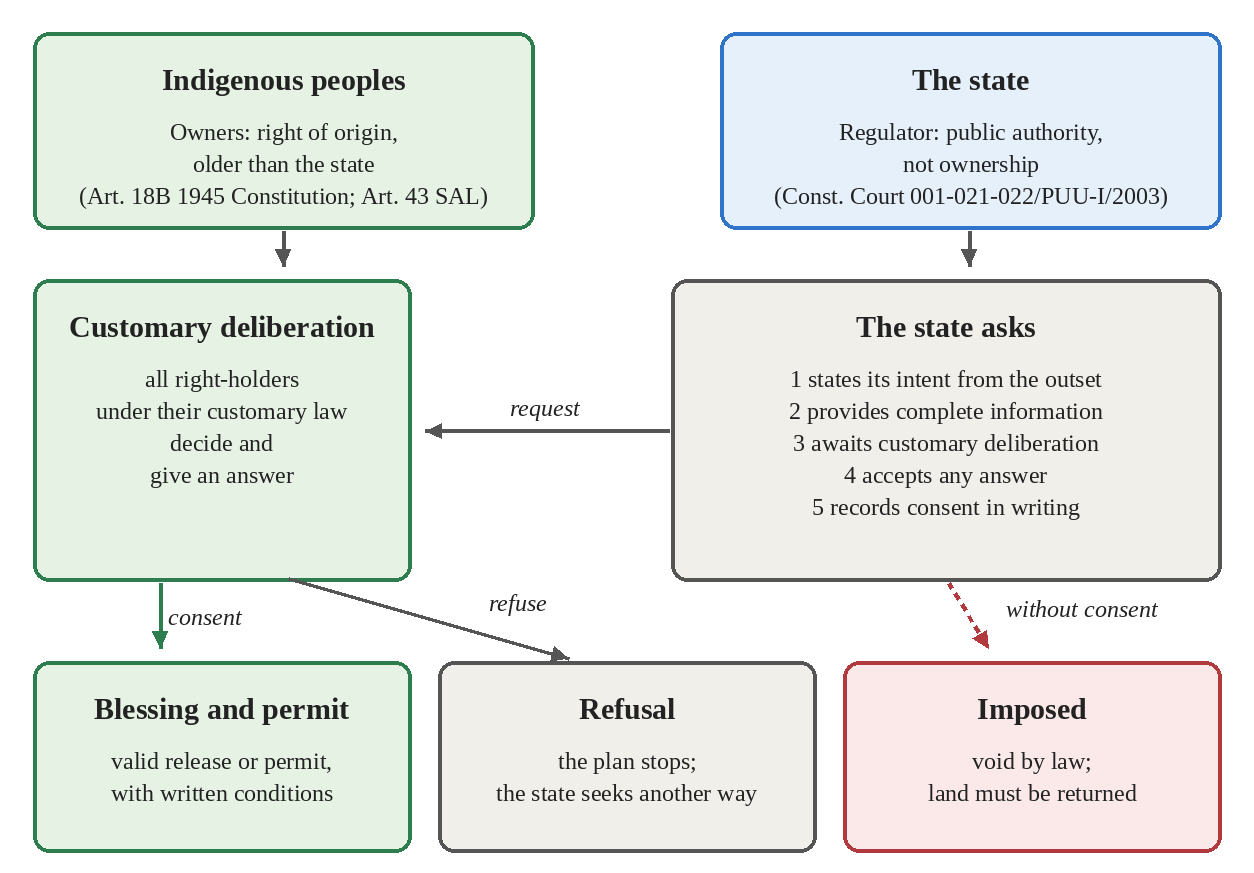
Figure 1. The principle of regulating by asking: the flow of consent over customary land
Source: compiled by the author based on Law No. 21 of 2001, Article 43; CERD (1997); Inter-American Court of Human Rights (2007).
Consent also need not mean the release of rights. Indigenous peoples may choose to grant a permit of use for a fixed period, with compensation and benefit-sharing that they set themselves, while ownership remains in their hands and the land returns in full when the period of use ends. The Saramaka judgment also recognised Indigenous peoples’ right to a reasonable share of the benefits of projects carried out in their territory (Inter-American Court of Human Rights, 2007). Permanent release should be the very last option, because release severs the bond between future generations and their land. In this framework, Indigenous peoples not only have the right to refuse, but also the right to set conditions when they choose to accept.
With this formulation, the state’s authority to regulate remains, but it opens no gap for arbitrariness. The state may still draw up spatial plans, set environmental standards, prohibit forest destruction and supervise land transactions. What the state may not do is use that authority to take, encumber or hand over customary land to others without its owners’ blessing. The authority to regulate is not an authority to take, much less to coerce.
6. When the State Does Not Ask: Tanah Papua 2024–2026
6.1 Merauke
The largest case in recent years is the food and energy PSN in Merauke, South Papua. Its planned area covers some 2.7 million hectares, including one million hectares of new rice fields (Mongabay Indonesia, 2025e). Simon Balagaize, chair of the Malind Anim Indigenous Peoples Forum, said the project targets the conversion of almost three million hectares of forest, swamp and savanna into rice, sugarcane and bioethanol estates, even though the area is not empty land (Mongabay Indonesia, 2026a). Nine UN Special Rapporteurs, in their letter to the government, stated that the entire project area of more than two million hectares lies within the territories of the Malind, Yeinan, Maklew, Khimaima and Yei Indigenous peoples (Mongabay Indonesia, 2025a).
Reports from the field show the same pattern: the land is mapped first, and its owners are asked later, or not at all. Onggari residents said they did not know who had released their land and forest for the sugarcane plantation (Mongabay Indonesia, 2025b). Simon Balagaize recounted that the government mapped customary land unilaterally and took control of it without consent, so that the land had already been staked and the company’s maps already existed while the people living there were unaware (Mongabay Indonesia, 2025c). Komnas HAM concluded that the project contravenes a number of national regulations protecting Indigenous peoples and identified five human rights violations (Mongabay, 2025).
The construction of a 135-kilometre access road from Wanam to Muting shows this pattern in greater detail. On 5 March 2026, five Malind residents challenged the road’s environmental feasibility permit at the Jayapura Administrative Court (Greenpeace Indonesia, 2026a). According to the advocacy team, by February 2026 road construction and land clearing had razed some 7,600 hectares of forest and displaced villages (Greenpeace Indonesia, 2026b). Witnesses stated that construction proceeded without adequate socialisation and without permission from the clans holding customary rights, and that refusal had been declared through customary sasi and the placing of red crosses without the government ever responding (Greenpeace Indonesia, 2026c). The judges ultimately rejected the lawsuit. The ruling, announced in September 2026, found that the regent’s decision had met the requirements of environmental impact assessment and public consultation, while the plaintiffs maintained that the permit was issued without FPIC and that the objections of the refusing clans had not been taken into account (Greenpeace Indonesia, 2026d).
Sasi and red crosses are the ways customary law says “no”. In this study’s framework, both are the owners’ answer to a request that was never properly made. That the refusal was ignored, and that the court then judged the procedure sufficient, reveals the core of the problem. Prevailing law still measures validity by the completeness of state documents, not by whether the landowners have given their blessing.
This pattern is reinforced by the decision to release almost 500,000 hectares of forest area in Papua. The executive director of the Pusaka Bentala Rakyat Foundation, Franky Samperante, called the decision a form of customary land grabbing. He also pointed to the still-living assumption that Tanah Papua is empty, ownerless land, so that the government feels no need to consult the people (Mongabay Indonesia, 2026b). It is this assumption that section 3 called a disguised domein verklaring. BRIN researchers have named a similar phenomenon the paradox of recognition, in which recognition turns into an instrument of control, and have warned that taking over customary land without consent carries the potential for latent conflict (Mongabay Indonesia, 2025d).
6.2 Boven Digoel
In Boven Digoel, Hendrikus Woro of the Awyu people challenged the environmental permit of an oil-palm company covering 36,094 hectares in the customary forest of the Woro clan. The Jayapura Administrative Court and the high administrative court rejected his lawsuit, and the Supreme Court rejected his cassation appeal in Decision No. 458 K/TUN/LH/2024 (Mongabay Indonesia, 2024). This case shows that eleven years after Constitutional Court Decision 35, the courts had not yet treated customary land rights as rights that limit state permits. Customary land rights are still viewed as interests that may be weighed, not as owners’ rights whose consent determines whether a permit is valid.
6.3 Recognition lagging behind
The Merauke and Boven Digoel cases took place against a wider background: the slow formal recognition of customary territories. By August 2026, BRWA had registered 2,284 customary territories covering 36.6 million hectares in 32 provinces. Of these, only 418 territories covering 7,540,332 hectares, or about 20.6 per cent, had received designation from regional governments. That area grew by only 79,025 hectares compared with March 2026 (Katadata, 2026a). Figure 2 shows the distribution of recognition status based on the March 2026 data edition, the only edition for which a breakdown by status was available to this study.
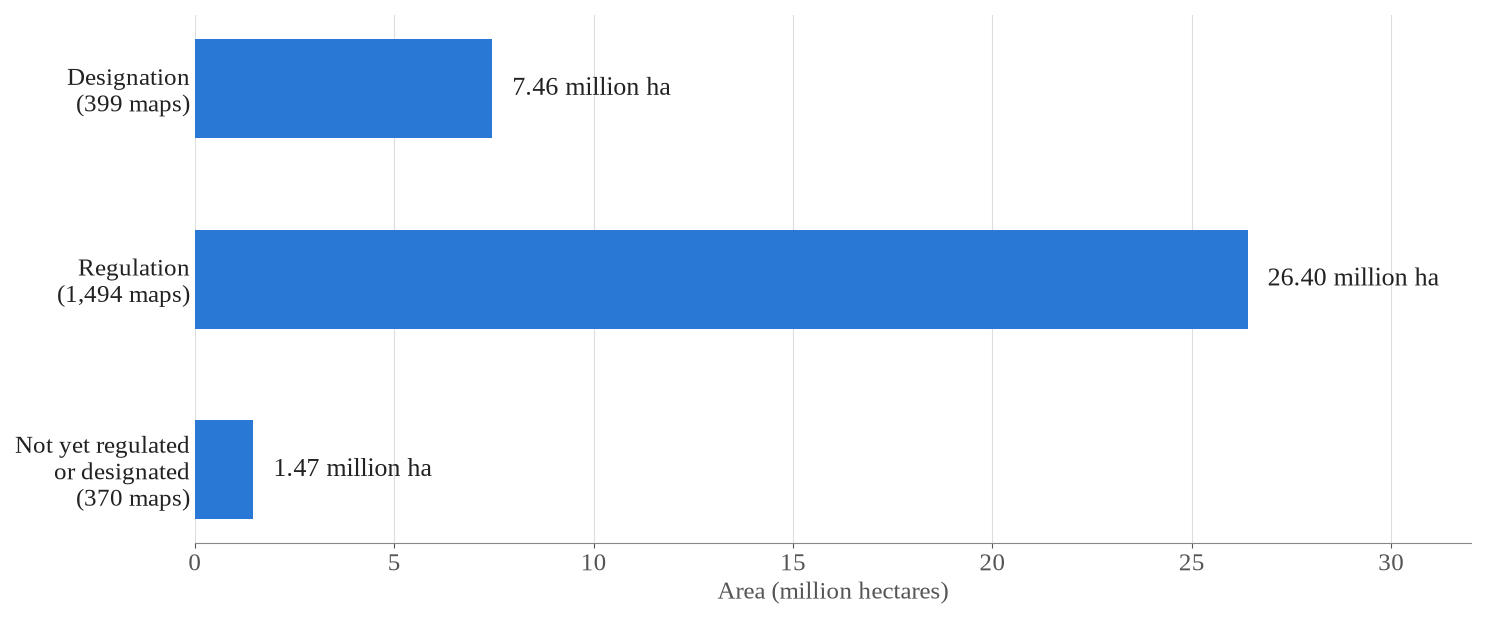
Figure 2. Recognition status of mapped customary territories by area, March 2026
Source: compiled from BRWA data, 17 March 2026 edition, as reported by Rendanianti (2026). The sum of the three categories (35.33 million ha) is slightly smaller than the reported mapped total (36.4 million ha).
The figure shows that most customary territories are in the “regulation” status: the region already has a regulation on recognition procedures, but the territory has not yet been designated. Papua accounts for 16.16 million hectares, or about 44.4 per cent, of all mapped customary territories, with South Papua, where the Merauke PSN is located, as the province with the largest customary territory, at 6.85 million hectares (GoodStats, 2026). The largest customary territory in Indonesia is also the territory where the largest state project is being carried out.
The slowness of recognition is not merely administrative. Hotspot data analysed by BRWA show a relationship between recognition, the absence of imposed business permits, and forest protection. Table 3 summarises it.
Table 3. Hotspots in customary territories by recognition status and surrounding permits, 2026
| Status of customary territory | Number of territories | Hotspots | Share of hotspots in customary territories |
|---|---|---|---|
| Recognised and free of business permits | 119 | 418 | 0.4% |
| Recognised but still surrounded by permits | 287 | 19,346 | about 21% |
| Not yet recognised and encircled by permits | 929 | 65,400 | 69% |
| All customary territories | – | 94,264 | 100% (17% of national hotspots) |
Source: Widodo (2026), based on BRWA analysis of NASA satellite data up to 26 October 2026. Permits counted include HGU, PBPH, IUP and forest-area use approvals within customary territories or within a 5 km radius of their boundaries. The percentage in the second row was calculated by the author from the source figures.
These figures do not yet strictly prove causation, because other factors such as soil type and weather also play a role. But the pattern is too clear to ignore. Customary territories that are recognised and free of imposed permits hardly burn at all, while territories that are not yet recognised and are encircled by permits account for more than two-thirds of hotspots. Respecting Indigenous peoples’ authority over their land is not only a matter of justice. It is also one of the most effective ways to protect forests, and its benefits are enjoyed by everyone, not only Indigenous peoples.
The latest legislative developments have not closed this gap. Law No. 10 of 2026 on the Regulation of Agrarian Reform, passed in September 2026, places Indigenous peoples as subjects of agrarian reform. HuMa has warned that without recognition of the autonomy of customary territories, such restructuring may in fact strengthen state control (Katadata, 2026b). This latest law still positions the state as the party that distributes land, not the party that recognises existing rights. Meanwhile, the drafting of the Indigenous Peoples Bill was only begun by the Working Committee of the House Legislation Body on 18 November 2026, with a target of passage before the recess on 18 December 2026 (Detik, 2026). In November 2025, UN human rights experts also urged Indonesia to give formal recognition to groups that self-identify as Indigenous peoples (JURIST, 2025).
7. Answering Objections
A strong argument must be able to face the strongest objections. This section discusses three main objections in detail, and then several others briefly.
7.1 Public interest and consignment
The most serious objection comes from prevailing law. Law No. 2 of 2012 on Land Acquisition for Development in the Public Interest states in Article 5 that entitled parties must release their land when land acquisition is carried out, after compensation has been provided or on the basis of a final and binding court decision. Article 42(1) states that if the entitled party rejects the form or amount of compensation, the compensation is deposited with the local district court (Law No. 2 of 2012; Hukumonline, 2021). Through this consignment mechanism, the state can obtain land even when its owners do not agree. Beyond that there is still Law No. 20 of 1961 on the Revocation of Rights to Land. It must be admitted that generally applicable land-acquisition law still opens a path of coercion. But the law as it stands is not always the same as just law, and for customary land in Papua, the law as it stands in fact already sides with Indigenous peoples through Article 43(4) of the Special Autonomy Law. This study defends consent as an absolute requirement with four arguments.
The first argument is the principle of lex specialis. In Tanah Papua, Article 43(4) of the Special Autonomy Law specifically regulates the provision of customary land “for any purpose” through agreement. The Land Acquisition Law regulates land acquisition generally throughout Indonesia. Under a principle widely accepted in legal science, a special rule overrides a general rule, and a later general rule does not by itself override an earlier special rule. With respect to the 1961 Revocation of Rights Law, the position of the Special Autonomy Law is even stronger, because it is both more specific and more recent. For customary land in Papua, therefore, the consignment and revocation mechanisms should not be usable to break through the agreement requirement.
The second argument is the contradiction within the Land Acquisition Law itself. Gozali (2017) shows that the law adopts the principle of agreement, yet the deposit of compensation in court can occur without the parties’ agreement. He also notes that consignment in civil law presupposes a pre-existing civil relationship, something absent in land acquisition. Gozali himself proposes revocation of rights as the way out when deliberation fails. This study does not follow that proposal for customary land, for the reasons explained in the first and third arguments. But his finding remains important: consignment has been questioned even for ordinary individually owned land.
The third argument concerns the nature of customary land. The Land Acquisition Law places Indigenous peoples as “entitled parties” to receive compensation, as if their position were the same as that of an ordinary land seller. Yet customary land belongs to a community across generations. It belongs to ancestors who have passed away, to members living today, and to descendants not yet born. Monetary compensation deposited in court cannot replace that relationship, and no one in the present generation has the authority to sell, under threat, the rights of generations yet unborn. That is why CERD General Recommendation 23 places restitution of land as the primary remedy and compensation only as the last option (CERD, 1997).
The fourth argument is constitutional. If the state’s right of control contains no function of owning, as the Constitutional Court has interpreted, then any mechanism that allows the state to take customary land without its owners’ consent is exercising a function the constitution never granted. For customary land, consignment is not an exercise of the authority to regulate. Consignment is expropriation wrapped in procedure.
7.2 Is FPIC really not a veto?
The second objection comes from international law. UN Special Rapporteur James Anaya stated in his 2009 report that the consultation provisions of UNDRIP are not intended to give Indigenous peoples a general veto over every decision that may affect them. In his view, the declaration makes consent the objective of consultation (Anaya, 2009). Barelli (2012) notes that a flexible approach to FPIC is increasingly accepted internationally. This objection needs a careful answer, not outright rejection. First, Anaya himself stated that the weight of the consent requirement depends on the magnitude of the impact. Significant and direct impacts on the lives or territories of Indigenous peoples give rise to a strong presumption that the plan should not proceed without their consent, and in certain circumstances that presumption hardens into a prohibition (Anaya, 2009). Taking customary land for plantations of millions of hectares clearly falls among the most severe impacts. Second, Article 10 of UNDRIP on relocation contains no exception whatsoever, and Saramaka requires consent for large-scale projects. Third, and most importantly, in Tanah Papua the consent requirement does not depend on international law. It is written in Article 43(4) of the Special Autonomy Law.
Furthermore, the term “veto” is itself misleading. A veto is the power of one party to block a collective decision concerning the affairs of many parties. When a landowner refuses to have their land taken, they are not blocking national policy. They are exercising the most basic right of every owner. No one calls a city dweller’s refusal to sell their house a veto. Calling Indigenous peoples’ refusal a veto quietly treats their land as state property that they merely happen to be occupying.
7.3 Sovereignty and the integrity of the state
The third objection holds that a sovereign state must not depend on the consent of a single group. This study answers it with the distinction built from the outset: sovereignty is not ownership. Mabo shows that a state can hold sovereignty and radical title over its entire territory while the original inhabitants retain ownership of their land. The Constitutional Court’s interpretation of the state’s right of control likewise contains no function of owning. UNDRIP itself, in Article 46, affirms that nothing in the declaration may be construed as authorising any action that would impair the territorial integrity of states (United Nations General Assembly, 2007).
The consent requirement does not diminish the state’s sovereignty in the slightest. The state still makes laws, still guards its borders, and still governs throughout its territory. Only one thing is limited: the state’s power to take land that already has owners. Such a limitation is not a threat to the state. It is in fact a hallmark of a state based on the rule of law. A state that respects its citizens’ property has stronger legitimacy than a state that takes whatever it wants.
7.4 Other objections
Several other objections need a brief answer. Some argue that Article 33 gives the state authority for the prosperity of all the people, not of one community. The answer is that Indigenous peoples are part of that people, and prosperity achieved by impoverishing part of the people is not the prosperity the constitution intends (Constitutional Court, 2004). Others state that customary rights are recognised only conditionally. As set out in section 4.4, those conditions concern how to identify the existence of Indigenous peoples, not the origin of their rights.
The Indonesian government has stated at UN forums that all Indonesians are indigenous, so that the UNDRIP concept of Indigenous peoples is irrelevant (Forest Peoples Programme & AMAN, 2016). This objection is weak because Indonesian law itself recognises “customary law communities” with their territories. The yardstick is community and territory, not ethnicity, and Article 43 of the Special Autonomy Law uses that yardstick.
From political philosophy, Waldron (1992) put forward the supersession thesis: changed circumstances can mean that past injustice no longer demands the return of land. This thesis does not apply to Tanah Papua. What this study defends is not a claim to land lost long ago, but land still occupied and used by its owners today. The injustice in Merauke did not happen in the past. It is happening now.
Business circles argue that strong recognition of customary rights undermines legal certainty and investment (Hukumonline, 2026). The reality is the reverse. Agrarian conflict born of taking land without consent is the greatest source of uncertainty, and permits issued on land whose owners refuse will continue to be challenged. Valid consent in fact provides certainty for all parties, including investors.
Finally, there is a risk that consent is hijacked by local elites, for example when one figure signs a release on behalf of an entire clan (Bedner & Arizona, 2019). This risk is real and must be acknowledged. But the answer is not to abolish the consent requirement. The answer is to tighten it: consent must be given through the deliberation of all right-holders according to their customary law, the process must be open, and every member of the community has the right to challenge a release made without deliberation.
8. Conclusions and Recommendations
8.1 Conclusions
This study reaches four conclusions. First, Indigenous peoples’ right to customary land is older and more fundamental than the authority of the state. The Indonesian state was founded on the territories of hundreds of customary communities that already had their own original structures, as the Elucidation of Article 18 of the 1945 Constitution acknowledges. In Tanah Papua, the state even arrived late in a territory already fully divided under customary law.
Second, Indonesian law itself separates Indigenous peoples’ ownership from the state’s authority to regulate. The constitution uses the word “recognise”, not “grant”. The UUPA revoked the domein verklaring and rejected the state’s position as landowner. The Constitutional Court interpreted the state’s right of control as five public functions with no function of owning, and then removed customary forests from state forests.
Third, because the state only regulates, with respect to customary land the state must regulate by asking. Article 43(4) of the Papua Special Autonomy Law requires deliberation to reach agreement for the provision of customary land for any purpose. International standards, from UNDRIP to CERD General Recommendation 23 and the Saramaka judgment, move in the same direction. Without the blessing and permission of Indigenous peoples, there is no valid release, acquisition or permit on customary land, and the state cannot impose one. Indigenous peoples not only have the right to refuse, but also the right to set conditions when they choose to accept, including choosing a fixed-term permit of use instead of release. It is this principle that limits state arbitrariness and ensures that rights to customary land truly remain in the ownership and control of Indigenous peoples themselves.
Fourth, practice in Tanah Papua in 2024–2026 has not yet respected that principle. In Merauke, land was mapped and forests razed before their owners gave consent, and refusal through customary sasi was ignored. In Boven Digoel, the courts up to the cassation level have not yet treated customary land rights as a limit on permits. Nationally, only about one-fifth of registered customary territories have been designated. This gap between norm and practice is rooted in the logic of the domein verklaring, which lives on even though its article was revoked more than six decades ago.
8.2 Recommendations
Based on these conclusions, this study puts forward nine recommendations.
- The House of Representatives and the Government should include in the Indigenous Peoples Bill a provision that the state’s recognition of Indigenous peoples and their territories is declaratory, so that customary land not yet designated may not be treated as state land.
- The Indigenous Peoples Bill should explicitly contain the principle of regulating by asking: every release, acquisition, encumbrance or permit on customary territory is valid only with the consent of Indigenous peoples given through deliberation according to their customary law, and Indigenous peoples have the right to refuse.
- Registered participatory customary territory maps should be recognised as valid prima facie evidence, with the reverse burden of proof on state agencies or companies that deny them.
- The law should set clear legal consequences: permits or releases made without consent are void by law, and land that has been taken must be returned, with compensation only where restitution is impossible.
- Law No. 2 of 2012 should be revised to exempt customary land from the consignment mechanism, and Law No. 20 of 1961 should be declared inapplicable to customary land.
- Provincial and regency/city governments in Tanah Papua should implement Article 43(4) of the Special Autonomy Law as a binding requirement for all projects, including PSNs. Activities on customary territories that have not obtained their owners’ consent, including in Merauke, should be suspended, all their permits audited, and communities whose land, forests or villages have been damaged should receive remedy.
- Where Indigenous peoples choose to accept a project, the preferred form should be a fixed-term permit of use with benefit-sharing, not permanent release, so that ownership remains with Indigenous peoples.
- The Supreme Court and the administrative courts should test the validity of permits on customary territories by whether customary owners have consented, not merely by the completeness of administrative documents.
- To prevent elite capture, implementing regulations should require deliberation by all right-holders, an open process, written records of consent, and a right of action for every community member against releases made without deliberation.
In the end, the question of customary land is a question of who must ask and who has the right to answer. As long as the state still acts as if it were the owner entitled to decide, Indigenous peoples will continue to be forced into the position of pleading that their own land not be taken. This study argues that this order must be restored to what it should be. A state that stands on customary land must come to its owners as the party that asks, and accept their answer, including the answer “no”.
References
AMAN. (2023, 16 Mei). Satu dekade Putusan MK 35/2012: Gagal paham pemerintah mengakui wilayah adat [Siaran pers]. Aliansi Masyarakat Adat Nusantara. https://aman.or.id/files/publication-documentation/84605Satu%20Dekade%20MK35.pdf
AMAN, ICRAF, & Forest Peoples Programme. (2003). Satu yang kami tuntut: Pengakuan. World Agroforestry Centre. https://cifor-icraf.org/publications/sea/Publications/files/booklet/BL0011-04.pdf
Anaya, J. (2009). Report of the Special Rapporteur on the situation of human rights and fundamental freedoms of indigenous people (A/HRC/12/34). United Nations Human Rights Council. https://digitallibrary.un.org/record/661230
Arizona, Y. (2022). Rethinking adat strategies: The politics of state recognition of customary land rights in Indonesia [Disertasi doktoral, Universiteit Leiden]. https://hdl.handle.net/1887/3309795
Barelli, M. (2012). Free, prior and informed consent in the aftermath of the UN Declaration on the Rights of Indigenous Peoples: Developments and challenges ahead. The International Journal of Human Rights, 16(1), 1–24. https://doi.org/10.1080/13642987.2011.597746
Bedner, A., & Arizona, Y. (2019). Adat in Indonesian land law: A promise for the future or a dead end? The Asia Pacific Journal of Anthropology, 20(5), 416–434. https://doi.org/10.1080/14442213.2019.1670246
Committee on the Elimination of Racial Discrimination [CERD]. (1997). General Recommendation No. 23: Indigenous peoples. United Nations. http://hrlibrary.umn.edu/gencomm/genrexxiii.htm
Detik. (2026, 18 November). Baleg DPR mulai susun RUU Masyarakat Adat, target rampung tahun ini. https://news.detik.com/berita/d-8758914/baleg-dpr-mulai-susun-ruu-masyarakat-adat-target-rampung-tahun-ini
Forest Peoples Programme & AMAN. (2016). Indonesia: Universal Periodic Review, third cycle [Laporan bersama]. https://www.forestpeoples.org/fileadmin/uploads/fpp/migration/publication/2016/09/indonesiaamanaippupr3rdcyclefinal.pdf
GoodStats. (2026). Papua punya wilayah adat terluas di Indonesia pada 2026. https://data.goodstats.id/statistic/papua-punya-wilayah-adat-terluas-di-indonesia-pada-2026-L5wwG
Gozali, D. S. (2017). Penerapan asas kesepakatan dalam pengadaan tanah bagi pembangunan untuk kepentingan umum. Yuridika, 32(3), 393–414. https://doi.org/10.20473/ydk.v32i3.4783
Greenpeace Indonesia. (2026a, 5 Maret). Stop PSN penghancur hutan: Masyarakat adat Malind gugat izin proyek pembangunan jalan 135 km di Merauke [Siaran pers]. https://www.greenpeace.org/indonesia/siaran-pers/65827/stop-psn-penghancur-hutan-masyarakat-adat-malind-gugat-izin-proyek-pembangunan-jalan-135-km-di-merauke/
Greenpeace Indonesia. (2026b, 9 Juni). Proses hukum gugatan jalan 135 kilometer masih berlangsung, pembangunan jalan harus dihentikan [Siaran pers]. https://www.greenpeace.org/indonesia/siaran-pers/66497/proses-hukum-gugatan-jalan-135-kilometer-masih-berlangsung-pembangunan-jalan-harus-dihentikan/
Greenpeace Indonesia. (2026c, 15 Juli). Keterangan saksi tergugat membuktikan proyek jalan 135 km berjalan serampangan [Siaran pers]. https://www.greenpeace.org/indonesia/siaran-pers/67334/keterangan-saksi-tergugat-membuktikan-proyek-jalan-135-km-berjalan-serampangan/
Greenpeace Indonesia. (2026d, 21 September). Kabar buruk dari Papua: PTUN Jayapura menolak gugatan jalan 135 km yang membelah hutan adat [Siaran pers]. https://www.greenpeace.org/indonesia/siaran-pers/67882/kabar-buruk-dari-papua-ptun-jayapura-menolak-gugatan-jalan-135-km-yang-membelah-hutan-adat/
Hukumonline. (2021). Konsinyasi dan penitipan ganti rugi pengadaan tanah di pengadilan. https://www.hukumonline.com/stories/article/lt606432352f05a/konsinyasi-dan-penitipan-ganti-rugi-pengadaan-tanah-di-pengadilan/
Hukumonline. (2026). RUU Masyarakat Adat harus jamin kepastian hukum, termasuk dunia usaha. https://www.hukumonline.com/berita/a/ruu-masyarakat-adat-harus-jamin-kepastian-hukum--termasuk-dunia-usaha-lt6a589e6c8e420/
Inter-American Court of Human Rights. (2001). Case of the Mayagna (Sumo) Awas Tingni Community v. Nicaragua (Judgment of August 31, 2001, Series C No. 79). https://hrlibrary.umn.edu/iachr/AwasTingnicase.html
Inter-American Court of Human Rights. (2007). Case of the Saramaka People v. Suriname (Judgment of November 28, 2007, Series C No. 172). https://summa.cejil.org/en/entity/ouxsi1al3anhfr
JURIST. (2025, November). Human rights experts call for Indonesia to formally recognize its Indigenous peoples. https://www.jurist.org/news/2025/11/human-rights-experts-call-for-indonesia-to-formally-recognize-its-indigenous-peoples/
Katadata. (2026a, 11 Agustus). Pengakuan wilayah adat baru 20,6%, BRWA pertanyakan komitmen negara. https://katadata.co.id/berita/nasional/6a7a9d022e0ff/pengakuan-wilayah-adat-baru-20-6-brwa-pertanyakan-komitmen-negara
Katadata. (2026b). UU Reforma Agraria picu kekhawatiran penguasaan negara di wilayah adat. https://katadata.co.id/ekonomi-hijau/investasi-hijau/6ab3b793244bd/uu-reforma-agraria-picu-kekhawatiran-penguasaan-negara-di-wilayah-adat
Kompas.id. (2020, 20 Juli). 150 years of shackles on land rights. https://www.kompas.id/baca/english/2020/07/20/150-years-of-shackles-on-land-rights
Mahkamah Konstitusi. (2004). Putusan Nomor 001-021-022/PUU-I/2003 perihal pengujian Undang-Undang Nomor 20 Tahun 2002 tentang Ketenagalistrikan. Ringkasan dalam https://berkas.dpr.go.id/puspanlakuu/resume/resume-public-886.pdf
Mahkamah Konstitusi. (2008). Putusan Nomor 31/PUU-V/2007 perihal pengujian Undang-Undang Nomor 31 Tahun 2007 tentang Pembentukan Kota Tual di Provinsi Maluku. https://pasal.id/peraturan/putusan-mk/puu-mk-31-2007
Mahkamah Konstitusi. (2013). Putusan Nomor 35/PUU-X/2012 perihal pengujian Undang-Undang Nomor 41 Tahun 1999 tentang Kehutanan.
Mongabay. (2025, April). Military-backed plantation project in Indonesian Papua triggers rights concerns. https://news.mongabay.com/2025/04/military-backed-plantation-project-in-indonesian-papua-triggers-rights-concerns/
Mongabay Indonesia. (2024, 5 November). Gugat izin perusahaan sawit, Mahkamah Agung tolak kasasi suku Awyu. https://mongabay.co.id/2024/11/05/gugat-izin-perusahaan-sawit-mahkamah-agung-tolak-kasasi-suku-awyu/
Mongabay Indonesia. (2025a, 22 Juni). PBB soal PSN Merauke, koalisi sebut respons pemerintah tak jujur. https://mongabay.co.id/2025/06/22/pbb-soal-psn-merauke-koalisi-sebut-respon-pemerintah-tak-jujur/
Mongabay Indonesia. (2025b, 2 Juli). PSN Merauke rentan kikis relasi perempuan dengan hutan. https://mongabay.co.id/2025/07/02/psn-merauke-rentan-kikis-relasi-perempuan-dengan-hutan/
Mongabay Indonesia. (2025c, 4 September). Masyarakat adat Papua suarakan keresahan terdampak PSN Merauke. https://mongabay.co.id/2025/09/04/masyarakat-adat-papua-suarakan-keresahan-terdampak-psn-merauke/
Mongabay Indonesia. (2025d, 20 November). Masyarakat adat Papua di tengah pusaran PSN Merauke. https://mongabay.co.id/2025/11/20/masyarakat-adat-papua-di-tengah-pusaran-psn-merauke/
Mongabay Indonesia. (2025e, 5 Desember). Mengapa keluhan masyarakat adat Papua terdampak PSN terabaikan? https://mongabay.co.id/2025/12/05/mengapa-keluhan-masyarakat-adat-papua-terdampak-psn-terabaikan/
Mongabay Indonesia. (2026a, 4 Maret). Ketika proyek pangan dan energi Papua gerus alam dan HAM. https://mongabay.co.id/2026/03/04/ketika-proyek-pangan-dan-energi-papua-gerus-alam-dan-ham/
Mongabay Indonesia. (2026b, 27 Maret). Kala masyarakat adat Papua protes pelepasan hampir 500 ribu hektar kawasan hutan. https://mongabay.co.id/2026/03/27/kala-masyarakat-adat-papua-protes-pelepasan-hampir-500-ribu-hektar-kawasan-hutan/
Mongabay Indonesia. (2026c, 21 April). Upaya mama Papua jaga tanah adat di tengah ancaman proyek nasional. https://mongabay.co.id/2026/04/21/upaya-mama-papua-jaga-tanah-adat-di-tengah-ancaman-proyek-nasional/
Neilson, J. (2020, 25 November). Domein verklaring: Colonial legal legacies and community access to land in Indonesia. Georgetown Journal of International Affairs. https://gjia.georgetown.edu/2020/11/25/domein-verklaring-colonial-legal-legacies-and-community-access-to-land-in-indonesia/
Parliament of Australia. (1996). Mabo v Queensland (No 2) (1992) 175 CLR 1: Ringkasan dalam laporan Joint Committee on Native Title. https://aph.gov.au/Parliamentary_Business/Committees/Joint/Former_Committees/ntlf/completed_inquiries/1996-99/report_06/e02
Rendanianti, A. (2026, 22 Juli). 36 juta ha wilayah adat terpetakan, bagaimana status pengakuannya? GoodStats. https://data.goodstats.id/statistic/36-juta-ha-wilayah-adat-terpetakan-bagaimana-status-pengakuannya-9Hg3n
RRI. (2025). Logika domein verklaring ala Indonesia. https://rri.co.id/ternate/sudut-pandang/2069893/logika-domein-verklaring-ala-indonesia
The Canadian Encyclopedia. (2014). Tsilhqot’in case [Tsilhqot’in Nation v. British Columbia, 2014 SCC 44]. https://thecanadianencyclopedia.ca/en/article/tsilhqot-in-case
Tobroni, F. (2013). Menguatkan hak masyarakat adat atas hutan adat (Studi Putusan MK Nomor 35/PUU-X/2012). Jurnal Konstitusi, 10(3). https://doi.org/10.31078/jk1035
Undang-Undang Dasar Negara Republik Indonesia Tahun 1945.
Undang-Undang Nomor 5 Tahun 1960 tentang Peraturan Dasar Pokok-Pokok Agraria. https://peraturan.go.id/files2/uu-no-5-tahun-1960_terjemah.pdf
Undang-Undang Nomor 20 Tahun 1961 tentang Pencabutan Hak-Hak atas Tanah dan Benda-Benda yang Ada di Atasnya.
Undang-Undang Nomor 29 Tahun 1999 tentang Pengesahan International Convention on the Elimination of All Forms of Racial Discrimination 1965.
Undang-Undang Nomor 39 Tahun 1999 tentang Hak Asasi Manusia.
Undang-Undang Nomor 21 Tahun 2001 tentang Otonomi Khusus bagi Provinsi Papua. https://jdih.setkab.go.id/puu/buka_puu/7261/UU%20NO%2021%20TH%202001.pdf
Undang-Undang Nomor 2 Tahun 2012 tentang Pengadaan Tanah bagi Pembangunan untuk Kepentingan Umum. https://jdih.kemenkeu.go.id/fulltext/2012/2tahun2012uu.htm
Undang-Undang Nomor 6 Tahun 2014 tentang Desa, Penjelasan. https://peraturan.go.id/files/uu6-2014pjl.pdf
Undang-Undang Nomor 2 Tahun 2021 tentang Perubahan Kedua atas Undang-Undang Nomor 21 Tahun 2001 tentang Otonomi Khusus bagi Provinsi Papua. https://peraturan.go.id/files/ln155tln6697-2021.pdf
United Nations General Assembly. (2007). United Nations Declaration on the Rights of Indigenous Peoples (A/RES/61/295). https://digitallibrary.un.org/record/609197
Waldron, J. (1992). Superseding historic injustice. Ethics, 103(1), 4–28.
Widodo, K. (2026, 13 November). Hak yang diakui, hutan yang terjaga. Katadata. https://katadata.co.id/indepth/opini/6af524b40104d/hak-yang-diakui-hutan-yang-terjaga
How to cite
Dumupa, Y. (2026). The state stands on customary land: Indigenous consent as the limit of state authority [Scholarly article]. Yakobus Dumupa. https://yakobusdumupa.com/kajian/negara-berdiri-di-atas-tanah-adat?lang=en

About the Author
Yakobus Dumupa
Writer, organic intellectual and activist from the Land of Papua, with an educational background in political science, government and anthropology. He served as a member of the Papuan People's Assembly (2012–2016) and as Regent of Dogiyai (2017–2022), and has written dozens of books and hundreds of articles.
Read biography