Scholarly Article
Two Faces of the Law in Tanah Papua: Impunity for Security Forces, Prison for Political Expression
Contents
Contents
Abstrak
Kajian ini menelusuri cara hukum Indonesia memperlakukan dua kelompok di Tanah Papua sejak 1963 sampai 2026: aparat keamanan yang diduga melakukan kekerasan, dan orang Papua yang menyatakan aspirasi politiknya secara damai. Data dihimpun melalui studi kepustakaan atas putusan pengadilan, peraturan perundang-undangan, dokumen PBB, laporan lembaga negara dan pemantau hak asasi manusia di dalam dan luar negeri, serta kajian akademik, lalu dianalisis dengan pelacakan proses dan perbandingan kasus. Temuannya memperlihatkan dua lintasan yang hampir tidak pernah bersilangan. Operasi militer masa Orde Baru, termasuk operasi 1977–1978 di Pegunungan Tengah, tidak pernah diselidiki secara pro-yustisia. Dari empat peristiwa sesudah 2000 yang ditetapkan Komnas HAM sebagai pelanggaran HAM berat, hanya satu yang menghasilkan hukuman, dua belas tahun setelah kejadian. Perkara lain yang sampai ke peradilan militer umumnya berakhir dengan dakwaan yang diturunkan atau hukuman yang dipangkas di tingkat banding. Sebaliknya, upacara bendera, kongres, demonstrasi, dan bahkan pengantaran surat dipidana dengan pasal subversi atau makar, kadang dengan hukuman yang lebih berat daripada hukuman bagi pembunuh seorang pemimpin Papua. Kajian ini menafsirkan asimetri tersebut sebagai produk rancangan kelembagaan dan cara pandang keamanan yang berakar pada rapuhnya persetujuan politik orang Papua atas pemerintahan Indonesia. Karena itu, perbaikan teknis hukum tidak akan cukup. Kajian ini merekomendasikan pembebasan tanpa syarat seluruh tahanan politik, dialog Jakarta–Papua yang dimediasi pihak ketiga yang netral, serta pengungkapan kebenaran dan penegakan keadilan yang berjalan seiring dengan dialog itu.
Kata kunci: impunitas, tahanan politik, makar, peradilan militer, dialog Jakarta–Papua, keadilan transisi
Abstract
This study traces how Indonesian law has treated two groups in Tanah Papua from 1963 to 2026: security personnel suspected of violence, and Papuans who express political aspirations peacefully. Data were gathered through library research on court rulings, legislation, United Nations documents, reports by state bodies and by domestic and international human rights monitors, and academic scholarship, and were analysed through process tracing and case comparison. The findings reveal two trajectories that almost never intersect. New Order military operations, including the 1977–1978 operations in the Central Highlands, were never judicially investigated. Of the four post-2000 events classified by Komnas HAM as gross human rights violations, only one has produced a conviction, twelve years after the event. Other cases that reached military courts mostly ended with reduced charges or sentences cut on appeal. By contrast, flag ceremonies, congresses, demonstrations and even the delivery of letters have been prosecuted as subversion or treason (makar), sometimes with heavier sentences than those imposed on the killers of a Papuan leader. The study interprets this asymmetry as the product of institutional design and a security outlook rooted in the fragility of Papuan political consent to Indonesian rule. Technical legal reform alone will therefore not suffice. The study recommends the unconditional release of all political prisoners, a Jakarta–Papua dialogue mediated by a neutral third party, and truth-seeking and justice that proceed alongside that dialogue.
Keywords: impunity, political prisoners, treason, military justice, Jakarta–Papua dialogue, transitional justice
1. Introduction
In 2005, a court in Jayapura sentenced Filep Karma to 15 years in prison. His offence was leading a Morning Star flag-raising ceremony on 1 December 2004. Prosecutors had sought only five years, but the judges tripled it (Freedom Now, 2015). Two years earlier, the Military Court in Surabaya had sentenced Lieutenant Colonel Hartomo to three and a half years in prison. He was the commander of the Kopassus unit whose members killed Theys Hiyo Eluay, Chair of the Papua Presidium Council, on his way home from a dinner at the unit’s headquarters. Thirteen years later, Hartomo was appointed Head of the TNI Strategic Intelligence Agency (Jakarta Post, 2016a).
Those two rulings do not sit side by side by mere coincidence. Each represents one of two legal tracks that have run in parallel in Tanah Papua since 1963. The first track is travelled by security personnel suspected of killing, torturing, or disappearing Papuans. On this track, events can go uninvestigated for decades, case files can shuttle back and forth without end, and sentences can be cut on appeal. The second track is travelled by Papuans who speak about their political future. On this track, arrests happen the same day, trials are over within months, and sentences can far exceed what prosecutors demand.
The government reads this situation differently. Enforcement of the treason (makar) articles is seen as a constitutional duty to safeguard territorial integrity. Violence by security forces is attributed to rogue individuals (oknum) who are dealt with through existing mechanisms. The state can also point to a number of steps: President Joko Widodo’s acknowledgement of gross human rights violations in Wasior and Wamena in January 2023 (Sekretariat Kabinet, 2023), the amnesty granted to six people convicted of unarmed treason in Papua in August 2025 (Kabar24, 2025), and the Supreme Court ruling that on 10 November 2026 finally convicted the defendant in the Paniai case (Tirto.id, 2026). These claims deserve to be weighed seriously, and this study attempts to do so.
The literature on Papua is rich but fragmented. There are historical studies that dismantle the 1969 Act of Free Choice (Pepera) (Drooglever, 2009; Saltford, 2003; Musgrave, 2015). There are reports on mass violence under the New Order (Asian Human Rights Commission, 2013; Brundige et al., 2004). There are studies of torture (Hernawan, 2018), extrajudicial killings (Amnesty International Indonesia, 2018), and political prisoners (Human Rights Watch, 2010). There are also legal studies of the treason articles (Institute for Criminal Justice Reform [ICJR], 2017; Wiratraman & Hanrahan, 2023). Each looks at one side. What is rarely done is to place both tracks within a single frame and a single time span, and then ask why they move in opposite directions.
This study fills that gap with three questions. How has the legal system treated security personnel suspected of violence in Papua from the beginning of integration to 2026? How has the same system treated Papuans accused of subversion or treason for political expression? And what explains the difference, so that the remedies offered address its causes and not merely its symptoms?
The argument advanced here is that legal asymmetry in Papua is the juridical form of an unresolved political problem. Chauvel and Bhakti (2004) identify the fragility of Jakarta’s authority and the absence of Papuan consent as both a cause and a consequence of reliance on violence. This study shows that the law works within that same circle: it protects the state’s instruments of violence and punishes those who question the basis of that power. If this diagnosis is correct, the way out must also be political.
Following this introduction, section 2 sets out the concepts used and the study’s position in the literature. Section 3 explains the data and approach. Sections 4 to 7 present the findings by period and type of case. Section 8 reads the asymmetry as a whole, section 9 discusses the way forward, and section 10 closes with conclusions and recommendations.
2. Conceptual Framework
2.1 Impunity as a condition
The United Nations principles on combating impunity define impunity as the impossibility, de jure or de facto, of bringing perpetrators of violations to account, whether in criminal, civil, administrative, or disciplinary proceedings (United Nations Commission on Human Rights, 2005). The principles also set out four rights of victims: the right to know the truth, the right to justice, the right to reparation, and guarantees of non-recurrence.
This definition shifts attention from whether a trial takes place to what it achieves. A trial with a single mid-ranking defendant, charges that turn torture into a disciplinary breach, or a sentence reduced on grounds that victims cannot find convincing can still be read as impunity. By the same measure, events that have never been investigated because they are deemed too old also fall within it. In this study, impunity is understood as a condition produced by a system, not as the failure of a single case.
2.2 Political prisoners and political justice
The Parliamentary Assembly of the Council of Europe sets out five criteria for political prisoners: detention in violation of fundamental rights such as freedom of expression and assembly, detention for purely political reasons, punishment clearly disproportionate to the offence, discriminatory treatment, and unfair proceedings (Parliamentary Assembly of the Council of Europe, 2012). A single criterion is sufficient. This study focuses on those imprisoned for peaceful expression, because that is where the comparison with the security track is sharpest.
Two ideas help explain why the law can be both highly active and highly passive. Kirchheimer (1961) calls the use of court procedure for political ends political justice: trials proceed according to form, but their outcomes serve the interests of power. Tamanaha (2004) distinguishes a state that acts through law from a state that is bound by law. The first can be very diligent in applying statutes to its citizens without ever placing its own agents under those same statutes.
2.3 Violence as a message
Hernawan (2018) compiled 431 cases of torture in Papua from 1963 to 2010 and concluded that torture in Papua is not primarily intended to extract information or to punish. It is staged to convey a message of power to a wider audience, and five decades of practice with near-total impunity have produced what he calls a theatre of torture. This idea matters for the present study because it connects the two tracks. If violence by security forces functions as a message, then the criminalisation of political expression is the same message in the language of law: there is a line that may not be crossed, and the law will stand with those who guard it.
2.4 Position of the study in the literature
Studies of state violence in Papua can be grouped into three streams. The first is documentary and legal, produced by monitoring organisations such as Amnesty International, Human Rights Watch, and the Asian Human Rights Commission. Some work in this stream raises the question of genocide. The Yale Law School human rights clinic found evidence of crimes against humanity but judged the element of genocidal intent difficult to prove (Brundige et al., 2004), while Elmslie and Webb-Gannon (2013) describe Indonesian rule in Papua as a slow-motion genocide. The second stream is political and policy-oriented, for example Chauvel and Bhakti (2004), the Papua Road Map (Widjojo et al., 2009), and International Crisis Group (2012) reports emphasising an overhaul of security policy. The third stream looks at Papuan resistance itself, including the shift from armed struggle to nonviolent civil resistance (MacLeod, 2015) and first-hand experience of events such as Biak in 1998 (Kirksey, 2012).
Domestic legal scholarship tends to treat the treason articles as a problem of drafting, for example the debate over whether the word makar should be read as meaning attack (ICJR, 2017). Wiratraman and Hanrahan (2023) go further, reading the inconsistencies of the justice system towards Papuans as institutionalised exclusionary nationalism. This study starts from a similar direction but adds a direct comparison between the two tracks across six decades and links it to proposals for a political settlement.
3. Data and Approach
This is a qualitative library-based study. Sources fall into five categories. First, legislation, including the old Criminal Code and the 2023 Criminal Code in force since 2 January 2026, Law No. 26 of 2000 on Human Rights Courts, Law No. 31 of 1997 on Military Justice, Law No. 21 of 2001 on Special Autonomy for Papua Province, and Government Regulation No. 77 of 2007 on Regional Emblems. Second, rulings of the courts and the Constitutional Court. Third, United Nations documents, namely the concluding observations of the Human Rights Committee, opinions of the Working Group on Arbitrary Detention, and statements by special rapporteurs. Fourth, reports by state bodies and monitors, both domestic (Komnas HAM, YLBHI, KontraS, Imparsial) and international (Amnesty International, Human Rights Watch, the Asian Human Rights Commission, the International Crisis Group, Human Rights Monitor, and TAPOL through Papuans Behind Bars). Fifth, academic scholarship and media reporting.
The analysis uses two techniques. Process tracing is used to follow each case from the event to its final outcome: whether it was investigated, by whom, on what charges, in which court, and what happened to it on appeal. Case comparison is used to set the two tracks side by side at the same points. The time span is divided into two broad periods, 1963–1998 and 1999–2026, with Reformasi as the dividing line, because the institutional changes after 1998 make it possible to test whether the old pattern changed as well.
Case selection followed two principles. Cases had to be documented well enough for their legal process to be traced, and cases that appear to contradict this study’s argument had to be included. Accordingly, the Mimika and Yahukimo cases, which produced heavy sentences for security personnel, are discussed in as much detail as those that ended lightly. Government claims are quoted from official sources and tested against comparative data.
Three limitations should be stated. Most military court rulings are not published, so some case outcomes can be known only from media reports or from monitoring organisations. For events before 1998, casualty figures come from non-governmental organisations and historical studies because the state never investigated them. Figures from different organisations are also compiled with different methods, so this study does not add them together.
The author is Papuan and therefore does not stand outside the problem under study. This proximity brings sensitivity to matters that outside observers often miss, but it also carries a risk of partiality. To control for it, every factual claim rests on verifiable sources, official government sources are used alongside monitoring sources, and cases that do not fit the argument are not set aside.
4. Archives Never Opened: 1963–1998
4.1 The Act of Free Choice and military operations
Indonesia took over the administration of Papua from the United Nations Temporary Executive Authority in May 1963. The 1962 New York Agreement required an act of self-determination, which was later carried out as the Pepera in July and August 1969. Historians who examined Dutch and United Nations archives reached similar conclusions. The Pepera was not conducted through a vote by every adult but through deliberation among 1,025 representatives selected and supervised by the security apparatus, and the United Nations accepted the result without adequate scrutiny (Drooglever, 2009; Saltford, 2003). Musgrave (2015) weighs the claim that the Pepera was engineered so that the will of the population was not reflected, and reads it from the perspective of international law on self-determination. The Indonesian government regards the Pepera as a final and legitimate settlement, because its result was noted by the United Nations General Assembly.
This study does not seek to assess the legal status of the Pepera. What is relevant is that the Pepera took place amid military operations, and those operations were never accounted for. YLBHI records that Operation Baratayuda in the late 1960s alone claimed some 3,500 lives, and considers that the military approach begun with Trikora never truly ended (NU Online, 2025). Osborne (1985) and Budiardjo and Liem (1988) documented subsequent operations throughout the 1970s and 1980s.
The 1977–1978 operations in the Central Highlands are the best documented of this period. Drawing on survivors’ testimony, the Asian Human Rights Commission (2013) recorded at least 4,146 people killed by aerial bombardment, shootings, torture, and sexual violence. The report called for an ad hoc human rights court and a truth commission. That call was never acted upon. Komnas HAM has never conducted a pro-justitia inquiry into those operations, and the government has never acknowledged them.
4.2 The bodies of leaders and the water tower
In the same period, Papuans deemed dangerous could vanish without due process. Arnold Ap, an anthropologist, curator of the Cenderawasih University Museum, and leader of the music group Mambesak, was detained by Kopassandha in late November 1983 without charge. On 26 April 1984, his body was found on a beach near Jayapura with gunshot and stab wounds (Jakarta Post, 2021). The official version said he was shot while trying to escape. The man killed was someone who had revived Papuan traditional songs, and not a single member of the security forces was tried.
The pattern outlasted the fall of Soeharto. On 6 July 1998, two months after Reformasi began, security forces opened fire on people gathered beneath the Biak water tower to raise the Morning Star flag. Kirksey (2012), who was in Biak at the time as a student, later wrote his account. Filep Karma, who led the action, was shot in both legs and detained (Human Rights Watch, 2024b). The death toll was never established because the state never investigated it. In 2013, a citizens’ tribunal in Sydney gathered survivors’ testimony and called on the Indonesian government to establish an independent judicial inquiry (ETAN, 2013).
4.3 The other side: subversion
In the same period, the second track was already working efficiently. Thomas Wainggai, a Japanese-trained doctor of law and lecturer at Cenderawasih University, led a peaceful ceremony raising the West Melanesian flag in Jayapura on 14 December 1988. He was sentenced to 20 years in prison for subversion, imprisoned in Jakarta some 3,700 kilometres from his home village, and died in prison on 12 March 1996. Amnesty International (1996) classified him as a prisoner of conscience. His death triggered major riots in Abepura.
Table 1 summarises this period. None of the incidents of violence by security forces recorded in it ever produced a single defendant. The only case that ended in a sentence was that of a lecturer who raised a flag.
Table 1. Violence by security forces and criminalisation of political expression, 1963–1998
| Year | Event | Legal process and outcome |
|---|---|---|
| 1965–1969 | Military operations ahead of the Pepera, including Operation Baratayuda with some 3,500 deaths according to YLBHI | Never investigated |
| 1977–1978 | Military operations in the Central Highlands; at least 4,146 killed according to AHRC | Never investigated and never acknowledged |
| 1980s | Further operations under various code names | Never investigated |
| 1984 | Arnold Ap and Eddie Mofu killed after detention by Kopassandha | No legal process; official version says both tried to escape |
| 1988 | Thomas Wainggai leads a West Melanesian flag ceremony | Sentenced to 20 years for subversion; died in prison (1996) |
| 1998 | Biak: Morning Star ceremony broken up with gunfire | No pro-justitia inquiry and no defendants |
Source: compiled from NU Online (2025); Asian Human Rights Commission (2013); Osborne (1985); Jakarta Post (2021); Amnesty International (1996); ETAN (2013).
When the Human Rights Courts Law was enacted in 2000, it provided a path to try gross human rights violations committed before 2000 through ad hoc human rights courts established on the recommendation of the House of Representatives (DPR). As of 2026, that path has never been opened for a single event in Papua. The archives of this period remain closed.
5. Courts That Choose: 1999–2026
Reformasi brought new instruments: the Human Rights Court, the separation of the National Police from the TNI, and Special Autonomy, which mandated a human rights court and a truth commission in Papua. The question is whether these new instruments changed the fate of cases of violence by security forces. Table 2 summarises thirteen major events after 1999.
Table 2. Violence by security forces in Tanah Papua and its legal process, 2000–2026
| Year | Event | Legal process and outcome |
|---|---|---|
| 2000 | Abepura: sweeping raids and torture by Brimob | Makassar Human Rights Court; two police officers acquitted (2005) |
| 2001 | Killing of Theys Hiyo Eluay by Kopassus members | Surabaya Military Court: 2 to 3.5 years (2003); unit commander later became Head of BAIS (2016) |
| 2001–2002 | Wasior: Brimob operation; 4 killed, 39 tortured, 4 disappeared | Classified as gross human rights violation; never tried |
| 2003 | Wamena: sweeps of 25 villages; 9 killed, 38 seriously injured | Classified as gross human rights violation; never tried |
| 2010 | Torture of Tunaliwor Kiwo and Telangga Gire, recorded on video | Jayapura Military Court: 8 to 10 months, only for disobeying orders |
| 2011 | Breakup of the Third Papuan People’s Congress; at least three killed | No criminal proceedings against security personnel |
| 2012 | Shooting of Mako Tabuni in Waena | No independent investigation announced |
| 2014 | Paniai: four students shot dead | One defendant; acquitted (2022); sentenced to 5 years by the Supreme Court (2026) |
| 2018–2019 | Operations in Nduga; volunteers recorded 182 deaths during displacement | No independent investigation; TNI denied |
| 2020 | Shooting of Pastor Yeremia Zanambani, Intan Jaya | Military justice; according to Imparsial, perpetrator sentenced to one year |
| 2022 | Killing and mutilation of four Nduga residents in Mimika | A major sentenced to life, reduced to 15 years on appeal |
| 2024 | Torture of Definus Kogoya, Puncak | 13 soldiers named suspects; no verdict found in open sources |
| 2024 | Shooting of Tobias Silak, Yahukimo | District court; four police officers convicted, one sentenced to 14 years (2025) |
Source: compiled from RNZ (2005); Jakarta Post (2011, 2012b, 2016a); Hukumonline (2024); KontraS (2025); Human Rights Watch (2011, 2012); CSIS (2012); Tirto.id (2022, 2026); detikNews (2019); NU Online (2026); Jubi (2023); Human Rights Watch (2024a); Human Rights Monitor (2025a).
Of the thirteen rows in Table 2, seven cases ever reached a courtroom. One ended in acquittal, one produced a sentence only after twelve years, four ended with light sentences or sentences cut on appeal, and only one produced a heavy sentence without downward correction. In the Definus Kogoya case, it is not even known whether a trial was ever held. The following sections discuss the mechanisms behind these figures.
5.1 The Human Rights Court: files that go round in circles
Since 2000, Komnas HAM has classified four events in Papua as gross human rights violations: Abepura, Wasior, Wamena, and Paniai. Abepura was the first to be tried, and in September 2005 the Makassar Human Rights Court acquitted the two police officers charged (RNZ, 2005).
Wasior and Wamena never reached trial. In Wasior, a Brimob operation followed the killing of five Brimob officers and a civilian in 2001. Komnas HAM recorded four residents killed, 39 tortured, one subjected to sexual violence, and four forcibly disappeared (Hukumonline, 2024; KontraS, 2025). In Wamena, sweeps after a raid on an arms depot in April 2003 killed nine people and seriously injured 38 others, while dozens of displaced people died of hunger (Hukumonline, 2024). Komnas HAM handed the findings of both inquiries to the Attorney General’s Office in September 2004 (detikNews, 2004). Since then, the files have gone round in circles between the two institutions. The Attorney General’s Office has refused to elevate them to formal investigation on the grounds of insufficient evidence (Jakarta Post, 2016b). Legal experts consider that the back-and-forth of gross human rights violation files has violated victims’ right to legal certainty and justice (Hukumonline, 2015).
The President’s acknowledgement in January 2023 did not stop that cycle. It came through a non-judicial track and was followed by a reparations programme, but was not accompanied by the establishment of an ad hoc human rights court. The United Nations Human Rights Committee, in its 2024 concluding observations on Indonesia, noted that only four of the sixteen gross human rights violations investigated by Komnas HAM had ever been brought to court, and called for Komnas HAM’s findings to be followed up by law enforcement (Human Rights Committee, 2024).
5.2 Paniai: one defendant and twelve years
The Paniai case shows a subtler form of impunity because it was in fact tried. There was only one defendant, Major (Infantry, Ret.) Isak Sattu, who at the time of the event was the liaison officer of the Paniai District Military Command. Komnas HAM itself criticised the naming of a single defendant and asked the Attorney General to prosecute those bearing command responsibility (Tirto.id, 2022). On 8 December 2022, the Makassar Human Rights Court acquitted the defendant. The panel acknowledged that a gross human rights violation had occurred but found that the defendant’s responsibility had not been proven.
It later emerged that the government was not confident of winning the case. Coordinating Minister for Political, Legal and Security Affairs Mahfud MD recounted that the President had ordered the Paniai case to be taken to court despite the risk of losing, while the Attorney General feared the defendant would go free because the evidence was weak (Jakarta Post, 2023a). The trial resembled a demonstration of commitment more than an effort to find out who gave the order to shoot.
On 10 November 2026, the Supreme Court granted the prosecutors’ cassation appeal, overturned the acquittal, imposed a five-year prison sentence, and ordered the defendant to pay compensation to the victims (Tirto.id, 2026). For the first time, a court found someone guilty of a gross human rights violation in Papua. The ruling deserves to be noted. But it came twelve years after the event, touched one person, and did not reach the chain of command. In 2024 the United Nations Human Rights Committee specifically cited the lack of follow-up on the killing of four Papuan children in Paniai (Human Rights Committee, 2024).
5.3 Military justice: charges reduced, sentences cut
Violence by security forces outside the category of gross human rights violations is handled according to who the perpetrator is. If a TNI soldier, the case goes to the military police, the military prosecutor, and the military court under Law No. 31 of 1997. A 2018 Amnesty International report shows how far this track filters cases: of 34 cases of extrajudicial killing allegedly involving soldiers, only six were tried in military courts (Medcom.id, 2020).
The Theys Eluay case is an early example. In 2003 the Surabaya Military Court sentenced the Kopassus members involved to between two and three and a half years in prison (Jakarta Post, 2011, 2016a). The unit commander, Hartomo, was sentenced to three and a half years and went on to pursue a career that took him to the head of military intelligence.
The 2010 torture of Tunaliwor Kiwo and Telangga Gire in Puncak Jaya shows a different technique. A ten-minute video shows soldiers kicking Kiwo in the face, burning his face with a cigarette, and burning his genitals with a smouldering stick. At the Jayapura Military Court, three soldiers were charged with and convicted of disobeying their superiors’ orders, receiving sentences of eight to ten months (Human Rights Watch, 2011; Jakarta Post, 2011). Torture never appeared in the charges.
In the case of Pastor Yeremia Zanambani in Intan Jaya, an independent team and Komnas HAM concluded that TNI soldiers were behind the shooting that killed him in September 2020 (Jakarta Post, 2020b). The family asked for the case to be brought before a human rights court because they did not trust the military justice system to uncover the truth (Jakarta Post, 2020a). That request was not granted. An Imparsial researcher stated that the perpetrator was sentenced to one year and considered that military justice had long been a safe haven for soldiers (NU Online, 2026).
The killing and mutilation of four Nduga residents in Mimika in August 2022 is often cited as proof that the system can work. At first instance, the panel of judges sentenced Major (Infantry) Helmanto Fransiskus Dakhi to life imprisonment and dismissal, far above the military prosecutor’s demand of only four years (Hukumonline, 2023b; Human Rights Monitor, 2023b). On appeal, the sentence was cut to 15 years, and the victims’ families expressed their disappointment (Jubi, 2023). This pattern of downward correction is not unique to Papua. In August 2026, a military appeals court also reduced the sentences and overturned the dismissal of two soldiers who threw acid at KontraS activist Andrie Yunus (Human Rights Watch, 2026).
The case of Definus Kogoya in Puncak in February 2024 shows the role of video. The TNI acted only after footage of the torture circulated widely; the regional military commander apologised, and 13 soldiers were detained (Human Rights Watch, 2024a). As of the writing of this study, the author has found no public information about the verdict. Such opacity is part of the problem, because victims and the public cannot judge whether justice has been done.
5.4 Cases that ended differently
On 28 October 2025, the Wamena District Court convicted four police officers of shooting Tobias Silak in Dekai, Yahukimo, and one of them was sentenced to 14 years in prison (Human Rights Monitor, 2025a). Together with the first-instance verdict in the Mimika case and the Paniai cassation ruling, this case shows that heavy sentences for security personnel are not impossible.
Yet all three share the same features. The perpetrators were individuals who could easily be identified, the cases attracted intense public attention, and none touched the chain of command. Even the Paniai ruling reached only one person, while in the Silak case the perpetrators were police officers tried in a general court, not soldiers in the military justice system. When a case involves military operations, command responsibility, or events with many victims, the legal process almost always stops, stalls, or touches only the lowest level. These exceptions make clearer where the limits of the system lie.
6. Unrecorded Violence
The cases in Table 1 and Table 2 are the visible part. Beneath them lies a far thicker layer: shootings, torture, arbitrary arrests, and forced displacement that occur almost every month and almost never become case files. The state publishes no official data on this layer. Its outline can be pieced together only from the records of monitoring organisations, as summarised in Table 3.
Table 3. Monitoring records of violence against civilians in Tanah Papua
| Monitor or researcher | Period | Findings |
|---|---|---|
| Hernawan (2018) | 1963–2010 | 431 documented cases of torture, with near-total impunity |
| Amnesty International Indonesia | January 2010 – February 2018 | 69 cases with 95 victims of extrajudicial killings by security forces; none examined through an independent criminal mechanism |
| Amnesty International | February 2018 – end of 2022 | A total of 105 victims of alleged extrajudicial killings in Papua and West Papua |
| UN special rapporteurs | April – November 2021 | Alleged extrajudicial killings including of children, enforced disappearances, torture, and the displacement of at least 5,000 people |
| YLBHI | 2013–2024 | At least 171 civilians killed; almost none reached court |
| YLBHI | 2023–2025 | 76,228 people displaced across seven areas |
| KontraS | December 2024 – November 2025 | 74 incidents of violence against civilians, including 28 shootings, 13 cases of torture, and 13 arbitrary arrests; 39 people killed |
| Komnas HAM | 2025 – April 2026 | 97 incidents of violence and armed conflict during 2025, plus 26 incidents up to April 2026 |
Source: Hernawan (2018); Amnesty International Indonesia (2018); Amnesty International (2023); UN News (2022); NU Online (2025); GoodStats (2025); Antara (2026).
These figures come from different methods and cannot be added together. Yet they all point the same way. Violence against civilians did not decline after Reformasi, after Special Autonomy, or after the President’s acknowledgement in 2023. Amnesty International Indonesia (2018) even found that most of the extrajudicial killings it documented occurred in incidents unrelated to political activity. The victims were ordinary people who were wrongly arrested, caught up in minor disturbances, or in the wrong place.
International attention to this layer has increased over the past decade. In March 2022, three UN special rapporteurs said they had received allegations of extrajudicial killings of children, enforced disappearances, torture, and mass displacement in Papua, and called for a comprehensive and independent investigation and for humanitarian access (UN News, 2022). The Indonesian government called the statement biased and said it had provided verifiable data (Jakarta Post, 2022). In 2024 the UN Human Rights Committee also expressed concern over reports of systematic torture of indigenous Papuans in detention and over uninvestigated extrajudicial killings (Human Rights Committee, 2024).
Displacement is the layer least often counted. After the operations in Nduga in late 2018, the Nduga Humanitarian Team recorded 182 deaths during displacement, most of them women and children. The TNI called the report propaganda (detikNews, 2019). The Ombudsman of the Republic of Indonesia questioned why, eight months after the displacement began, the government had no data on the number of displaced people (Ombudsman RI, 2019). A state that does not count its victims also feels no need to demand accountability.
Several other events show how this layer works. When the Third Papuan People’s Congress was broken up on 19 October 2011, at least three people were killed and dozens injured, yet no member of the security forces faced criminal proceedings (Human Rights Watch, 2012). In June 2012, Mako Tabuni, Deputy Chair of the West Papua National Committee, was shot dead by police in Waena. Police said he resisted arrest, while witnesses said he was buying betel nut (CSIS, 2012; Jakarta Post, 2012b). The findings of an independent investigation were never announced.
Why does this layer almost never reach the courts? Most incidents are not officially reported because victims are afraid or do not believe a report will be followed up. Victims are often immediately labelled members of armed groups, so their deaths are treated as part of legitimate operations. Access for journalists and monitors to operational areas is restricted. The bodies authorised to investigate, such as the military police, are part of the institution suspected of the violence. Even the Office of the UN High Commissioner for Human Rights, promised access to Papua since 2018, stated as late as 2024 that it had not been able to agree on the terms of a visit with the Indonesian government (PINA, 2024; RNZ, 2019b). Under such conditions, impunity is not merely a matter of major cases stalled at the Attorney General’s Office. It is an everyday condition.
7. Prison for Words
7.1 From subversion to treason
After the Law on the Eradication of Subversive Activities was repealed in 1999, the tools for criminalising Papuan political expression moved to Articles 106 and 110 of the Criminal Code. The term makar itself was problematic from the start. ICJR (2017) shows that makar is a translation of the Dutch word aanslag, meaning attack, but in practice it has been stretched to cover acts involving no violence at all. Since 2 January 2026, these provisions have been replaced by Articles 191 to 196 of the 2023 Criminal Code, with makar defined in Article 160 as an intention to carry out an attack that has been manifested through preparation of that act (Law No. 1 of 2023). This new formulation lowers the threshold of conduct, from the commencement of execution to preparation. Government Regulation No. 77 of 2007 complements it by prohibiting regional emblems that resemble the emblems of separatist organisations, turning the Morning Star into evidence.
Efforts to narrow the treason articles through the Constitutional Court failed. On 31 January 2018, the Court rejected ICJR’s petition asking that makar be read as attack, as well as a separate petition from Papuans who had been convicted under those articles (Hukumonline, 2018). The Court merely reminded law enforcement to apply the treason articles with care so that they would not become a tool for restricting freedom of expression (Kabar24, 2018). That reminder is not binding.
At the international level, the assessment has been firmer. In November 2011, the UN Working Group on Arbitrary Detention declared Filep Karma’s detention arbitrary. The Working Group found that Karma had been imprisoned for exercising his freedom of expression, assembly, and association, and that the provisions used to convict him were drafted so broadly and vaguely that they could be applied arbitrarily (Working Group on Arbitrary Detention, 2012). The government did not act on that opinion, and Karma was released only in 2015.
7.2 Scale and patterns
The government publishes no official data on political prisoners. In June 2010, Human Rights Watch recorded more than 100 Papuan and Moluccan activists imprisoned for peacefully expressing political views, and called for Government Regulation 77/2007 to be revoked (Human Rights Watch, 2010). Fifteen years later, Papuans Behind Bars recorded 291 political arrests during 2025. At least 233 of those arrested were released without charge within hours or days (Papuans Behind Bars, 2026a). These figures show that arrest is often used to disperse and intimidate, not to prosecute. At the end of 2025, at least 63 Papuan political prisoners remained behind bars (Papuans Behind Bars, 2026b).
The pattern of punishment in the major cases is summarised in Table 4.
Table 4. Selected subversion and treason cases against Papuan political expression
| Case | Act charged | Prosecution demand | Verdict |
|---|---|---|---|
| Thomas Wainggai (1988–1989) | Leading a West Melanesian flag-raising ceremony in Jayapura | Unknown | 20 years for subversion; died in prison (1996) |
| Filep Karma (2004–2005) | Leading a Morning Star flag-raising ceremony in Abepura | 5 years | 15 years; declared arbitrary by the UN Working Group (2011); released 2015 |
| Five leaders of the Third Papuan People’s Congress (2011–2012) | Reading a declaration at a peaceful congress in Abepura | 5 years | 3 years each |
| Balikpapan Seven (2019–2020) | Involvement in anti-racism demonstrations in Jayapura | 5 to 17 years | 10 to 11 months; trial moved to Balikpapan |
| Victor Yeimo (2021–2023) | Accused of mobilising the 2019 anti-racism demonstrations | 3 years | Jayapura District Court: treason not proven, 8 months; High Court: found guilty of treason, sentence increased |
| Four NFRPB activists, Sorong (2025) | Delivering letters on behalf of the NFRPB | 8 months | 7 months; trial moved to Makassar |
Source: compiled from Amnesty International (1996, 2024); Freedom Now (2015); Working Group on Arbitrary Detention (2012); Jakarta Post (2012a); Human Rights Watch (2012); Amnesty International UK (2020); Tirto.id (2020); Human Rights Monitor (2023a, 2025b).
Table 4 reveals several recurring techniques. Judges can impose sentences far above the prosecution’s demand, as in Karma’s case. Prosecutors can demand very heavy sentences, such as 17 years in the Balikpapan Seven case, so that defendants spend months in detention under the threat of more than a decade in prison even though the judges ultimately impose less than a year (Tirto.id, 2020; Amnesty International UK, 2020). Trials can be moved far from Papua. Wainggai was imprisoned in Jakarta, the Balikpapan Seven were tried in Kalimantan, and the four Sorong activists were tried in Makassar. TAPOL recorded two Papuan political prisoners dying in South Sulawesi, one while on trial in Makassar and one while serving a sentence in Takalar Prison (UCA News, 2025).
The direction of appeals also deserves attention. In the Victor Yeimo case, the Jayapura District Court found the treason charge unproven and sentenced him to only eight months under another article. Prosecutors appealed, and the Jayapura High Court found him guilty of treason with a heavier sentence (Human Rights Monitor, 2023a). In the Mimika case, an appeal reduced the sentence of an officer who killed and mutilated four people. In the Yeimo case, an appeal increased the sentence of an activist.
The Third Papuan People’s Congress case places both tracks within a single event. Forkorus Yaboisembut, Edison Waromi, Dominikus Sorabut, August Kraar, and Selpius Bobii were sentenced to three years for treason. The security forces who broke up the congress violently, leaving at least three people dead, faced no criminal proceedings (Human Rights Watch, 2012; Jakarta Post, 2012a).
7.3 A selective amnesty
The government can point to amnesty as proof of good faith. Presidential Decree No. 17 of 2025 granted amnesty to 1,178 convicts (Antara, 2025), and the Minister of Law said six of them were people convicted of unarmed treason in Papua (Kabar24, 2025). For those six people and their families, the decision meant a great deal. Yet political arrests continued in the following months, and the articles that imprisoned them remain in force. Anum Siregar, Director of the Democratic Alliance for Papua, described the way the government announced the amnesty as public deception and image-building (Jubi, 2025). Amnesty also presupposes a wrong that is being pardoned. For people imprisoned for raising a flag, what ought to be acknowledged is that their actions should never have been criminalised in the first place.
8. Reading the Asymmetry
8.1 Two trajectories in one picture
Figure 1 places all the major cases on a single timeline. Above the line, hollow circles mark incidents of violence by security forces that never produced a defendant, while filled circles mark incidents that were tried. Below the line, squares mark political expression cases that ended in a sentence. Before 2000, there is not a single filled circle. Even afterwards, hollow circles continue to appear in almost every decade.
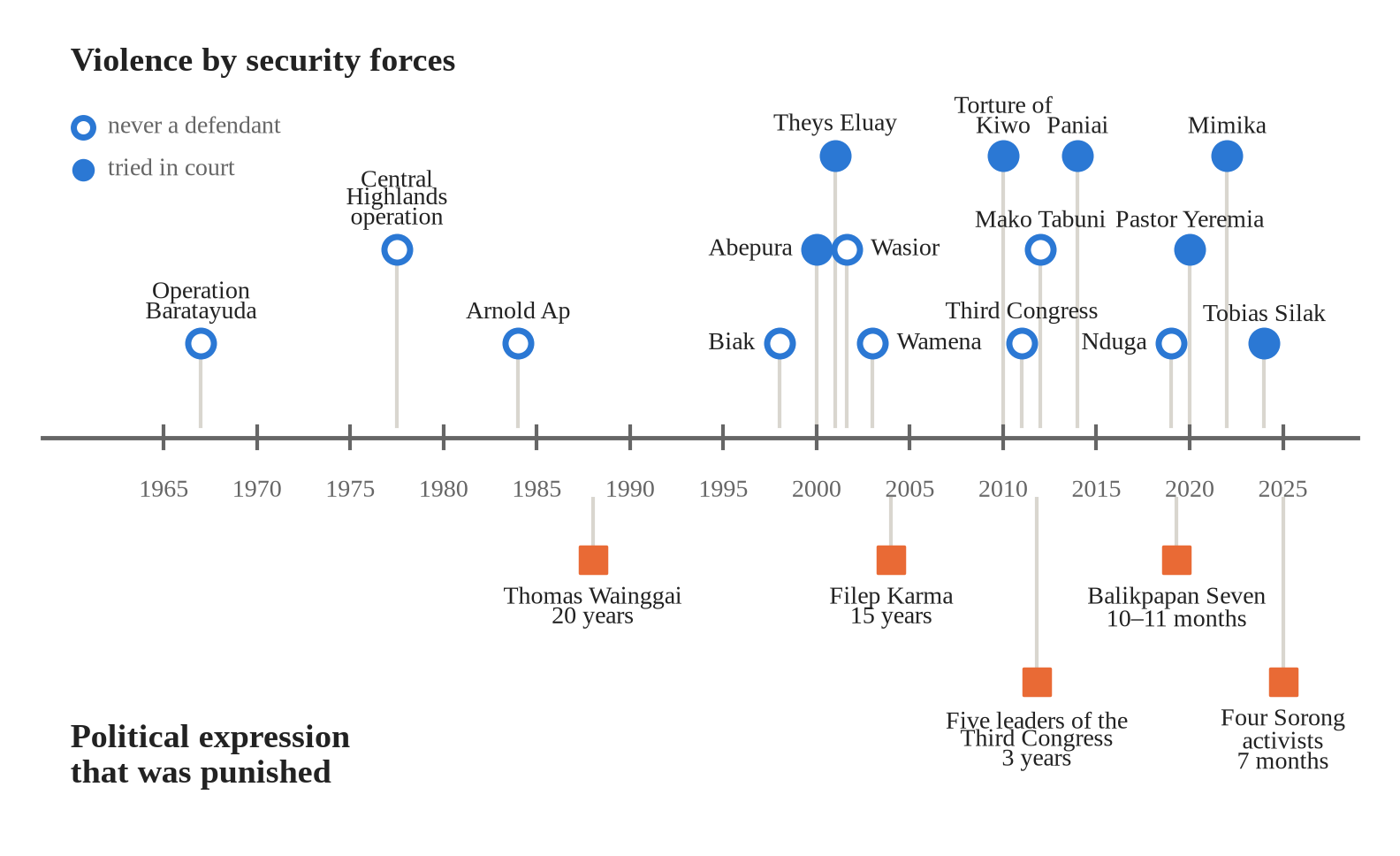
Figure 1. Timeline of the two legal tracks in Tanah Papua, 1963–2026
Source: compiled by the author from Table 1, Table 2, and Table 4.
Before looking at the size of sentences, the comparison of the two tracks at each stage is summarised in Table 5.
Table 5. Comparison of the two legal tracks in Tanah Papua
| Aspect | Security personnel suspected of violence | Papuans expressing political views |
|---|---|---|
| Legal basis | Human Rights Courts Law; Criminal Code and Military Criminal Code through military justice | Subversion Law (until 1999); treason articles of the Criminal Code; Government Regulation 77/2007 |
| Investigation | Dependent on Komnas HAM and the Attorney General’s Office; events before 2000 never investigated | Police and prosecutors act from the day of the event |
| Speed | Years; Wasior and Wamena still untried after more than two decades | Verdict within months |
| Who is tried | Field-level perpetrators or a single officer; commanders untouched | Leaders, activists, and ordinary citizens |
| Charges | Tend to be reduced (torture becomes disobeying orders) | Tend to be escalated (letters and ceremonies become treason) |
| Trial venue | Makassar, Surabaya, or military courts with limited access | Often moved outside Papua (Balikpapan, Makassar) |
| Direction of appeal | Tends to reduce (Mimika) | Can increase (Victor Yeimo) |
| After the verdict | Careers can continue (Hartomo) | Stigma, surveillance, and re-arrest |
| UN assessment | Impunity and uninvestigated killings (Human Rights Committee, 2024) | Arbitrary detention (Working Group, 2011) |
Source: compiled by the author from Tables 1–4 and sections 4–7.
Figure 2 compares the heaviest final prison sentences in cases that reached a verdict. The comparison is not meant to equate different acts. That is precisely the point: the acts in the upper part of the chart are torture, killing, and mutilation, while the acts in the lower part are flag ceremonies, a congress, demonstrations, and the delivery of letters. The two heaviest sentences in the lower part, 20 years for Thomas Wainggai and 15 years for Filep Karma, are equal to or heavier than the heaviest final sentence imposed on security personnel in the cases examined here.
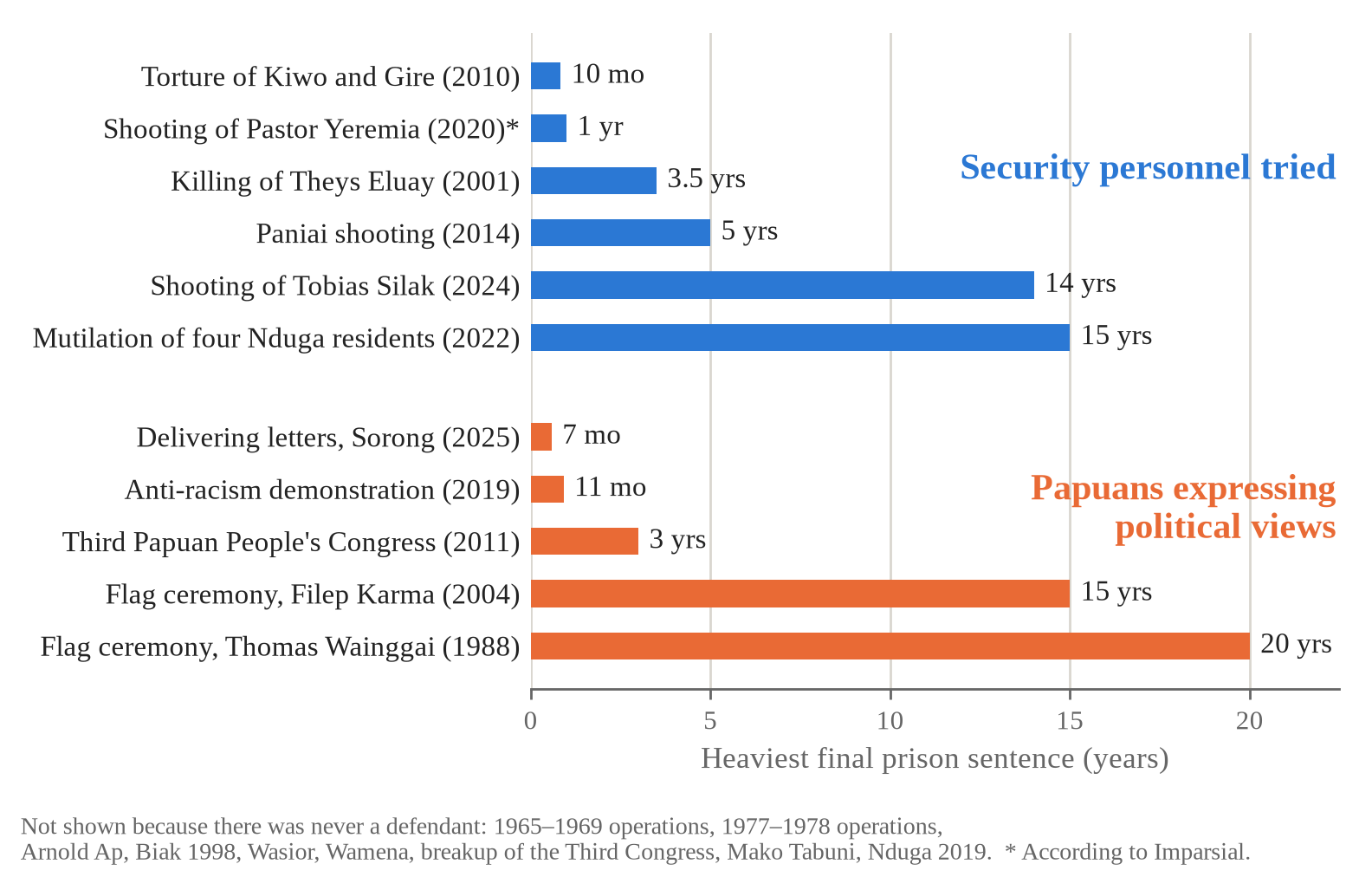
Figure 2. Heaviest prison sentences for security personnel and for Papuans expressing political views
Source: compiled by the author from Table 2 and Table 4.
8.2 Three mechanisms
The asymmetry in Table 5 is produced by three mutually reinforcing mechanisms. The first lies in institutional design. The Human Rights Courts Law divides authority between Komnas HAM as inquirer and the Attorney General’s Office as investigator without firm deadlines, so files can circulate endlessly (Hukumonline, 2015). Ad hoc human rights courts for events before 2000 can be established only on the recommendation of the DPR and by presidential decision, so justice for victims from the 1960s to 1998 depends entirely on political will. The Human Rights Court and the Truth and Reconciliation Commission in Papua mandated by the Special Autonomy Law were never established. Efforts to create a national truth and reconciliation commission stopped after the Constitutional Court annulled Law No. 27 of 2004 on the Truth and Reconciliation Commission in 2006, and no replacement law has yet been enacted (Constitutional Court Decision No. 006/PUU-IV/2006). In 2024 the UN Human Rights Committee urged Indonesia to expedite the adoption of a bill on truth and reconciliation (Human Rights Committee, 2024). Soldiers who commit ordinary crimes are still tried in the military justice system. All these design features lead to the same place: keeping security personnel away from open courts. Treason cases, by contrast, proceed through ordinary criminal procedure that is fast and unfiltered.
The second mechanism is language. In official statements, violence by security forces is called the act of rogue individuals, while Papuan political expression is called separatism. The first term separates the perpetrator from the institution, so the institution and the chain of command need not be examined. The second ties an individual act to a threat against the state, so heavy punishment seems reasonable. When the TNI described Definus Kogoya as a member of an armed criminal group shortly after the video of his torture circulated, the label served to reduce sympathy for the victim (CNN Indonesia, 2024). In Hernawan’s (2018) framework, both terms are part of the same message about whom the state protects and whom it regards as a threat.
The third mechanism is the source of the other two: the problem of political consent. Chauvel and Bhakti (2004) argue that Jakarta’s authority in Papua is fragile because it does not rest on Papuan consent, and that this fragility is both a cause and a consequence of reliance on violence. In such circumstances, trying the commanders of operations would mean exposing how that power is enforced, and investigating the events of the 1960s would mean reopening the history of integration, including the Pepera. Releasing all political prisoners and removing peaceful expression from the reach of the treason articles would mean acknowledging that Papuan political aspirations are a legitimate matter for discussion. For the state, these steps feel costly. Wiratraman and Hanrahan (2023) read the justice system’s inconsistencies towards Papuans as institutionalised exclusionary nationalism, and the findings of this study are consistent with that reading.
8.3 Accumulating consequences
This asymmetry leaves several consequences. Trust in the law collapses. The refusal of Pastor Yeremia’s family to accept military justice (Jakarta Post, 2020a) and Komnas HAM’s statement that the Paniai acquittal dashed victims’ hopes (Tirto.id, 2022) are signs of a distrust born of long experience. A law that is not trusted can hardly become a path to resolving conflict.
The memory of suffering also keeps growing. The Papua Road Map names memoria passionis as one of the roots of the conflict (Widjojo et al., 2009). Parents in the Central Highlands pass down stories of 1977, the people of Biak stories of the water tower, and the younger generation grows up with stories of Wasior, Wamena, Paniai, Nduga, and Intan Jaya, together with stories of relatives imprisoned for a flag.
The most worrying consequence concerns the space for peaceful politics. MacLeod (2015) notes that the Papuan movement has in recent decades shifted increasingly towards nonviolent civil resistance. The treason articles most often target precisely those forms of resistance: ceremonies, congresses, demonstrations, petitions, and letters. When the nonviolent path is criminalised while violence by security forces goes unpunished, the space for peaceful political struggle narrows. The International Crisis Group (2012) warned long ago that changing the way security forces treat Papuans is the quickest step towards halting the spiral of violence.
9. From the Courtroom to the Dialogue Table
If legal asymmetry is the expression of an unresolved political problem, reform in the courtroom alone will not end it. Revised laws and new courts are still needed, but as long as Papuan political aspirations are treated as crimes, there will always be people imprisoned for them, and as long as Papua is treated as a security problem, there will always be operations that claim victims and security personnel who are protected.
9.1 Lessons from failed attempts
The idea of dialogue has a long history. The Papua Road Map proposed it in 2009 as a way of addressing the four root causes simultaneously (Widjojo et al., 2009). The Papua Peace Network, coordinated by Father Neles Tebay, campaigned for Papua as a Land of Peace and urged the government to prepare an inclusive dialogue (Pamungkas, 2017). In August 2017, President Joko Widodo met Papuan leaders and approved Neles Tebay as a liaison. However, the government wanted a sectoral dialogue on development, not on human rights violations and political status, and the main resistance groups were not involved (RNZ, 2017). The process did not continue.
The second attempt came from Komnas HAM in its 2017–2022 term. After three exploratory meetings in Geneva, Komnas HAM, the Papuan People’s Assembly, the West Papua Council of Churches, and the United Liberation Movement for West Papua signed a memorandum of understanding on a Joint Humanitarian Pause on 11 November 2022, aimed among other things at addressing displaced people and political prisoners (Human Rights Monitor, 2022; Hukumonline, 2023c). The next Komnas HAM term stated that it was not in a position to continue the agreement because such initiatives were better undertaken by the parties to the conflict (Hukumonline, 2023a). The TNI Commander at the time also said he did not believe in the agreement (CNN Indonesia, 2023).
These two experiences reveal the conditions that were not met. The agenda was set unilaterally, the parties with the greatest stake were not involved, and there was no mediator neutral enough and strong enough to safeguard the process. The experience of Aceh shows that these conditions can be met. The conflict between the government and the Free Aceh Movement ended with a peace agreement on 15 August 2005 (Kumparan, 2023), the outcome of negotiations in Helsinki facilitated by a third party. The agreement did not resolve all of Aceh’s problems, but it stopped the violence and opened the way for the release of political prisoners.
9.2 Voices from outside and from within
Pressure for dialogue has also come from abroad. In September 2019, as Papua was swept by a wave of anti-racism protests, UN High Commissioner for Human Rights Michelle Bachelet encouraged the Indonesian government to engage in dialogue with the people of Papua about their aspirations and concerns (RNZ, 2019a). Pacific Islands Forum leaders that same year urged Indonesia and the Office of the High Commissioner to agree on the timing of a visit to Papua, while reaffirming recognition of Indonesian sovereignty (Pacific Islands Forum, 2019). At the 2022 Universal Periodic Review, a civil society coalition noted that the government did not support a single recommendation on investigation, accountability, and the prevention of impunity in Papua (Jakarta Post, 2023b). The government regards some of this international scrutiny as unbalanced, as its response to the statement by UN special rapporteurs in 2022 shows (Jakarta Post, 2022), and that position should be noted. Yet the recurring scrutiny shows that the problem will not disappear on its own.
From within the government, a similar awareness has begun to be heard. In May 2026, responding to the Komnas HAM report of 97 incidents of violence during 2025, Minister of Human Rights Natalius Pigai stated that resolving the Papua conflict requires a national decision involving the executive, the legislature, the judiciary, political parties, and national figures, and criticised the tendency of state institutions to handle Papuan issues case by case (Antara, 2026). That criticism is on target. The asymmetry described in this study cannot be resolved one case at a time.
9.3 Truth, justice, and dialogue as a single package
Dialogue without truth risks becoming an agreement to forget. Justice without dialogue risks becoming the punishment of a handful of people without changing the conditions that gave rise to the violence. This study therefore proposes that the three be pursued together. Releasing political prisoners can be a confidence-building step that opens the way to dialogue. A truth commission can work in parallel with dialogue, tracing violations since 1963 and laying the groundwork for reparations to victims. A human rights court can handle cases with sufficient evidence, so that dialogue does not turn into bargaining over impunity.
10. Conclusions and Recommendations
10.1 Conclusions
Since 1963, the law in Tanah Papua has moved along two trajectories that almost never intersect. On the security track, New Order military operations, the killing of Arnold Ap, and Biak 1998 were never investigated. Of the four gross human rights violations after 2000, only one produced a conviction, twelve years after the event and for one person. Other cases mostly went to military justice, with charges reduced and sentences cut. Beneath those cases, violence against civilians has occurred almost every year without any legal process at all. On the political expression track, flag ceremonies, congresses, demonstrations, and letters have been prosecuted as subversion or treason, sometimes with heavier sentences than those imposed on the killers of Papuans.
There has been progress, such as the Paniai cassation ruling, the verdict in the Yahukimo case, the President’s acknowledgement in 2023, and the 2025 amnesty. But that progress has come case by case and has not changed the design that produces the asymmetry. This study shows that the design rests on an unresolved political problem: the fragility of Papuan consent to the government that runs it. As long as that problem is answered with weapons and treason articles, the law will continue to wear two faces.
10.2 Recommendations
-
Release all political prisoners unconditionally. Everyone imprisoned for peaceful political expression, including for raising a flag, demonstrating, holding a congress, or delivering a letter, should be released unconditionally and without being required to admit guilt. This step should be accompanied by an end to new political arrests and to the transfer of trials outside Papua, the revocation of Government Regulation 77/2007, and the restriction of Articles 191 to 196 of the 2023 Criminal Code to acts involving actual violence or threats of violence. Without this, emptied prisons will soon be filled again.
-
Open a Jakarta–Papua dialogue mediated by a neutral third party. The government and Papuan representatives, including groups pursuing self-determination, need to sit down in an open and equal dialogue. The agenda should be agreed by both sides and cover the history of integration, human rights violations, and Papua’s political future. The experience of the 2017 sectoral dialogue and the 2022 Humanitarian Pause shows the need for a mediator trusted by both sides, as in the 2005 Aceh negotiations. Releasing political prisoners, halting military operations in residential areas, returning displaced people, and opening access for journalists, independent monitors, and the Office of the UN High Commissioner for Human Rights can serve as first steps.
-
Pursue truth-seeking and justice alongside dialogue. The Papua Truth and Reconciliation Commission mandated by the Special Autonomy Law should be established with a mandate to investigate violations since 1963, including the 1977–1978 operations and Biak 1998, and to formulate reparations for victims. At the same time, a Human Rights Court should be established in Papua, the Attorney General’s Office should follow up the Wasior and Wamena files, the President and the DPR should establish an ad hoc human rights court for events before 2000, and the Paniai cassation ruling should be followed by investigation of those bearing command responsibility.
-
Reform military justice as a guarantee of non-recurrence. The Military Justice Law should be revised so that soldiers who commit ordinary crimes against civilians are tried in general courts, torture is charged as torture, and military court rulings are published in full.
Justice in Papua will not be born of acknowledgements, amnesties, or a single ruling that comes too late. It becomes possible only when the same law is applied in the same measure to security personnel who carry weapons and to citizens who carry flags, and when the problem that for six decades has been answered with operations and prisons is finally discussed at the dialogue table.
References
Amnesty International. (1996). Indonesia: Death of prisoner of conscience Dr Thomas Wainggai (ASA 21/11/96). https://www.amnesty.org/en/documents/asa21/011/1996/en/
Amnesty International. (2023). Amnesty International report 2022/23: The state of the world’s human rights; Indonesia 2022. https://www.ecoi.net/en/document/2089535.html
Amnesty International. (2024). Indonesia: Further information: Judges find Victor Yeimo not guilty of treason (ASA 21/7642/2024). https://www.amnesty.org/en/documents/asa21/7642/2024/en/
Amnesty International Indonesia. (2018). ”Sudah, kasi tinggal dia mati”: Pembunuhan dan impunitas di Papua (ASA 21/8198/2018). https://www.amnesty.org/en/documents/asa21/8198/2018/id/
Amnesty International UK. (2020). 7 Papuan activists jailed for anti-racism protest. https://amnesty.org.uk/urgent-actions/7-papuan-activists-jailed-anti-racism-protest
Antara. (2025, 4 Agustus). Presiden Prabowo beri amnesti 1.178 terpidana. https://jogja.antaranews.com/berita/759253/presiden-prabowo-beri-amnesti-1178-terpidana
Antara. (2026, 10 Mei). Menteri HAM sebut penyelesaian konflik Papua butuh keputusan nasional. https://www.antaranews.com/berita/5562356/menteri-ham-sebut-penyelesaian-konflik-papua-butuh-keputusan-nasional
Asian Human Rights Commission. (2013). The neglected genocide: Human rights abuses against Papuans in the Central Highlands, 1977–1978. Asian Human Rights Commission & Human Rights and Peace for Papua. https://alrc.asia/the-neglected-genocide-human-rights-abuses-against-papuans-in-the-central-highlands-1977-1978/
Brundige, E., King, W., Vahali, P., Vladeck, S., & Yuan, X. (2004). Indonesian human rights abuses in West Papua: Application of the law of genocide to the history of Indonesian control. Allard K. Lowenstein International Human Rights Clinic, Yale Law School.
Budiardjo, C., & Liem, S. L. (1988). West Papua: The obliteration of a people (Edisi ke-3). TAPOL.
Chauvel, R., & Bhakti, I. N. (2004). The Papua conflict: Jakarta’s perceptions and policies (Policy Studies 5). East-West Center Washington. https://scholarspace.manoa.hawaii.edu/handle/10125/3518
CNN Indonesia. (2023, 3 Februari). Panglima TNI tak percaya kesepakatan jeda kemanusiaan di Papua. https://www.cnnindonesia.com/nasional/202302023014314-12-908354/panglima-tni-tak-percaya-kesepkatan-jeda-kemanusiaan-di-papua
CNN Indonesia. (2024, 24 Maret). Amnesty desak evaluasi penempatan TNI buntut aksi penyiksaan di Papua. https://www.cnnindonesia.com/nasional/20240323200338-12-1078191/amnesty-desak-evaluasi-penempatan-tni-buntut-aksi-penyiksaan-di-papua
CSIS. (2012). Violence hits Papua (again): A crisis in need of a leader. Center for Strategic and International Studies. https://csis.org/publication/violence-hits-papua-again-crisis-need-leader
detikNews. (2004, 2 September). Komnas HAM serahkan kasus Wasior & Wamena ke Kejagung. https://news.detik.com/berita/d-201813/komnas-ham-serahkan-kasus-wasior-wamena-ke-kejagung
detikNews. (2019, 14 Agustus). TNI soal Nduga: Kami hormati HAM dan tak sandera anak-anak. https://news.detik.com/berita/d-4666001/tni-soal-nduga-kami-hormati-ham-dan-tak-sandera-anak-anak
Drooglever, P. (2009). An act of free choice: Decolonisation and the right to self-determination in West Papua. Oneworld.
Elmslie, J., & Webb-Gannon, C. (2013). A slow-motion genocide: Indonesian rule in West Papua. Griffith Journal of Law and Human Dignity, 1(2), 142–166.
ETAN. (2013, 5 Juli). Groups urge justice for Biak, West Papua massacre. East Timor and Indonesia Action Network & West Papua Advocacy Team. https://www.etan.org/news/2013/07biak.htm
Freedom Now. (2015). Media release: Papuan activist Filep Karma released from prison. https://www.freedom-now.org/media-release-papuan-activist-filep-karma-released-from-prison-2/
GoodStats. (2025). Ragam bentuk kekerasan di Tanah Papua, penembakan paling sering. https://data.goodstats.id/statistic/ragam-bentuk-kekerasan-di-tanah-papua-penembakan-paling-sering-UHNnP
Hernawan, B. (2018). Torture and peacebuilding in Indonesia: The case of Papua. Routledge.
Hukumonline. (2015). Bolak-balik berkas dinilai langgar hak korban. https://www.hukumonline.com/berita/a/bolak-balik-berkas-dinilai-langgar-hak-korban-lt55e55e34d0f19
Hukumonline. (2018). MK tegaskan pasal makar dalam KUHP tetap konstitusional. https://www.hukumonline.com/berita/a/mk-tegaskan-pasal-makar-dalam-kuhp-tetap-konstitusional-lt5a72c0085038c
Hukumonline. (2023a). 4 sikap Komnas HAM tentang jeda kemanusiaan di Papua. https://www.hukumonline.com/berita/a/4-sikap-komnas-ham-tentang-jeda-kemanusiaan-di-papua-lt63e4b72c0fc8c/
Hukumonline. (2023b). Komnas HAM apresiasi vonis seumur hidup pelaku mutilasi warga Papua. https://www.hukumonline.com/berita/a/komnas-ham-apresiasi-vonis-seumur-hidup-pelaku-mutilasi-warga-papua-lt63d11b5a326d6/
Hukumonline. (2023c). Menagih janji pemerintah tuntaskan konflik bersenjata di Tanah Papua. https://www.hukumonline.com/berita/a/menagih-janji-pemerintah-tuntaskan-konflik-bersenjata-di-tanah-papua-lt63e3143c436f5
Hukumonline. (2024, 22 Oktober). Daftar 12 peristiwa pelanggaran HAM berat di Indonesia. https://www.hukumonline.com/berita/a/daftar-12-peristiwa-pelanggaran-ham-berat-di-indonesia-lt63bf8f6412ecd
Human Rights Committee. (2024). Concluding observations on the second periodic report of Indonesia (CCPR/C/IDN/CO/2). United Nations. https://digitallibrary.un.org/record/4045908
Human Rights Monitor. (2022). West Papua: Agreement of conflict parties over humanitarian pause. https://humanrightsmonitor.org/news/west-papua-agreement-of-conflict-parties-over-humanitarian-pause/
Human Rights Monitor. (2023a). Papuan activist Victor Yeimo found guilty of treason after prosecutor’s appeal: Longer sentence imposed. https://humanrightsmonitor.org/news/papuan-activist-victor-yeimo-found-guilty-of-treason-after-prosecutors-appeal-longer-sentence-imposed/
Human Rights Monitor. (2023b). One year after the killing and mutilation of 4 Papuans from Nduga: Sentences handed down by military tribunal more lenient than civilian court verdicts. https://humanrightsmonitor.org/news/one-year-after-the-killing-and-mutilation-of-4-papuans-from-nduga-sentences-handed-down-by-military-tribunal-more-lenient-than-civilian-court-verdicts/
Human Rights Monitor. (2025a). Police officer sentenced to 14 years for the fatal shooting of Tobias Silak. https://humanrightsmonitor.org/news/police-officer-sentenced-to-14-years-for-the-fatal-shooting-of-tobias-silak/
Human Rights Monitor. (2025b). Four political prisoners from Sorong found guilty of treason and sentenced to seven months in prison for delivering letters. https://humanrightsmonitor.org/news/four-political-prisoners-in-sorong-found-guilty-of-treason-and-sentenced-to-seven-months-in-prison-for-delivering-letters/
Human Rights Watch. (2010). Prosecuting political aspiration: Indonesia’s political prisoners. https://www.hrw.org/report/2010/06/22/prosecuting-political-aspiration/indonesias-political-prisoners
Human Rights Watch. (2011, 9 Februari). Indonesian military gets away with torture. https://www.hrw.org/news/2011/02/09/indonesian-military-gets-away-torture
Human Rights Watch. (2012, 16 Maret). Indonesia: Five Papuans convicted for peaceful protest. https://www.hrw.org/news/2012/03/16/indonesia-five-papuans-convicted-peaceful-protest
Human Rights Watch. (2024a, 28 Maret). Indonesian army apologizes after torture video goes viral. https://www.hrw.org/news/2024/03/28/indonesian-army-apologizes-after-torture-video-goes-viral
Human Rights Watch. (2024b, 1 November). Filep Karma: Political prisoner who fought racism in West Papua. https://www.hrw.org/news/2024/11/01/filep-karma-political-prisoner-who-fought-racism-west-papua
Human Rights Watch. (2026, 9 September). Indonesian military court reduces acid attack sentences. https://hrw.org/news/2026/09/09/indonesian-military-court-reduces-acid-attack-sentences
Institute for Criminal Justice Reform. (2017). Mengembalikan makna “makar” dalam hukum pidana Indonesia: Uji materil ICJR terhadap pasal-pasal makar dalam KUHP di Mahkamah Konstitusi dalam perkara No. 7/PUU-XV/2017. https://icjr.or.id/wp-content/uploads/2017/10/Mengembalikan-Makna-Makar.pdf
International Crisis Group. (2012). Indonesia: Dynamics of violence in Papua (Asia Report No. 232). https://www.refworld.org/reference/countryrep/icg/2012/en/88080
Jakarta Post. (2011, 31 Januari). Papua violence should lead to military court reform. https://www.thejakartapost.com/news/2011/01/31/papua-violence-should-lead-military-court-reform.html
Jakarta Post. (2012a, 17 Maret). Papuans found guilty of subversion, get 3-year jail terms. https://www.thejakartapost.com/news/2012/03/17/papuans-found-guilty-subversion-get-3-year-jail-terms
Jakarta Post. (2012b, 15 Juni). Riots in Jayapura as police shoot dead Papuan activist. https://www.thejakartapost.com/news/2012/06/15/riots-jayapura-police-shoot-dead-papuan-activist.html
Jakarta Post. (2016a, 24 September). Activists question Hartomo’s promotion. https://www.thejakartapost.com/news/2016/09/24/activists-question-hartomo-s-promotion.html
Jakarta Post. (2016b, 14 November). Old problems hinder Papua taskforce. https://www.thejakartapost.com/news/2016/11/14/old-problems-hinder-papua-taskforce.html
Jakarta Post. (2020a, 12 November). Family demand those behind Papuan pastor’s killing be brought to human rights court. https://www.thejakartapost.com/news/2020/11/12/family-demand-those-behind-papuan-pastors-killing-be-brought-to-human-rights-court.html
Jakarta Post. (2020b, 13 November). Army military police name eight soldiers suspects in Intan Jaya house fire. https://www.thejakartapost.com/news/2020/11/13/army-military-police-name-eight-soldiers-suspects-in-intan-jaya-house-fire.html
Jakarta Post. (2021, 2 September). Arnold Ap: Papua’s lost cultural crusader gets long-delayed recognition. https://www.thejakartapost.com/life/2021/09/02/arnold-ap-papuas-lost-cultural-crusader-gets-long-delayed-recognition
Jakarta Post. (2022, 2 Maret). Indonesia dismisses UN experts' call to probe alleged abuses in Papua. https://www.thejakartapost.com/indonesia/2022/03/02/indonesia-dismisses-un-experts-call-to-probe-alleged-abuses-in-papua
Jakarta Post. (2023a, 7 Januari). AGO appeals against 'Bloody Paniai' ruling. https://www.thejakartapost.com/paper/2023/01/07/ago-appeals-against-bloody-paniai-ruling.html
Jakarta Post. (2023b, 27 Maret). RI under pressure to fully embrace UPR recommendations. https://www.thejakartapost.com/paper/2023/03/27/ri-under-pressure-to-fully-embrace-upr-recommendations.html
Jubi. (2023, 29 Agustus). Family of Mimika mutilation victims disappointed over reduced sentence for perpetrator. https://en.jubi.id/family-of-mimika-mutilation-victims-disappointed-over-reduced-sentence-for-perpetrator/
Jubi. (2025, 9 Agustus). Pemberian amnesti kepada tapol Papua dianggap pembohongan publik. https://jubi.id/polhukam/2025/pemberian-amnesti-kepada-tapol-papua-dianggap-pembohongan-publik/
Kabar24. (2018, 31 Januari). Uji materi pasal makar: Begini putusan Mahkamah Konstitusi. https://kabar24.bisnis.com/read/20180131/15/732882/uji-materi-pasal-makar-begini-putusan-mahkamah-konstitusi
Kabar24. (2025, 2 Agustus). Terpidana penghina Jokowi juga nikmati amnesti dari Prabowo. https://kabar24.bisnis.com/read/20250802/15/1898704/terpidana-penghina-jokowi-juga-nikmati-amnesti-dari-prabowo
Keputusan Presiden Nomor 17 Tahun 2025 tentang Pemberian Amnesti.
Kirchheimer, O. (1961). Political justice: The use of legal procedure for political ends. Princeton University Press.
Kirksey, E. (2012). Freedom in entangled worlds: West Papua and the architecture of global power. Duke University Press.
KontraS. (2025, 14 Juni). 20 years after Wasior Tragedy: State remains mute, impunity continues [Siaran pers, terjemahan IndoLeft]. https://www.indoleft.org/statements/2025-06-14/20-years-after-wasior-tragedy-state-remains-mute-impunity-continues.html
Kumparan. (2023). Melewati batas nyali demi damai Papua. https://kumparan.com/kumparannews/melewati-batas-nyali-demi-damai-papua-1zpEjWl2Huu
MacLeod, J. (2015). Merdeka and the Morning Star: Civil resistance in West Papua. University of Queensland Press.
Medcom.id. (2020). Aparat terlibat penembakan Pendeta Yeremia harus diproses di peradilan umum. https://www.medcom.id/nasional/hukum/yKXDzBaK-aparat-terlibat-penembakan-pendeta-yeremia-harus-diproses-di-peradilan-umum
Musgrave, T. D. (2015). An analysis of the 1969 Act of Free Choice in West Papua. Dalam C. Chinkin & F. Baetens (Ed.), Sovereignty, statehood and state responsibility: Essays in honour of James Crawford (hlm. 209–228). Cambridge University Press.
NU Online. (2025, 16 Desember). YLBHI: Operasi militer di Papua berlangsung sejak 1961 dan tak pernah benar-benar berakhir. https://nu.or.id/nasional/ylbhi-operasi-militer-di-papua-berlangsung-sejak-1961-dan-tak-pernah-benar-benar-berakhir-jsGsE
NU Online. (2026, 16 Februari). Imparsial bongkar vonis ringan di peradilan militer, sebut jadi sarana impunitas tentara. https://nu.or.id/nasional/imparsial-bongkar-vonis-ringan-di-peradilan-militer-sebut-jadi-sarana-impunitas-tentara-kmqH5
Ombudsman RI. (2019, 29 Agustus). Ombudsman pertanyakan pemerintah tak punya data pengungsi Nduga. https://ombudsman.go.id/news/r/ombudsman-pertanyakan-pemerintah-tak-punya-data-pengungsi-nduga
Osborne, R. (1985). Indonesia’s secret war: The guerilla struggle in Irian Jaya. Allen & Unwin.
Pacific Islands Forum. (2019). Fiftieth Pacific Islands Forum, Funafuti, Tuvalu, 13–16 August 2019: Forum communiqué (PIF(19)14). https://forumsec.org/publications/fiftieth-pacific-islands-forum-tuvalu-13-16-august-2019
Pamungkas, C. (2017). The campaign of Papua Peace Network for Papua Peace Land. Jurnal Ilmu Sosial dan Ilmu Politik, 21(2), 147–159. https://doi.org/10.22146/jsp.30440
Papuans Behind Bars. (2026a). Annual overview 2025. https://papuansbehindbars.org/annual-overview-2025/
Papuans Behind Bars. (2026b). Quarterly update October–December 2025. https://papuansbehindbars.org/q4-2025/
Parliamentary Assembly of the Council of Europe. (2012). The definition of political prisoner (Resolution 1900).
Peraturan Pemerintah Nomor 77 Tahun 2007 tentang Lambang Daerah.
PINA. (2024, 24 Juli). Fiji, PNG fail to secure UN human rights mission to Indonesia’s Papuan provinces. Pacific Islands News Association. https://pina.com.fj/2024/07/24/fiji-png-fail-to-secure-un-human-rights-mission-to-indonesias-papuan-provinces/
Putusan Mahkamah Konstitusi Nomor 006/PUU-IV/2006 tentang Pengujian Undang-Undang Nomor 27 Tahun 2004 tentang Komisi Kebenaran dan Rekonsiliasi.
RNZ. (2005, 9 September). Papua secession campaigners scorn acquittal of Indonesian police officer. https://www.rnz.co.nz/international/pacific-news/157405/papua-secession-campaigners-scorn-acquittal-of-indonesian-police-officer
RNZ. (2017, 5 September). Signs that Jakarta is entering West Papua dialogue process. https://www.rnz.co.nz/international/pacific-news/338714/signs-that-jakarta-is-entering-west-papua-dialogue-process
RNZ. (2019a, 5 September). UN rights chief urges Indonesia to engage with Papuans on aspirations. https://www.rnz.co.nz/international/pacific-news/398148/un-rights-chief-urges-indonesia-to-engage-with-papuans-on-aspirations
RNZ. (2019b, 9 September). UN rights chief unable to secure West Papua visit. https://www.rnz.co.nz/international/pacific-news/398405/un-rights-chief-unable-to-secure-west-papua-visit
Saltford, J. (2003). The United Nations and the Indonesian takeover of West Papua, 1962–1969: The anatomy of betrayal. RoutledgeCurzon.
Sekretariat Kabinet Republik Indonesia. (2023, 11 Januari). Presiden tegaskan upaya pemerintah agar pelanggaran HAM berat tidak terjadi lagi. https://setkab.go.id/presiden-tegaskan-upaya-pemerintah-agar-pelanggaran-ham-berat-tidak-terjadi-lagi/
Tamanaha, B. Z. (2004). On the rule of law: History, politics, theory. Cambridge University Press.
Tirto.id. (2020). Divonis makar & 11 bulan penjara, Buchtar Tabuni: Saya tidak salah. https://tirto.id/divonis-makar-11-bulan-penjara-buchtar-tabuni-saya-tidak-salah-fJio
Tirto.id. (2022, 9 Desember). Komnas HAM: Vonis bebas terdakwa Paniai pupuskan harapan korban. https://tirto.id/komnas-ham-vonis-bebas-terdakwa-paniai-pupuskan-harapan-korban-gzAC
Tirto.id. (2026, 18 November). MA batalkan vonis bebas terdakwa kasus HAM berat Paniai. https://tirto.id/ma-batalkan-vonis-bebas-terdakwa-kasus-ham-berat-paniai-idWP
UCA News. (2025, 2 September). Indonesian activists demand return of four arrested Papuans. https://www.ucanews.com/news/indonesian-activists-demand-return-of-four-arrested-papuans/110155
UN News. (2022, 1 Maret). Indonesia: Shocking abuses against indigenous Papuans, rights experts report. https://news.un.org/en/story/2022/03/1113062
Undang-Undang Nomor 31 Tahun 1997 tentang Peradilan Militer.
Undang-Undang Nomor 26 Tahun 2000 tentang Pengadilan Hak Asasi Manusia.
Undang-Undang Nomor 21 Tahun 2001 tentang Otonomi Khusus bagi Provinsi Papua.
Undang-Undang Nomor 1 Tahun 2023 tentang Kitab Undang-Undang Hukum Pidana.
United Nations Commission on Human Rights. (2005). Updated set of principles for the protection and promotion of human rights through action to combat impunity (E/CN.4/2005/102/Add.1).
Widjojo, M. S., Elisabeth, A., Al Rahab, A., Pamungkas, C., & Dewi, R. (2009). Papua road map: Negotiating the past, improving the present and securing the future. Yayasan Obor Indonesia, LIPI, & TIFA Foundation.
Wiratraman, H. P., & Hanrahan, E. (2023). Exclusionary nationalism as institutionalised racism: Inconsistencies within the Indonesian justice system. Australian Journal of Asian Law, 24(2), 81–99.
Working Group on Arbitrary Detention. (2012). Opinion No. 48/2011 (Indonesia), concerning Filep Jacob Semuel Karma (A/HRC/WGAD/2011/48). United Nations Human Rights Council. https://digitallibrary.un.org/record/729058
How to cite
Dumupa, Y. (2026). Two faces of the law in Tanah Papua: Impunity for security forces, prison for political expression [Scholarly article]. Yakobus Dumupa. https://yakobusdumupa.com/kajian/dua-wajah-hukum-di-tanah-papua?lang=en
About the Author
Yakobus Dumupa
Writer, organic intellectual and activist from the Land of Papua, with an educational background in political science, government and anthropology. He served as a member of the Papuan People's Assembly (2012–2016) and as Regent of Dogiyai (2017–2022), and has written dozens of books and hundreds of articles.
Read biography