Scholarly Article
The Jakarta–Papua Dialogue That Has Yet to Materialise: Lessons from Aceh, Bougainville, and Mindanao for the Peaceful Resolution of the Papua Conflict
Abstrak
Gagasan dialog Jakarta–Papua sudah beredar lebih dari seperempat abad, sejak Tim 100 bertemu Presiden B. J. Habibie pada Februari 1999. Namun hingga akhir 2026 gagasan itu belum pernah menjadi perundingan resmi antara pihak-pihak yang bertikai. Artikel ini menelusuri sebabnya dengan membandingkan Papua dengan tiga proses damai yang kerap dijadikan rujukan: Aceh di Indonesia, Bougainville di Papua Nugini, dan Mindanao di Filipina. Penelitian ini merupakan riset kepustakaan dengan pendekatan kualitatif dan perbandingan kasus terstruktur. Sumbernya meliputi naskah perjanjian dan undang-undang, laporan lembaga riset dan organisasi internasional, kajian akademik, serta pemberitaan media yang diperiksa silang. Analisis dipandu enam syarat keberhasilan dialog yang diturunkan dari teori kematangan konflik, pengelolaan pihak perusak (spoiler), dan pembangunan perdamaian. Hasilnya menunjukkan bahwa ketiga kasus pembanding sampai ke meja perundingan karena sebagian besar syarat itu terpenuhi pada waktu yang sama: kedua pihak merasakan dorongan untuk berunding, ada wakil yang diakui, ada pihak ketiga yang dipercaya, agendanya menyentuh soal pokok, dan pelaksanaannya dipantau. Di Papua syarat-syarat itu belum pernah bertemu. Pemerintah memandang Papua sebagai urusan pembangunan dalam negeri, sedangkan kelompok prokemerdekaan menuntut agenda status politik dan mediasi internasional. Jarak itu belum dijembatani oleh pihak ketiga yang diterima kedua belah pihak. Artikel ini menyimpulkan bahwa kebuntuan dialog bersumber dari belum adanya kesepakatan tentang siapa yang berunding, apa yang dirundingkan, dan bagaimana caranya, bukan dari kurangnya gagasan. Karena itu, langkah awal yang paling masuk akal adalah "dialog tentang dialog", yakni perundingan pendahuluan untuk menyepakati para pihak, agenda, dan fasilitator.
Kata kunci: dialog Jakarta–Papua; resolusi konflik; Aceh; Bougainville; Mindanao; mediasi pihak ketiga
Abstract
The idea of a Jakarta–Papua dialogue has circulated for more than a quarter of a century, since the Team of 100 met President B. J. Habibie in February 1999. Yet by the end of 2026 it had never become a formal negotiation between the parties to the conflict. This article asks why, by comparing Papua with three peace processes often cited as models: Aceh in Indonesia, Bougainville in Papua New Guinea, and Mindanao in the Philippines. The study is library-based research using a qualitative approach and structured, focused comparison. Sources include peace agreements and statutes, reports by research institutes and international organisations, academic studies, and cross-checked media reporting. The analysis is guided by six conditions for successful dialogue drawn from theories of conflict ripeness, spoiler management, and peacebuilding. The three comparison cases reached the negotiating table because most of these conditions were met at the same time: both sides felt pressure to negotiate, recognised representatives existed, a trusted third party was present, the agenda addressed core issues, and implementation was monitored. In Papua these conditions have never converged. The government treats Papua as a domestic development matter, while pro-independence groups demand an agenda on political status and international mediation, and no third party acceptable to both has bridged that gap. The article concludes that the impasse stems less from a shortage of ideas than from the absence of agreement on who negotiates, what is negotiated, and how. A realistic first step is therefore a "dialogue about dialogue": preliminary talks to agree on the parties, the agenda, and the facilitator.
Keywords: Jakarta–Papua dialogue; conflict resolution; Aceh; Bougainville; Mindanao; third-party mediation
1. Introduction
1.1 Background
The Papua conflict is among the longest-running conflicts in Southeast Asia without a resolution. Its roots have, in fact, been mapped quite clearly. The Indonesian Institute of Sciences (LIPI) research team identified four sources of the problem in the Papua Road Map: the history and political status of Papua’s integration into Indonesia; state violence and human rights violations since 1965; development failures in education, health, and the people’s economy; and the marginalisation of and discrimination against Indigenous Papuans (Widjojo et al., 2009). The road map also proposed a way to address them: dialogue. Since then, the phrase “Jakarta–Papua dialogue” has entered a shared vocabulary. Church leaders, academics, parliamentarians, human rights organisations, and even some government officials have used it. Yet a widely accepted term does not necessarily have an agreed meaning.
Looking further back, efforts towards dialogue began long before the term became popular. On 26 February 1999, the Team of 100, led by Tom Beanal, met President B. J. Habibie at the State Palace and conveyed the Papuan people’s desire for independence. The meeting had no follow-up; discussion of it was subsequently prohibited (Human Rights Watch, 2001). Abdurrahman Wahid’s administration opened more space, including restoring the name Papua and assisting the organisation of the Second Papua Congress in 2000. That space narrowed again, however, when leaders of the Papua Presidium Council were arrested towards the end of the same year (Chauvel & Bhakti, 2004). Law No. 21 of 2001 on Special Autonomy for Papua Province then became Jakarta’s response—a response formulated without negotiations with groups demanding independence (McGibbon, 2004).
The following two decades saw a succession of efforts. Father Neles Tebay, who later coordinated the Papua Peace Network, systematically developed the idea of dialogue (Tebay, 2009). Susilo Bambang Yudhoyono’s administration offered “constructive communication” and established the Unit for the Acceleration of Development in Papua and West Papua Provinces (UP4B) (International Crisis Group [ICG], 2011). President Joko Widodo met Papuan religious leaders in August 2017 and mentioned the possibility of “sectoral dialogue” (RNZ, 2017). The National Commission on Human Rights (Komnas HAM) for the 2017–2022 term signed a memorandum of understanding on a Joint Humanitarian Pause in Geneva in November 2022, which commissioners for the following term revoked in February 2023 (Hukumonline, 2023). Prabowo Subianto’s administration offered an amnesty in 2025, but many considered the offer meaningless without dialogue (CNN Indonesia, 2025a). All these efforts stopped before reaching the negotiating table.
Meanwhile, violence continued. Records from the Commission for the Disappeared and Victims of Violence (KontraS), cited by Kompas.com (2023b), reported 60,642 displaced civilians and 732 deaths resulting from armed conflict in Papua. According to Human Rights Monitor, as cited by Pamungkas (2026), the number of internally displaced people had reached 105,878 in January 2026. At the same time, three other conflicts in the same region moved in a different direction. Aceh achieved peace through the Helsinki Memorandum of Understanding in 2005. Bougainville held a referendum in 2019 and now awaits a decision from Papua New Guinea’s parliament. The Bangsamoro region in Mindanao held its first parliamentary election in September 2026. These different outcomes invite a simple but difficult question: what do those three regions possess that Papua lacks?
1.2 Research questions
Against this background, the article addresses three questions.
- How have efforts towards Jakarta–Papua dialogue unfolded from 1999 to 2026, and at what point did each effort stop?
- What conditions enabled the peace processes in Aceh, Bougainville, and Mindanao to move from armed conflict to negotiations and agreements?
- Which conditions remain unmet in Papua, and what does this mean for the prospects of future dialogue?
1.3 Aims and contribution
The article aims to explain the impasse in Jakarta–Papua dialogue comparatively, rather than merely reiterating that dialogue is necessary. Existing studies of dialogue in Papua have mostly been normative, explaining why dialogue is needed and what its ideal form would be (Tebay, 2009; Widjojo et al., 2009; Sihaloho et al., 2022). Comparisons with Aceh have been made (McGibbon, 2004), but few studies place Papua alongside several cases at once, use an explicit framework, and update their data to the latest developments. This article seeks to fill that gap. Its contribution is twofold. Academically, it examines whether conditions for dialogue formulated in conflict-resolution theory can explain the different outcomes in the four regions. Practically, it maps unmet conditions so that discussion of dialogue in Papua can move from “is it necessary?” to “what must be prepared first?”
2. Literature Review and Analytical Framework
2.1 Dialogue, negotiation, and peace
In Indonesian public discussion, “dialogue” often refers to different things: a meeting between the president and community leaders, a development consultation forum, or political negotiations between the government and an armed movement. Conflict-resolution studies distinguish these more clearly. Galtung (1969) separates negative peace, the cessation of direct violence, from positive peace, the elimination of structural violence embedded in the social and political order. This distinction matters in Papua because violence there encompasses not only armed clashes but also longstanding inequality and discrimination. Dialogue that merely stops shooting without addressing structural roots will produce a pause, not peace.
Lederach (1997) adds that lasting peace is built simultaneously at three levels of leadership: top-level leaders who negotiate, middle-level leaders such as religious leaders, academics, and customary leaders who build bridges, and the grassroots who bear the consequences of conflict daily. This framework explains why many Papuan dialogue initiatives originate at the middle level, for example within churches and civil-society networks, but never reach the top level. In this article, “dialogue” is understood in its narrowest and most decisive sense: structured political negotiations between a government and representatives of those who challenge its authority, with an agreed agenda and binding outcomes.
2.2 Conflict ripeness
Zartman (2000) argues that parties will engage seriously in negotiations only when a conflict is “ripe”. Ripeness has two features. First, both parties perceive a mutually hurting stalemate: neither is confident of victory, while the costs of continuing the conflict grow heavier. Second, both see a plausible way out through negotiations. Perceptions, rather than objective circumstances alone, are decisive. A conflict may be highly damaging, but if one party still believes it can win or considers the costs bearable, negotiations will not begin. This theory is often used to explain Aceh, where large-scale military operations in 2003–2004 and the tsunami disaster at the end of 2004 changed both parties’ calculations (Aspinall, 2008).
2.3 Spoilers and commitment
Stedman (1997) shows that the greatest threats to peace processes often come from spoilers: leaders or groups who feel their interests threatened by peace and seek to undermine it. Spoilers may exist within a government, within a resistance movement, or outside both. According to Stedman, the success of a peace process depends on the ability of third parties and supporters of peace to identify different types of spoilers and manage them appropriately. Braithwaite et al. (2010) complement this perspective with Bougainville’s experience. They show that peace is built gradually through a series of interlocking commitments, making retreat more costly than progress.
2.4 Previous studies of dialogue in Papua
Studies of dialogue in Papua can be grouped into three streams. The first is normative and programmatic. Tebay (2009) explains dialogue from a Papuan perspective, including its principles and preparatory stages. Widjojo et al. (2009) position dialogue as one of four major agendas in the Papua Road Map, alongside recognition, a new development paradigm, and reconciliation over human rights violations. Sihaloho et al. (2022) examine the dialogue narrative through a national-resilience framework and find that the central government and the Papuan side understand dialogue differently.
The second stream examines Jakarta’s policies. Chauvel and Bhakti (2004) describe Jakarta elites’ perceptions, which view Papuan demands primarily as a threat to national integrity. McGibbon (2004) compares special autonomy in Aceh and Papua and concludes that autonomy designed without negotiations has difficulty gaining legitimacy. ICG reports (2010, 2011) document how development approaches have repeatedly been offered as substitutes for political dialogue. Bertrand (2004) and King (2004) locate Papua within a broader picture of nationalism and ethnic conflict in Indonesia after the New Order.
The third stream comprises comparative studies of regional peace processes: Aceh (Aspinall, 2008; Feith, 2007; Kingsbury, 2006), Bougainville (Braithwaite et al., 2010; Regan, 2010), and Mindanao (Herbolzheimer, 2015). These studies are rich, but are rarely connected systematically to Papua. This is the gap the article seeks to fill.
2.5 Analytical framework: six conditions for dialogue
Drawing on the theories and studies above, this article formulates six conditions that together enable separatist conflicts to move to the negotiating table and produce lasting agreements. These six conditions are not a checklist that must be completed before dialogue begins. They are better understood as mutually reinforcing conditions: the more conditions fulfilled simultaneously, the greater the chances that negotiations will proceed and endure.
- Ripeness. Both parties perceive a damaging stalemate and see negotiations as a way out (Zartman, 2000).
- Credible representatives. Recognised representatives exist for each side and can bind their followers to the outcome of negotiations.
- A trusted third party. A mediator or facilitator is accepted by both parties, possesses technical capacity, and can maintain confidentiality and negotiating momentum.
- An agenda addressing root causes. Negotiations cover the sources of conflict rather than just its symptoms, and formulations allow room for compromise on both sides.
- Monitoring and guarantees. Mechanisms oversee implementation of the agreement, particularly during the vulnerable transition period.
- Spoiler management and constituent support. The parties and their supporters can restrain groups seeking to undermine the process, and the agreement has constituent support on both sides (Stedman, 1997; Lederach, 1997).
Figure 1 summarises the framework as used in the analysis.
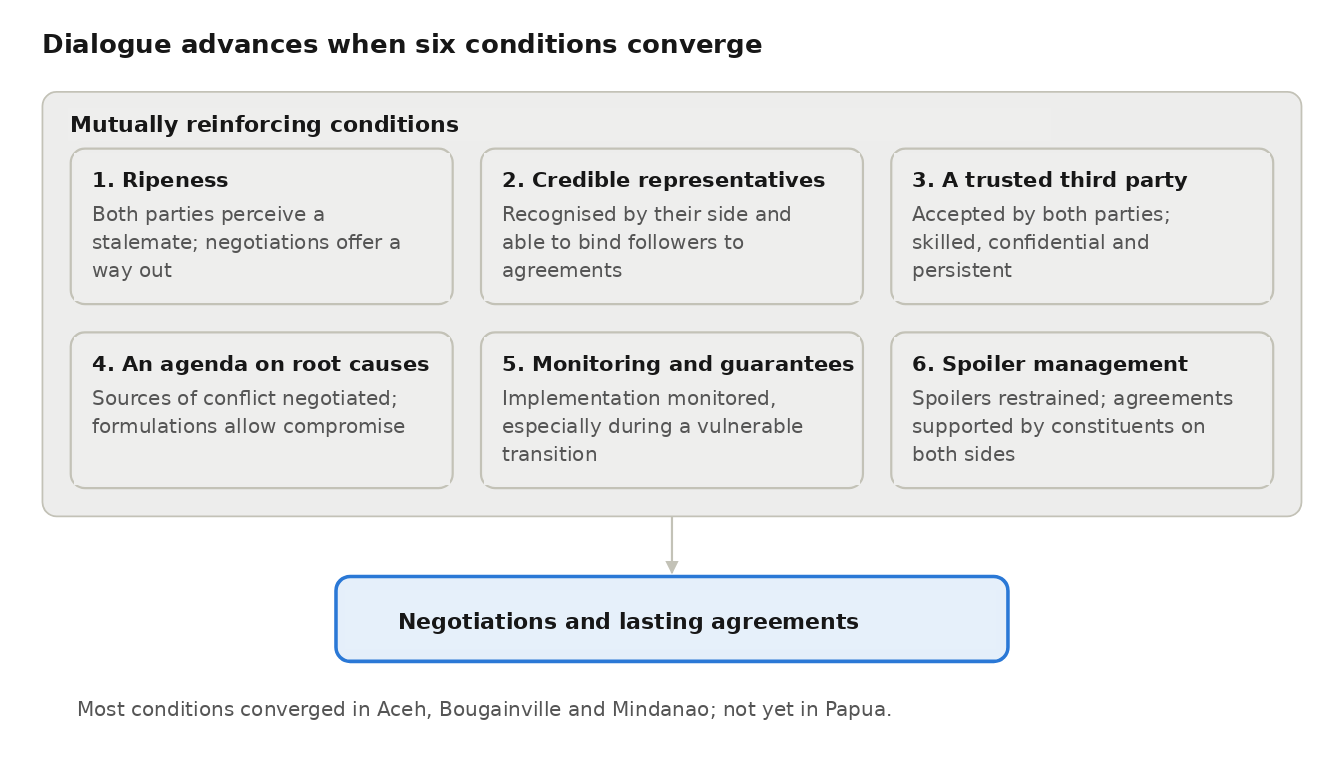
Figure 1. Analytical framework: six conditions for dialogue
Source: prepared by the author from Zartman (2000), Stedman (1997), Lederach (1997), and Braithwaite et al. (2010).
These six conditions serve as an interpretive tool, not a formula. Each case is assessed according to whether each condition was present when negotiations began, then compared with the situation in Papua.
3. Research Method
3.1 Approach and design
This study is library-based research using a qualitative approach. All data come from written documents; the author conducted no interviews or field observations. Its design follows the structured, focused comparison method formulated by George and Bennett (2005). In this method, each case is examined using the same set of questions, allowing findings across cases to be compared systematically rather than merely narrated side by side. The standard questions used here derive from the six conditions for dialogue in Figure 1.
3.2 Case selection
Three cases were selected because of their similarities to Papua in aspects important to the analysis, alongside their different outcomes. Aceh is a separatist conflict within the same country, with the same central government and military, and a special-autonomy framework similar to Papua’s. Bougainville is a conflict in a Melanesian territory in Papua’s nearest neighbouring country, likewise involving a major mine, cultural identity, and demands for independence. Mindanao illustrates prolonged negotiations that experienced several failures and involved intensive international third-party participation, including Indonesia itself in negotiations with the Moro National Liberation Front (MNLF) in the 1990s. All three also ended in negotiated forms of autonomy or political-status determination, whereas Papua did not.
3.3 Data sources
Data sources are grouped into four types.
- Primary documents, namely peace agreements and legislation: the Helsinki Memorandum of Understanding (2005), Law No. 11 of 2006 on the Governing of Aceh, the Bougainville Peace Agreement (2001), the Comprehensive Agreement on the Bangsamoro (2014), Republic Act No. 11054 (2018), and Law No. 21 of 2001 and its amendment through Law No. 2 of 2021.
- Academic studies, including books and journal articles on conflict resolution and on each case.
- Institutional reports, including those from International Crisis Group, Human Rights Watch, the United States Institute of Peace, the Centre for Humanitarian Dialogue, and the Norwegian Centre for Conflict Resolution.
- Media reporting and official statements, particularly for events in 2017–2026 that have received limited attention in academic literature.
3.4 Analysis and validity
The analysis follows three steps. First, each Papuan dialogue initiative is arranged chronologically and its stopping point recorded. Second, each comparison case is examined against the six conditions for dialogue. Third, the findings are compared in a single matrix (Table 2) to identify patterns. Data validity is maintained through source triangulation: important facts, such as dates, figures, and the content of agreements, are checked wherever possible against two or more sources of different types. For ongoing events, the data are fixed at the situation as of 18 November 2026.
3.5 Limitations
The study has three limitations. First, relying solely on documents means it cannot capture views never recorded in writing, including deliberately confidential informal negotiations. Second, for recent events the study depends on media reporting that may contain editorial bias; this risk is reduced by comparing media from Jakarta, Papua, and abroad. Third, cross-case comparison inevitably simplifies. Each conflict has a distinctive history and configuration of power, so the findings are intended as material for consideration rather than a recipe to be copied unchanged.
4. Results and Discussion
4.1 Tracing Papuan dialogue initiatives, 1999–2026
The history of the idea of dialogue in Papua can be read as a sequence of doors opened and then closed again. The first door opened on 26 February 1999, when the Team of 100, led by Tom Beanal, was received by President Habibie. For the Papuan delegates, the meeting was an opportunity to convey aspirations directly to the head of state, and they used it to express their desire for independence. For Jakarta, that statement was a surprise. The president asked the delegates to reconsider their demands, and shortly afterwards discussion of the meeting’s outcome in Papua was prohibited (Human Rights Watch, 2001). From the outset, a recurring pattern was visible: meetings could occur, but there was no agreement on what could be discussed.
President Abdurrahman Wahid’s tenure opened the door wider. The name Papua was restored, the raising of the Morning Star flag was tolerated under certain conditions, and the government helped finance the Second Papua Congress in late May and early June 2000. The congress affirmed the Papua Presidium Council, formed at the Papua Grand Assembly in February 2000, as a political body enjoying broad recognition within Papuan society. This openness, however, lacked support from the military and some Jakarta elites. Towards the end of 2000, Presidium leaders were arrested on treason charges (Chauvel & Bhakti, 2004). Its chair, Theys Hiyo Eluay, was murdered in November 2001 by members of the Special Forces Command who were subsequently tried and convicted (King, 2004). The Special Autonomy Law was passed that same month. Special autonomy became Jakarta’s principal offer, but it was formulated without involving the Presidium as a negotiating party (McGibbon, 2004).
Over the following decade, the idea of dialogue was sustained chiefly by society’s middle level. Neles Tebay and Muridan S. Widjojo initiated the Papua Peace Network, which developed preparatory steps for dialogue and held the Papua Peace Conference in Jayapura in July 2011. The conference formulated indicators of “Papua as a land of peace” and nominated five Papuan figures abroad as prospective negotiators (ICG, 2011). Yudhoyono’s administration responded with “constructive communication”, established UP4B through Presidential Regulations Nos. 65 and 66 of 2011, and tasked Farid Husain, who had participated in the Aceh negotiations, with contacting various groups. This approach started from development rather than political negotiations, and thus did not answer demands from groups seeking discussions of political status (ICG, 2011).
In August 2017, President Joko Widodo received Papuan religious leaders and the Papua Peace Network at the palace. The meeting agreed on Neles Tebay as liaison, and the president mentioned “sectoral dialogue” to discuss issues by sector (RNZ, 2017). The United Liberation Movement for West Papua (ULMWP), an independence movement umbrella organisation established in 2014, rejected the framework because it did not address political status. The idea subsequently failed to develop, particularly after Tebay’s death in April 2019. The years that followed instead saw escalation: armed violence in highland areas, a wave of anti-racism protests in August 2019, amendment of the Special Autonomy Law through Law No. 2 of 2021, and the creation of new provinces in 2022. All were decided in Jakarta.
The effort closest to negotiations occurred in 2022. Through a series of meetings in Geneva, Komnas HAM for the 2017–2022 term, the Papuan People’s Assembly (MRP), the Papuan Council of Churches, and ULMWP signed a memorandum of understanding on a Joint Humanitarian Pause on 11 November 2022. The agreement was designed to address displaced people and political prisoners as an initial step towards dialogue (Kompas.com, 2023a; Human Rights Monitor, 2023). However, Komnas HAM for the 2022–2027 term revoked it on 9 February 2023. Its reasoning was that Komnas HAM was not a party to the conflict and therefore was not an appropriate signatory, and that such initiatives should more appropriately be undertaken by the conflicting parties themselves (Hukumonline, 2023). This reasoning indirectly identified the core problem: the government and the armed wing, the actual conflicting parties, had never sat at the same table.
Under President Prabowo Subianto, the government announced an amnesty plan in early 2025 that also covered Papuan political prisoners. National Research and Innovation Agency (BRIN) researcher Cahyo Pamungkas argued that amnesty without dialogue would not resolve the root causes (CNN Indonesia, 2025a). The amnesty ultimately granted in August 2025 covered only six people convicted of treason, five of whom were Papuan (Human Rights Monitor, 2025). ULMWP rejected dialogue that did not place self-determination on the table and requested that any negotiations take place under the United Nations (Wenda, 2025). The Papua Peace Network urged the president to appoint a special envoy able to speak directly with the parties (Tempo, 2025). The government chose accelerated development through the Executive Committee for the Acceleration of Papua’s Special Autonomy Development, which met the president in December 2025 (CNN Indonesia, 2025b). This continued the old pattern. Between 2002 and 2021 alone, special-autonomy funds and additional infrastructure funds for Papua and West Papua reached Rp138.65 trillion (Bisnis.com, 2021), but large funding does not automatically change political demands.
Table 1 summarises these initiatives.
Table 1. Initiatives towards Jakarta–Papua dialogue, 1999–2026
| Year | Initiative | Main parties | Stopping point |
|---|---|---|---|
| 1999 | Team of 100 meeting with President Habibie | Team of 100, president and ministers | Independence demand conveyed; no follow-up, discussion prohibited |
| 2000–2001 | Abdurrahman Wahid’s openness; Second Papua Congress | President, Papua Presidium Council | Presidium leaders arrested; Theys Eluay murdered; special autonomy imposed unilaterally |
| 2009–2011 | Papua Peace Network; Papua Peace Conference | Civil society, churches, academics | Peace indicators and prospective negotiators identified; not treated as negotiations |
| 2011–2012 | UP4B, constructive communication, special envoy | Yudhoyono government | Development approach; political status not discussed |
| 2017–2019 | President Joko Widodo’s meeting with religious leaders | President, Papua Peace Network | “Sectoral dialogue” rejected by ULMWP; stalled after Tebay’s death |
| 2022–2023 | Joint Humanitarian Pause in Geneva | Komnas HAM, MRP, Papuan Council of Churches, ULMWP | Revoked by the new Komnas HAM commissioners in February 2023 |
| 2025–2026 | Amnesty plan; Special Autonomy Executive Committee | Prabowo government | Limited amnesty; call for a special envoy unanswered |
Source: compiled from Human Rights Watch (2001), Chauvel and Bhakti (2004), ICG (2011), RNZ (2017), Hukumonline (2023), Human Rights Monitor (2025), and Tempo (2025).
4.2 Aceh: from two failures to Helsinki
The conflict between the Indonesian government and the Free Aceh Movement (GAM) lasted nearly three decades from 1976 and claimed tens of thousands of lives. Often forgotten is that the Helsinki agreement was not the first attempt. In 2000, facilitated by the Henry Dunant Centre (now the Centre for Humanitarian Dialogue), both parties agreed on a “Humanitarian Pause”, a term used again for Papua two decades later. In December 2002, the same institution facilitated the Cessation of Hostilities Agreement. Both agreements collapsed, and in May 2003 the government imposed martial law (Aspinall, 2008).
Those failures provided lessons. Military operations in 2003–2004 significantly weakened GAM but did not eliminate it. The new administration under Susilo Bambang Yudhoyono and Jusuf Kalla, inaugurated in October 2004, had already explored contacts with GAM leaders before the disaster (Kingsbury, 2006). The tsunami of 26 December 2004, which killed more than one hundred thousand people in Aceh, accelerated both parties’ calculations and attracted substantial international attention. In Zartman’s (2000) terms, the conflict had become ripe: GAM could not win militarily, the government could not end the rebellion at an acceptable cost, and both saw a way out.
Negotiations were facilitated by the Crisis Management Initiative, led by former Finnish President Martti Ahtisaari, and took place over five rounds between January and July 2005. Two principles determined their course. First, “nothing is agreed until everything is agreed”, allowing the parties to discuss difficult issues without fearing premature commitments. Second, negotiations moved from demands for independence and special autonomy towards a new formulation, self-government, allowing GAM to engage legally in politics, including through local political parties (Kingsbury, 2006). The memorandum of understanding was signed on 15 August 2005. Implementation was monitored by the Aceh Monitoring Mission, established by the European Union together with five ASEAN countries, from 15 September 2005 to 15 December 2006. It supervised GAM’s weapons surrender and the withdrawal of non-organic troops (Feith, 2007). The agreement was subsequently incorporated into Law No. 11 of 2006 on the Governing of Aceh.
Aceh is not a flawless story. The promised human rights court and truth commission lagged far behind, leaving some victims feeling that peace had been purchased at the expense of justice (Aspinall, 2008). Nevertheless, Aceh has not returned to armed conflict for more than twenty years.
4.3 Bougainville: gradual peace and a referendum still awaiting resolution
War in Bougainville broke out in 1988, triggered by a dispute over the Panguna copper mine, and lasted around a decade. Deaths are estimated at tens of thousands, up to approximately twenty thousand people. The peace process began with meetings in Burnham, New Zealand, in 1997, followed by a permanent ceasefire in 1998. The international presence in Bougainville was deliberately designed to be light. Monitoring groups from New Zealand, Australia, Fiji, and Vanuatu worked unarmed, while the UN opened a small political office to accompany the process (Regan, 2010).
The Bougainville Peace Agreement, signed on 30 August 2001, rested on three interlocking pillars: extensive autonomy, a referendum on political status deferred until 10–15 years after the autonomous government was established, and weapons disposal. This design illustrates what Braithwaite et al. (2010) call an architecture of commitment. Each party obtained something important, but only after fulfilling its own obligations. Deferring the referendum also gave both parties time to build trust.
The referendum was finally held in late 2019, and 97.7 per cent of voters chose independence. However, the 2001 agreement stipulated that the outcome must be decided by Papua New Guinea’s national parliament. This stage has dragged on. The governments of Papua New Guinea and Bougainville signed the Melanesian Agreement in June 2025, recognising the referendum’s validity (The Diplomat, 2026). The result was not brought to parliament until August 2026, and voting was repeatedly postponed (Mathieson, 2026). After debate in October, parliament adjourned until 24 November 2026, when voting was expected to begin. Ratification requires support from three-quarters of parliament’s members (ABC Pacific, 2026). Bougainville reveals two sides at once. Good negotiations can stop war and open a path towards determining political status, but an agreement that postpones the most difficult question will confront it again later.
4.4 Mindanao: prolonged negotiations and a stalled transition
Armed conflict in western Mindanao has continued since the early 1970s, killing tens of thousands. Its peace process has several layers. The Philippine government first made peace with MNLF through the Tripoli Agreement (1976) and the Final Peace Agreement (1996). The latter was facilitated by Indonesia on behalf of the Organisation of the Islamic Conference. The Moro Islamic Liberation Front (MILF), which rejected that agreement, began negotiations with the government in 1997, with Malaysia acting as facilitator from 2001 (Herbolzheimer, 2015).
The path was not smooth. The Memorandum of Agreement on Ancestral Domain (MOA-AD), almost signed in 2008, was struck down by the Philippine Supreme Court, triggering renewed violence. Two innovations rescued the negotiations. First, the International Monitoring Team maintained the ceasefire on the ground. Second, the distinctive International Contact Group combined states and non-governmental organisations to support negotiations (Herbolzheimer, 2015). The Comprehensive Agreement on the Bangsamoro was finally signed on 27 March 2014, around seventeen years after negotiations began. Its organic law, Republic Act No. 11054, was enacted only in 2018 after being delayed by the Mamasapano incident in 2015. The Bangsamoro Autonomous Region in Muslim Mindanao (BARMM) was established through a plebiscite in 2019.
The transition proved longer than planned. The Philippine Supreme Court excluded Sulu Province from BARMM in 2024 (Province of Sulu v. Medialdea, 2024), and the first parliamentary election was postponed several times. It was finally held on 14 September 2026 and produced a parliament without a single majority (Al Jazeera, 2026). On 30 October 2026, parliament elected Abdulraof Macacua, a senior MILF figure, as its first elected Chief Minister (Gulf News, 2026). Mindanao shows that failed negotiations need not be the end. With a persistent third party and mechanisms that maintain a ceasefire, negotiations can be revived. It also shows that signing an agreement is merely the beginning of a longer undertaking (Bahuet, 2026).
4.5 Comparing the four regions
Table 2 places the four regions side by side according to the most decisive elements in the analytical framework.
Three patterns emerge. First, in all three comparison cases, negotiations began after events or circumstances simultaneously changed both parties’ calculations, whether disaster, military stalemate, or failures too costly to repeat. Second, none of the three negotiations proceeded without a third party. Their forms varied—from private organisations and neighbouring states to combinations of states and non-governmental organisations—but all were accepted by both sides. Third, agreements in the three regions found formulations enabling both parties to claim success. Governments retained sovereignty, or at least their constitutional processes, while resistance movements obtained real political power. Papua differs on all three patterns.
Table 2. Comparing peace processes in Aceh, Bougainville, Mindanao, and Papua
| Aspect | Aceh | Bougainville | Mindanao | Papua |
|---|---|---|---|---|
| Period of armed conflict | 1976–2005 | 1988–1998 | Early 1970s–2014 | 1960s–present |
| Impetus for negotiations | Two failures, military operations, new government, tsunami | Military stalemate and war fatigue | Failure of MOA-AD in 2008, pressure to revive negotiations | No impetus perceived by both parties |
| Negotiating parties | Indonesian government and GAM | Papua New Guinea government and Bougainville leaders | Philippine government and MILF | Not yet agreed |
| Third party | Crisis Management Initiative (Martti Ahtisaari) | New Zealand, Australia, UN | Malaysia and International Contact Group | None accepted by both parties |
| Compromise formulation | Self-government and local parties | Autonomy and a deferred referendum | Bangsamoro autonomous region | Special autonomy imposed unilaterally |
| Monitoring | Aceh Monitoring Mission (EU and five ASEAN countries) | Unarmed regional monitoring group; UN political office | International Monitoring Team and third-party monitoring team | None |
| Situation in 2026 | Peace endures; transitional justice lags | Awaiting parliamentary ratification of the referendum outcome | Parliament formed after the first election | Violence and displacement continue |
Source: compiled from Aspinall (2008), Feith (2007), Kingsbury (2006), Regan (2010), Braithwaite et al. (2010), Herbolzheimer (2015), ABC Pacific (2026), Al Jazeera (2026), and Table 1.
4.6 Reading Papua’s impasse through the six conditions
Ripeness. This condition remains unmet because neither party perceives a mutually hurting stalemate. From Jakarta’s perspective, armed conflict is concentrated in several highland districts, its national political cost is relatively manageable, and international pressure is limited (Chauvel & Bhakti, 2004; ICG, 2010). The government also remains convinced that development and special autonomy will eventually dampen political demands, as reflected in policy continuity from 2001 through the Executive Committee’s establishment in 2025. From the independence movement’s perspective, the struggle is seen as a long-term undertaking that can continue through Pacific diplomacy and international forums. In these circumstances, neither party sees negotiations as a better way out than the present situation. In Zartman’s (2000) terms, the hurting stalemate affects civilians, but not yet decision-makers.
Credible representatives. In Aceh, GAM had relatively centralised leadership, allowing the Helsinki signatories to bind commanders in the field. In Papua, resistance is divided among several bodies: ULMWP in politics and diplomacy; the West Papua National Liberation Army (TPNPB) in armed resistance, with diverse regional commands; and cultural representative institutions such as the Papuan People’s Assembly, churches, and customary councils. Relations among these bodies do not always align. Government envoys’ difficulties in identifying interlocutors were recorded as early as 2011 (ICG, 2011). This problem is not confined to the Papuan side. Revocation of the Humanitarian Pause memorandum by the new Komnas HAM commissioners shows that the state, too, lacks a single voice authorised to make commitments on its behalf (Hukumonline, 2023).
A trusted third party. This is perhaps the widest gap. The Indonesian government has long rejected foreign involvement in Papuan affairs, fearing that it would open a door to internationalisation, especially because Papua’s status within Indonesia is rooted in a UN-supervised process in the 1960s. Conversely, ULMWP demands negotiations under the UN (Wenda, 2025). Domestic third parties such as church leaders and the Papua Peace Network are trusted by many Papuans but have never received an official government mandate to facilitate negotiations. The only involvement of an international mediation organisation, during the 2022 Humanitarian Pause process, was brief and did not directly involve the government or TPNPB (Human Rights Monitor, 2023). Aceh demonstrates that Indonesia has previously accepted foreign facilitators, but acceptance was preceded by a compromise that negotiations would remain within the unitary-state framework (Kingsbury, 2006).
An agenda addressing root causes. The government offers an agenda of development, welfare, and strengthened special autonomy. ULMWP demands an agenda of self-determination. Between them, the Papua Road Map identifies four sources of conflict that could form a middle-ground agenda: history and political status, human rights violations, development failure, and the marginalisation of Indigenous Papuans (Widjojo et al., 2009). The difficulty is that the first issue—history and political status—is most avoided by Jakarta but most demanded by the independence movement. In Aceh, a similar impasse was resolved through self-government. In Papua, no such bridging formulation has ever been negotiated. Law No. 21 of 2001 actually contains several elements that could support compromise, including recognition of regional emblems as cultural symbols, the MRP, and a Truth and Reconciliation Commission. Because it was enacted without negotiations, however, the law is not regarded as an agreed outcome by those most in need of persuasion (McGibbon, 2004).
Monitoring and guarantees. This condition becomes relevant only after an agreement, a stage Papua has not reached. Yet its absence helps explain why even small steps are hard to sustain. The 2022 Humanitarian Pause lacked an implementation team established before its validity expired (Human Rights Monitor, 2023), and there was no monitorable ceasefire mechanism. In Mindanao, the International Monitoring Team maintained trust even when political negotiations reached an impasse. Such mechanisms have never existed in Papua.
Spoiler management and constituent support. Every peace process faces spoilers, and Papua is no exception. On the state side, some regard dialogue as weakness or a threat to sovereignty. Some economic and security interests may also benefit more from the current situation than from change. Within the independence movement, some groups reject any negotiations that do not lead to independence. Stedman (1997) distinguishes limited spoilers, whose demands can be accommodated, from total spoilers, who can only be isolated. In Papua, this distinction has never been made systematically because the process itself has not begun. At the same time, national public support for dialogue in Papua has not become as strong as support for peace in Aceh after the tsunami.
4.7 Limits of comparison
This comparison is not intended to suggest that Papua should imitate any of the three cases. At least three fundamental differences must be acknowledged. First, Papua’s political-status question has a stronger international dimension than Aceh’s because its integration through the 1962 New York Agreement and the 1969 Act of Free Choice occurred under UN supervision. The historical agenda is therefore much more sensitive. Second, East Timor’s separation through the 1999 referendum makes the Bougainville model—a deferred referendum—almost certain to be rejected by Jakarta in the near future. Third, the Papuan movement is more fragmented than GAM or MILF, so representation must be settled first.
Nevertheless, some lessons can be transferred without ignoring these differences. The principle “nothing is agreed until everything is agreed” creates space to discuss difficult matters without premature political risk. Compromise formulations enabling both sides to claim success can be sought, as with self-government in Aceh. Third-party involvement can be designed gradually and in a limited form, for example through private mediation organisations or neighbouring regional states, as New Zealand and Australia did in Bougainville, without immediately involving the UN. Light, unarmed monitoring can also maintain trust early on (Regan, 2010). Most importantly, all three comparison cases show that formal negotiations are almost always preceded by exploratory stages: informal contacts, secret meetings, and agreements on procedure. Papua has never truly passed through this stage.
5. Conclusions and Recommendations
5.1 Conclusions
This article began by asking why Jakarta–Papua dialogue, discussed since 1999, has never materialised as formal negotiations. Tracing seven major initiatives from 1999 to 2026 reveals a consistent pattern. Each stopped at the same point: before the parties agreed who would negotiate, what would be negotiated, and who would facilitate. Meetings occurred repeatedly, but meetings are not negotiations.
Comparison with Aceh, Bougainville, and Mindanao shows that these three regions reached the negotiating table because most conditions for dialogue were fulfilled simultaneously. Both parties perceived a damaging stalemate; representatives could bind their followers; a third party was jointly accepted; compromise formulations enabled both parties to claim success; and monitors safeguarded implementation. These processes were also imperfect. Aceh deferred justice for victims, Bougainville still awaits a parliamentary decision on its referendum outcome, and Mindanao has undergone a longer transition than planned. In all three, however, war has given way to politics.
In Papua, the six conditions have never converged. The government does not yet see political dialogue as a better way out than development and special autonomy, while the independence movement does not yet see negotiations within the state framework as a better way out than long-term struggle. Neither side’s representatives are consolidated. No third party is jointly accepted. The most sensitive agenda—history and political status—has not found a bridging formulation. The Papuan dialogue impasse is therefore better understood as an absence of agreement on the conditions for dialogue, rather than an absence of ideas or goodwill. Until those conditions are built, every new offer, whether amnesty, funding, or a new institution, will tend to end at the same point as earlier offers.
5.2 Recommendations
Based on these findings, this article makes five recommendations.
- Begin with a dialogue about dialogue. Before substantive negotiations, a confidential exploratory stage is needed to agree on the parties, procedures, initial agenda, and facilitator. The government can initiate it by appointing a presidential special envoy with a clear mandate and direct access to the president, as proposed by the Papua Peace Network (Tempo, 2025) and previously undertaken in Aceh.
- Consolidate representation on both sides. On the Papuan side, ULMWP, TPNPB, the Papuan People’s Assembly, churches, and customary councils need to agree on a joint negotiating team or at least a binding consultation mechanism. On the state side, negotiating authority must be vested in a single institution capable of making commitments on behalf of the government, preventing a repetition of the Humanitarian Pause’s revocation.
- Build third-party involvement gradually. Domestic facilitators trusted by Papuans, particularly churches, can be combined with international mediation organisations working discreetly. Indonesia has a precedent for accepting such facilitators in Aceh. Nor does third-party involvement have to mean the UN immediately; Bougainville demonstrates roles for neighbouring regional states.
- Begin with a humanitarian agenda, but do not stop there. Displaced people, political prisoners, and humanitarian access are the most plausible points of agreement. A new humanitarian pause must directly involve the government and TPNPB as conflicting parties. Its agenda, however, must be designed as a gateway to the four core issues in the Papua Road Map, under the principle “nothing is agreed until everything is agreed”.
- Expand research. This library-based study needs to be complemented by field research, including interviews with participants in the peace processes in Aceh, Bougainville, and Mindanao and with parties in Papua, to understand informal negotiations never recorded in documents.
Dialogue does not guarantee peace. Three neighbouring regions show that negotiations can fail, be delayed, or leave lengthy unfinished work. Yet the same experience shows that without negotiations, separatist conflicts do not end. They merely shift location and pass from one generation to the next.
References
ABC Pacific. (2026). PNG Parliament vote on Bougainville independence expected in late November [Siaran radio]. Pacific Beat. https://www.abc.net.au/pacific/programs/pacificbeat/bougainnville-update/107317752
Al Jazeera. (2026, 15 September). Election in Philippines’ Bangsamoro region ends in hung parliament. https://www.aljazeera.com/news/2026/9/15/election-in-philippines-bangsamoro-region-ends-in-hung-parliament
Aspinall, E. (2008). Peace without justice? The Helsinki peace process in Aceh. Centre for Humanitarian Dialogue.
Bahuet, C. (2026, 29 September). BARMM’s first parliamentary elections: A milestone for peace, democracy and development. United Nations Development Programme. https://www.undp.org/philippines/blog/barmms-first-parliamentary-elections-milestone-peace-democracy-and-development
Bertrand, J. (2004). Nationalism and ethnic conflict in Indonesia. Cambridge University Press.
Bisnis.com. (2021, 8 April). Kemenkeu: 20 tahun terakhir, dana otsus Papua capai Rp138,65 triliun. https://ekonomi.bisnis.com/read/20210408/10/1378286/kemenkeu-20-tahun-terakhir-dana-otsus-papua-capai-rp13865-triliun
Braithwaite, J., Charlesworth, H., Reddy, P., & Dunn, L. (2010). Reconciliation and architectures of commitment: Sequencing peace in Bougainville. ANU E Press.
Chauvel, R., & Bhakti, I. N. (2004). The Papua conflict: Jakarta’s perceptions and policies (Policy Studies No. 5). East-West Center Washington.
CNN Indonesia. (2025a, 7 Februari). Amnesti untuk tapol Papua tak berarti tanpa dialog. https://www.cnnindonesia.com/nasional/20250207074726-20-1195550/amnesti-untuk-tapol-papua-tak-berarti-tanpa-dialog
CNN Indonesia. (2025b, 16 Desember). Prabowo colek Purbaya, ingin dana otsus Papua 2026 tak turun. https://www.cnnindonesia.com/nasional/20251216204952-20-1307579/prabowo-colek-purbaya-ingin-dana-otsus-papua-2026-tak-turun
Comprehensive Agreement on the Bangsamoro. (2014, 27 Maret). Pemerintah Republik Filipina dan Moro Islamic Liberation Front.
Feith, P. (2007). The Aceh peace process: Nothing less than success (Special Report No. 184). United States Institute of Peace.
Galtung, J. (1969). Violence, peace, and peace research. Journal of Peace Research, 6(3), 167–191. https://doi.org/10.1177/002234336900600301
George, A. L., & Bennett, A. (2005). Case studies and theory development in the social sciences. MIT Press.
Gulf News. (2026, 30 Oktober). Philippines: Macacua elected first BARMM Chief Minister in 51–27 vote. https://gulfnews.com/world/asia/philippines/philippines-macacua-elected-first-barmm-chief-minister-in-5127-vote-1.500730560
Herbolzheimer, K. (2015). The peace process in Mindanao, the Philippines: Evolution and lessons learned. Norwegian Centre for Conflict Resolution.
Hukumonline. (2023, 9 Februari). 4 sikap Komnas HAM tentang jeda kemanusiaan di Papua. https://www.hukumonline.com/berita/a/4-sikap-komnas-ham-tentang-jeda-kemanusiaan-di-papua-lt63e4b72c0fc8c/
Human Rights Monitor. (2023). West Papua: Humanitarian pause not implemented after three months. https://humanrightsmonitor.org/news/west-papua-humanitarian-pause-not-implemented-after-three-months/
Human Rights Monitor. (2025). President’s amnesty decision raises questions about political prisoner rights. https://humanrightsmonitor.org/news/presidents-amnesty-decision-raises-questions-about-political-prisoner-rights/
Human Rights Watch. (2001). Indonesia: Violence and political impasse in Papua (Vol. 13, No. 2[C]).
International Crisis Group. (2010). Indonesia: The deepening impasse in Papua (Asia Briefing No. 108).
International Crisis Group. (2011). Indonesia: Hope and hard reality in Papua (Asia Briefing No. 126).
King, P. (2004). West Papua and Indonesia since Suharto: Independence, autonomy or chaos? UNSW Press.
Kingsbury, D. (2006). Peace in Aceh: A personal account of the Helsinki peace process. Equinox Publishing.
Kompas.com. (2023a, 22 Februari). KontraS sebut perjanjian jeda kemanusiaan Komnas HAM gagal berikan solusi untuk konflik Papua. https://nasional.kompas.com/read/2023/02/22/12484751/kontras-sebut-perjanjian-jeda-kemanusiaan-komnas-ham-gagal-berikan-solusi
Kompas.com. (2023b, 22 Februari). KontraS sebut 60.642 warga sipil mengungsi dan 732 tewas akibat konflik. https://nasional.kompas.com/read/2023/02/22/13301631/kontras-sebut-60642-warga-sipil-mengungsi-dan-732-tewas-akibat-konflik
Lederach, J. P. (1997). Building peace: Sustainable reconciliation in divided societies. United States Institute of Peace Press.
Mathieson, A. (2026, 31 Agustus). PNG parliament delays vote for Bougainville independence. National Indigenous Times. https://nit.com.au/31-08-2026/26202/pngs-parliament-delays-the-vote-for-bougainville-independence-further
McGibbon, R. (2004). Secessionist challenges in Aceh and Papua: Is special autonomy the solution? (Policy Studies No. 10). East-West Center Washington.
Memorandum of understanding between the Government of the Republic of Indonesia and the Free Aceh Movement. (2005, 15 Agustus).
Pamungkas, C. (2026, 9 Februari). Pathways to peace in West Papua: The need for a humanitarian pause and inclusive dialogue. Asia Pacific Solidarity Network. https://www.asia-pacific-solidarity.net/news/2026-02-09/pathways-peace-west-papua-need-humanitarian-pause-and-inclusive-dialogue.html
Perjanjian Damai Bougainville [Bougainville Peace Agreement]. (2001, 30 Agustus).
Province of Sulu v. Medialdea, G.R. No. 242255 (Mahkamah Agung Filipina, 9 September 2024).
Regan, A. J. (2010). Light intervention: Lessons from Bougainville. United States Institute of Peace Press.
Republic Act No. 11054: Organic Law for the Bangsamoro Autonomous Region in Muslim Mindanao. (2018).
RNZ. (2017, 5 September). Signs that Jakarta is entering West Papua dialogue process. https://www.rnz.co.nz/international/pacific-news/338714/signs-that-jakarta-is-entering-west-papua-dialogue-process
Sihaloho, R. A. H., Hanita, M., & Pamungkas, C. (2022). Narasi dialog damai Papua–Jakarta dalam bingkai ketahanan nasional dan implementasinya. Jurnal Masyarakat Indonesia, 48(1), 91–101.
Stedman, S. J. (1997). Spoiler problems in peace processes. International Security, 22(2), 5–53. https://doi.org/10.1162/isec.22.2.5
Tebay, N. (2009). Dialog Jakarta–Papua: Sebuah perspektif Papua. Sekretariat Keadilan dan Perdamaian Keuskupan Jayapura.
Tempo. (2025, 24 Mei). Prabowo urged to appoint special envoy to tackle Papua conflict. https://en.tempo.co/read/2010618
The Diplomat. (2026, 20 Oktober). Bougainville needs a credible timetable for PNG’s independence vote. Australia can help. https://thediplomat.com/2026/10/bougainville-needs-a-credible-timetable-for-pngs-independence-vote-australia-can-help/
Undang-Undang Republik Indonesia Nomor 21 Tahun 2001 tentang Otonomi Khusus bagi Provinsi Papua.
Undang-Undang Republik Indonesia Nomor 11 Tahun 2006 tentang Pemerintahan Aceh.
Undang-Undang Republik Indonesia Nomor 2 Tahun 2021 tentang Perubahan Kedua atas Undang-Undang Nomor 21 Tahun 2001 tentang Otonomi Khusus bagi Provinsi Papua.
Wenda, B. (2025, 5 Februari). [Pernyataan ULMWP tentang tawaran amnesti dan dialog dari pemerintah Indonesia]. https://www.bennywenda.org/?p=7396
Widjojo, M. S., Elisabeth, A., Al Rahab, A., Pamungkas, C., & Dewi, R. (2009). Papua road map: Negotiating the past, improving the present and securing the future. Yayasan Obor Indonesia, LIPI, & TIFA Foundation.
Zartman, I. W. (2000). Ripeness: The hurting stalemate and beyond. Dalam P. C. Stern & D. Druckman (Ed.), International conflict resolution after the Cold War (hlm. 225–250). National Academy Press.