Scholarly Article
Between "Non-Negotiable" and the Right to Self-Determination: Mapping the Positions of Actors Outside Papua on Papua's Future
Abstrak
Sikap pihak di luar Papua terhadap masa depan Papua sering disederhanakan menjadi dua kubu: "NKRI harga mati" dan "pro-Papua merdeka". Artikel ini memetakan keragaman sikap di antara kedua kutub itu. Pihak luar Papua didefinisikan sebagai lembaga negara Indonesia beserta aparatnya, termasuk yang bertugas di Papua, serta orang dan kelompok yang tidak berasal dari Papua, termasuk yang tinggal di Papua. Penelitian ini merupakan riset kepustakaan dengan analisis isi kualitatif atas dokumen resmi, pernyataan organisasi, pernyataan perorangan di media massa, dan kajian akademik dari 1998 sampai November 2026. Sikap dipetakan menurut dua dimensi, yaitu masa depan yang dibayangkan dan cara menentukannya. Pemetaan menghasilkan tujuh kelompok sikap, mulai dari status final yang dijaga dengan pendekatan keamanan sampai penentuan nasib sendiri melalui referendum, dengan 35 pihak yang ditempatkan berdasarkan bukti pernyataannya. Lembaga negara hampir seluruhnya berada pada tiga kelompok yang menganggap status Papua sudah final dan hanya berbeda dalam cara mengelolanya. Organisasi keagamaan, lembaga hak asasi manusia, dan akademisi sebagian besar berkumpul pada kelompok dialog dengan hasil terbuka. Gagasan negara federal pernah muncul pada awal Reformasi tetapi tidak lagi diperjuangkan, sedangkan dukungan terhadap referendum kecil dan menanggung risiko hukum. Temuan utamanya adalah bahwa garis pemisah terpenting bukan antara pendukung dan penolak dialog, melainkan antara pihak yang membolehkan dan yang menolak status politik Papua dibicarakan.
Kata kunci: Papua; masa depan politik; peta sikap; negara kesatuan; dialog; penentuan nasib sendiri
Abstract
The positions of actors outside Papua on Papua's future are often reduced to two camps: "the unitary state is non-negotiable" and "pro-independence". This article maps the range of positions between these two poles. Actors outside Papua are defined as Indonesian state institutions and their personnel, including those stationed in Papua, and individuals and groups not of Papuan origin, including those living in Papua. The study is library-based research using qualitative content analysis of official documents, organisational statements, individual statements in the media, and academic studies from 1998 to November 2026. Positions are mapped along two dimensions: the future envisaged and the means of deciding it. The mapping yields seven groups of positions, ranging from a final status guarded by security measures to self-determination through a referendum, with 35 actors placed on the basis of documented statements. State institutions fall almost entirely within the three groups that treat Papua's status as settled and differ only in how it should be managed. Religious organisations, human rights groups, and academics cluster mostly in the open-ended dialogue group. The idea of a federal state surfaced early in the Reformasi era but is no longer pursued, while support for a referendum is small and carries legal risk. The main finding is that the most important dividing line is not between supporters and opponents of dialogue, but between those who allow Papua's political status to be discussed and those who refuse.
Keywords: Papua; political future; position mapping; unitary state; dialogue; self-determination
1. Introduction
1.1 Background
The question of Papua's future is usually discussed from the perspective of Papuans themselves: what they demand, who represents them, and why those demands never subside. The other side of the same question is rarely mapped systematically: how actors outside Papua view the territory's future. Yet most decisions that determine Papua's fate, from special autonomy legislation, the creation of new provinces, and security operations to diplomatic positions at the United Nations, are taken by actors outside Papua.
In Indonesian public discourse, positions on Papua are often reduced to two camps: "NKRI harga mati" ("the Unitary State of the Republic of Indonesia is non-negotiable") and "pro-Papuan independence". This simplification obscures the range of positions between these two poles. Some regard Papua's status as settled but disagree on how it should be governed. Some advocate political negotiations along the lines of those in Aceh. Some have proposed changing the form of the state. Some call for dialogue without predetermining its outcome. There are also non-Papuans, albeit few in number, who support the right to self-determination. Because these positions are rarely presented alongside one another, readers find it difficult to establish who actually stands where.
1.2 Research questions
This article addresses three questions.
-
What positions do actors outside Papua hold on Papua's future and the means of deciding it?
-
Which actors, whether state institutions, organisations, or individuals, hold each of these positions?
-
What patterns characterise the distribution of these positions across the state and society?
1.3 Aims and scope
The article's aims are descriptive and cartographic. It does not assess which position is correct, offer policy recommendations, or predict which position will prevail. It seeks to produce a verifiable map: each actor's placement is accompanied by a statement or document demonstrating their position, together with its source. Readers can therefore examine the basis for that placement themselves and correct it if new data become available.
The meaning of "outside Papua" in this article is explained in section 2.1. In brief, the mapping covers Indonesian state institutions, including their personnel stationed in Papua, and individuals and groups not of Papuan origin, including those living in Papua. The views of Indigenous Papuans and Papuan organisations are deliberately excluded because they require a separate study.
2. Literature Review and Mapping Framework
2.1 Who counts as "outside Papua"
This article uses two criteria to determine which actors count as being outside Papua. The first is institutional: all Indonesian state institutions and their personnel are classified as actors outside Papua, wherever they serve. Military commands in Jayapura, regional police forces, the National Commission on Human Rights (Komnas HAM) representative office in Papua, and Indonesian diplomats in New York all represent the state, and their positions are therefore recorded as state positions. The second criterion is origin: individuals and groups not of Papuan origin are classified as actors outside Papua, including those who have long lived in Papua or were born there into migrant families.
Under these two criteria, Indigenous Papuan figures who hold state office or are active in national organisations are not mapped in this article, because their positions lie at the intersection of the two categories and warrant separate study. The same applies to organisations founded and led by Indigenous Papuans, whether they support the Unitary State of the Republic of Indonesia (NKRI) or demand independence.
2.2 Previous studies
Studies of Jakarta's perspectives on Papua already exist, but generally focus on the government. Chauvel and Bhakti (2004) describe the perceptions of elites in Jakarta, who view Papuan demands primarily as a threat to territorial integrity, and show how these perceptions shape policy. Bertrand (2004) situates Papua within the broader debate about Indonesia's model of nationhood after the New Order, when regional demands challenged the idea of the unitary state. McGibbon (2004) examines special autonomy as the state's response to demands for secession in Aceh and Papua. Widjojo et al. (2009) map the sources of the Papua conflict and propose dialogue as a way forward. Sihaloho et al. (2022) examine narratives of Papua–Jakarta dialogue within a national resilience framework and show that the central government and Papuan actors understand dialogue differently. King (2004) discusses options for Papua's future after Soeharto, ranging from independence and autonomy to chaos.
These studies are highly valuable, but none systematically maps the positions of diverse actors beyond government, such as religious organisations, human rights groups, academics, and solidarity groups, and places them alongside those of state institutions. Most also appeared before important developments over the past two decades, such as the 2021 revision of the Special Autonomy Law and changes in the official designation of armed groups. This is the gap that the article seeks to fill.
2.3 Two dimensions of mapping
Positions on Papua's future can be understood through two distinct questions. The first concerns what future is envisaged. The second concerns who determines that future, or by what means. These questions need to be distinguished because two actors may agree on the ultimate outcome but disagree on the means, or vice versa.
For the first dimension, this article draws on the distinction in international law between internal and external self-determination (Cassese, 1995). Internal self-determination means that a group obtains scope to govern itself within an existing state, for example through autonomy. External self-determination means that the group determines its international status, including the possibility of becoming an independent state. From this distinction, five possible envisaged futures are identified: (a) Papua remains within the unitary state under the present arrangements; (b) Papua remains within the unitary state under a negotiated political settlement; (c) Papua forms part of a state reconstituted as a federation; (d) the ultimate outcome is left undetermined and entrusted to the process; and (e) independence is recognised as a legitimate option.
For the second dimension, five means of deciding are identified: (a) no further decision is needed because the matter is considered settled; (b) the state decides through policy or legislation; (c) the matter is negotiated between the state and representatives of the opposing side; (d) the matter is decided through constitutional change; and (e) the matter is decided through a referendum.
2.4 Seven groups of positions
Combining these two dimensions yields the seven groups of positions used in this article, as summarised in Table 1. The first three groups all regard Papua's status as settled, but differ in emphasis: security enforcement, development and special autonomy, or dialogue that does not address status. This distinction is retained because, in practice, these three positions are held by different actors and produce different policies.
Table 1. Seven groups of positions held by actors outside Papua on Papua's future
| Group | Future envisaged | Means of deciding |
|---|---|---|
| 1. Final status, affirmed through law and security | Remaining within the unitary state | Already settled; threats are countered |
| 2. Final status, addressed through development and special autonomy | Remaining within the unitary state, with special arrangements | Already settled; policy is determined by the state |
| 3. Final status, dialogue without discussing status | Remaining within the unitary state | Already settled; dialogue is restricted to welfare |
| 4. Aceh-style political negotiations | Remaining within the unitary state, with a negotiated settlement | Negotiations with the opposing side |
| 5. Change in the form of the state | A federal state | Constitutional change |
| 6. Open-ended dialogue | Undetermined | Dialogue or negotiations |
| 7. Self-determination | Independence as a legitimate option | Referendum |
Source: compiled by the author on the basis of Cassese (1995) and the document review.
3. Research Methods
3.1 Approach
This study is library-based research employing a qualitative approach. Data were collected from written documents and examined through qualitative content analysis: systematically reading statements to identify the positions they contain and then classifying them into predetermined categories (Krippendorff, 2004). The author conducted no interviews, surveys, or field observations.
3.2 Data sources
The data sources comprise four types: (1) official state documents, such as legislation, court rulings, ministerial press releases, and statements at United Nations forums; (2) organisational statements of position, such as press releases from religious organisations and human rights groups; (3) individual statements quoted in the mass media or written by the individuals themselves; and (4) academic studies. The review covers the period from 1998 to 18 November 2026.
3.3 Placement criteria
An actor is placed in a group if three conditions are met. First, there must be a traceable statement or document that identifies, either directly or through clear implication, the future envisaged for Papua or the means of deciding it. Second, the statement must have been made by the actor themselves or on behalf of their institution, rather than being someone else's interpretation. Third, readers must be able to verify the source independently. Applying these criteria, the review identified 35 actors that could be mapped.
Because positions can change, placements are recorded according to the date of the statement. Where an actor expressed different positions at different times, both positions are recorded with their respective years. Where an institution held more than one position simultaneously, for example affirming final status while also allowing limited dialogue, it is recorded in more than one group.
3.4 Limitations
This study has four limitations. First, the mapping covers only actors whose positions are documented; those who have never publicly stated a position are not included. Second, most evidence comes from media reports and therefore depends on the accuracy of quotations. Third, the author found no national public opinion survey specifically measuring the distribution of public support for each position; the article therefore maps actors' positions rather than the extent of public support. Fourth, political parties rarely state positions officially as party positions, so the statements recorded are generally those of their members or leaders.
4. Findings
This section presents the seven groups of positions in turn. For each group, it outlines the core position, followed by the actors holding it and evidence from their statements.
4.1 Group 1: final status, affirmed through law and guarded by security measures
This group regards Papua as a legitimate part of Indonesia whose status is beyond dispute. Papua's future is considered to have been determined by the 1962 New York Agreement and the 1969 Act of Free Choice, leaving nothing further to decide. Demands for secession are treated as threats to sovereignty that must be countered. This group consists predominantly of state institutions responsible for defence, security, law, and diplomacy.
Ministry of Defence. During a visit to Jayapura, the Minister of Defence affirmed that Papua's position as an integral part of the NKRI was "settled, non-negotiable and no longer open to debate" (Kementerian Pertahanan, n.d.).
Indonesian National Armed Forces (TNI). On 5 April 2024, the TNI reverted to designating armed groups in Papua as the Free Papua Movement (OPM), after the government had previously agreed on the designation Terrorist Separatist Group at a coordination meeting of the Coordinating Ministry for Political, Legal and Security Affairs on 29 April 2021 (Antara Papua Barat, 2024). In June 2026, the TNI's Habema Operations Command called on OPM members still in the forest to "return to the fold of the NKRI", after eight members of the group surrendered their weapons and recited a pledge of allegiance (RRI, 2026).
Constitutional Court. In January 2020, the Court rejected a petition for judicial review of the law that provided the legal basis for the 1969 Act of Free Choice. In its reasoning, the Court stated that alleging violations of constitutional rights in that process amounted to compelling the Court to question the legitimacy of the United Nations (The Jakarta Post, 2020).
Ministry of Foreign Affairs. Exercising the right of reply at the United Nations General Assembly in 2020, an Indonesian diplomat affirmed that Papua and West Papua were inseparable parts of Indonesia and that Vanuatu did not represent Papuans (Kabar24, 2020). At the 81st General Assembly in September 2026, Indonesia again exercised its right of reply to reject allegations of systematic human rights violations in Papua made by Solomon Islands and Vanuatu (Antara, 2026).
National Resilience Institute (Lemhannas). Lemhannas Governor Agus Widjojo described Benny Wenda's declaration of a provisional government in December 2020 as a violation of Indonesia's legal system that would be addressed by law enforcement authorities (JPNN, 2020).
Leadership of the People's Consultative Assembly (MPR) and members of the House of Representatives (DPR). In April 2021, MPR Speaker Bambang Soesatyo called for armed groups in Papua to be "wiped out" and declared himself ready to take responsibility for that call (Hukumonline, 2021). In DPR Commission I, Satya Widya Yudha of the Golkar faction urged the TNI to take firm action against separatists following the unrest of 2019 (detikNews, 2019a). In 2023, TB Hasanuddin of the Indonesian Democratic Party of Struggle faction cautioned the Indonesian National Police (Polri) against discussing sovereignty in negotiations for the release of a hostage and affirmed that "NKRI harga mati" (Merahputih.com, 2023). In 2026, Abraham Sridjaja of the Golkar faction condemned the Solomon Islands Prime Minister's speech on Papua at the United Nations and urged a forceful right of reply (Sindonews, 2026).
Former intelligence official. Former Head of the State Intelligence Agency A. M. Hendropriyono called on all regional heads in Papua to declare their allegiance to the NKRI publicly and described the OPM as a terrorist separatist organisation (Warta Ekonomi, n.d.).
Academic. University of Indonesia Professor of International Law Hikmahanto Juwana stated that the issue of racism could not lead to a referendum because the international community had long recognised Papua as part of Indonesia (detikNews, 2019b). In 2021, he argued that the international community could understand the application of anti-terrorism legislation to violence by certain groups in Papua, while cautioning that this did not justify repressive action (Sahbani, 2021).
4.2 Group 2: final status, addressed through development and special autonomy
This group also regards Papua's status as settled, but emphasises that Papua's problems are fundamentally problems of underdevelopment and governance. The answer is development, funding, and special powers determined by the state through policy and legislation. This group consists primarily of successive central governments.
President Joko Widodo (2014–2024). Since taking office in 2014, President Joko Widodo prioritised economic advancement and infrastructure development, including the Trans-Papua Road, as the principal solution to Papua's problems (The Jakarta Post, 2023a). In 2020, this approach was institutionalised through Presidential Instruction No. 9 of 2020 on Accelerating Welfare Development in Papua Province and West Papua Province.
President Prabowo Subianto (2024–present). In a 2023 presidential debate, Prabowo described the Papua conflict as influenced by separatist movements and foreign interference, and stated that he would strengthen the security forces and economic development (Kompas.com, 2023). The amnesty plan announced in early 2025 was conditional on a declaration of allegiance to the state and the cessation of activities aimed at Papua's secession (Reuters, 2025). In December 2025, the President ordered the completion of the Trans-Papua Road during a briefing for regional heads from across Papua and the Executive Committee for the Acceleration of Papua's Special Autonomy Development (Kabar24, 2025).
Vice-President Gibran Rakabuming Raka. While chairing a plenary meeting of the Steering Committee for the Acceleration of Papua's Special Autonomy in Manokwari in November 2025, the Vice-President affirmed that Papua was part of the NKRI and must receive special attention and development on a par with other regions (Republika, 2025).
The DPR and the government as legislators. The second amendment to the Special Autonomy Law, enacted through Law No. 2 of 2021, was adopted by the DPR and the government. Earlier, in 2014, the Ministry of Law and Human Rights proposed a Bill on Special Autonomous Governance for the Provinces in the Land of Papua, arguing that the Land of Papua needed to be governed with greater powers than those available under the existing special autonomy arrangements (Kabar24, 2014).
Vice-President Jusuf Kalla (2018). In December 2018, Jusuf Kalla stated that the government was in fact subsidising Papua and questioned what else there was to discuss through dialogue, because "everything has been given to Papua, except independence" (Industry.co.id, 2018). His position subsequently shifted, as recorded under Group 4.
4.3 Group 3: final status, dialogue allowed without discussing status
This group accepts dialogue as a means but restricts its substance. Welfare, services, and improvements to life in Papua may be discussed; political status may not. This position has been expressed primarily by coordinating ministers for political, legal and security affairs.
Coordinating Minister for Political, Legal and Security Affairs (Menko Polhukam) Wiranto (2019). Amid the wave of protests in 2019, Wiranto stated that the matter was settled under both international and national law, leaving no room for discussion of a referendum (Republika, 2019b). He affirmed that the government was allowing space for dialogue but had "closed the door to dialogue on a referendum"; the dialogue needed concerned aspects of life in Papua that required improvement (Antara Jabar, 2019).
Coordinating Minister for Political, Legal and Security Affairs Mahfud MD (2019–2024). In September 2020, Mahfud affirmed that there would be no negotiations of any kind over Papua's independence or secession (Tirto.id, 2020). In June 2021, after meeting the Papuan People's Assembly, he conveyed the President's instruction that Papua's problems must be resolved not through arms but through dialogue for the sake of welfare (CNN Indonesia, 2021).
Presidential Chief of Staff Moeldoko (2019). Moeldoko described dialogue as a humanitarian path and stated that the government hoped for the best possible dialogue to resolve the conflict (Medcom.id, 2019).
President Susilo Bambang Yudhoyono (2004–2014). In November 2011, Yudhoyono declared himself open to dialogue initiatives, but insisted that dialogue must rest on three pillars: the Unitary State of the Republic of Indonesia, special autonomy, and accelerated development in Papua and West Papua as a national priority (UCA News, 2011). A member of the Papua conflict resolution team formed by Yudhoyono in 2010 later recalled that the President had also suggested that the Aceh dialogue model could be used (Kompas.id, 2019). Because this latter statement is recorded only as another person's recollection, Yudhoyono is placed in this group on the basis of his direct statement in 2011.
4.4 Group 4: Aceh-style political negotiations within the framework of the unitary state
This group envisages Papua remaining within the unitary state, but through a political settlement negotiated with the opposing side, along the lines of the Helsinki negotiations with the Free Aceh Movement in 2005. Unlike Group 3, this group is willing to negotiate with resistance groups, not merely with community leaders.
Jusuf Kalla (2020). In November 2020, after leaving office as vice-president, Jusuf Kalla declared himself ready to mediate dialogue between the central government and the Papuan people. He added that the approach to Papua might differ from that used in Aceh (Antara, 2020). This statement differed from his 2018 position, recorded under Group 2.
Research institute. In 2012, Syahganda Nainggolan, Chair of the Board of Directors of the Sabang-Merauke Circle, called on the OPM to follow the path of the Free Aceh Movement: a transition from armed struggle to negotiations culminating in unity within the unitary state (Antara Jogja, 2012).
4.5 Group 5: changing the form of the state
This group does not address Papua specifically, but rather the form of the state. Its premise is that regional discontent, including in Papua, could be alleviated if Indonesia became a federal state. The means of deciding this would be constitutional change.
Amien Rais and the National Mandate Party (PAN) (1998–1999). As General Chair of the newly established PAN, Amien Rais proposed a federal state on the grounds that regional discontent with the centre could be alleviated under a federal system (Asia Pacific Solidarity Network, 1998). He is recorded as the principal figure who briefly promoted the idea of a federal state during the early Reformasi era, although without success (Forum of Federations, n.d.).
This idea did not endure. Following East Timor's separation in 1999, the term "NKRI" became a military and nationalist slogan affirming the unitary form of the state (Forum of Federations, n.d.). In 2002, Amien Rais himself called for East Timor's separation not to be repeated in other provinces such as Papua, Aceh, and Maluku (Asia Pacific Solidarity Network, 2002). This review found no state institution, party, or figure from outside Papua publicly advocating a federal state as a path for Papua over the past ten years.
4.6 Group 6: open-ended dialogue
This group advocates dialogue or negotiations between the government and actors in Papua, including those on the opposing side, without predetermining the ultimate outcome. Most of its members do not express support for independence, but neither do they make final status a precondition for dialogue. This is the most diverse group: state institutions concerned with human rights and research, Christian and Islamic religious organisations, human rights groups, and academics.
National Commission on Human Rights (Komnas HAM). In 2019, Komnas HAM Commissioner Beka Ulung Hapsara stated that the best course at the time was dialogue to disentangle Papua's problems one by one (Tirto.id, 2019). Komnas HAM's 2017–2022 commission also signed a Joint Humanitarian Pause memorandum of understanding in Geneva in November 2022, together with the Papuan People's Assembly, the Papuan Council of Churches, and the ULMWP. The subsequent Komnas HAM commission withdrew from it in February 2023 on the grounds that Komnas HAM was not a party to the conflict (Hukumonline, 2023).
Researchers at the Indonesian Institute of Sciences (LIPI) and the National Research and Innovation Agency (BRIN). The LIPI team led by Muridan S. Widjojo produced the Papua Road Map, which presented dialogue as a means of addressing the sources of the Papua conflict, including differing interpretations of history and political status (Widjojo et al., 2009). Muridan, a Surabaya-born researcher, played a major role in making the word "dialogue" no longer taboo in relation to Papua (Jones, 2014). In 2025, BRIN researcher Cahyo Pamungkas argued that amnesty without dialogue would not address the root causes (CNN Indonesia, 2025).
Churches. In September 2019, the Communion of Churches in Indonesia (PGI), the Indonesian Bishops' Conference (KWI), the Gusdurian Network, and Amnesty International Indonesia issued a joint statement urging the government to prioritise dialogue and a humanitarian approach and to avoid a military approach as far as possible (NU Online, 2019). In the same month, KWI Chair Monsignor Ignatius Suharyo called on all parties to engage in dialogue (Republika, 2019a). In July 2026, the Indonesian Christian Forum, comprising PGI, KWI, the Communion of Pentecostal Churches in Indonesia, the Communion of Evangelical Churches and Institutions in Indonesia, and several other churches, urged the government to undertake a comprehensive evaluation of the militaristic security approach in Papua (JawaPos.com, 2026).
Figures from Islamic organisations. In November 2023, interfaith figures called for dialogue to end violence in Papua. They included Alissa Wahid, one of the chairs of the Nahdlatul Ulama Executive Board, Abdul Mu'ti, General Secretary of Muhammadiyah's Central Board, and Gomar Gultom, General Chair of PGI (The Jakarta Post, 2023b). In 2021, Ahmad Suaedy, an academic at Nahdlatul Ulama University of Indonesia, stated that the government and armed groups must open dialogue to find a mutually agreed solution (NU Online, 2021).
Human rights groups. The Commission for the Disappeared and Victims of Violence (KontraS) stated that it had consistently advocated resolving the Papua conflict through participatory peaceful dialogue involving all parties to the conflict, and proposed linking amnesty to negotiations, citing the Helsinki Memorandum of Understanding as an example (Tirto.id, 2025). In 2024, Imparsial and the Academics' Forum for a Peaceful Papua published a policy paper arguing that the security approach did not address the root causes and advocating dialogue (Forum Akademisi untuk Papua Damai, 2024). Amnesty International Indonesia advocates dialogue and respect for human rights, but explicitly states that it takes no position on the political status of any province in Indonesia (Amnesty International, 2021; Republika, 2021). Amnesty is therefore recorded in this group as an actor neutral on status.
4.7 Group 7: self-determination through a referendum
This group recognises independence as a legitimate option and seeks to have that choice determined through a referendum. Among actors outside Papua, this is the smallest group and the one most frequently subject to legal proceedings.
Indonesian People's Front for West Papua (FRI-WP). This front was established in 2016 by non-Papuan Indonesian activists and intellectuals as an expression of solidarity, and declared its support for the Papuan people's right to self-determination through a referendum (The Jakarta Post, 2016). In December 2025, FRI-WP and the Papuan Students Alliance again held a demonstration in Jakarta, with demands that included granting the Papuan people the right to self-determination (NU Online, 2025).
Veronica Koman. This human rights lawyer publicly declared, "I am pro-self-determination", and described a referendum as a democratic instrument that should not be taboo (Tempo, 2019).
4.8 Summary of the mapping
Table 2 summarises the placement of all actors identified. The years indicate when the statements used as evidence were made.
Table 2. Actors outside Papua and their groups of positions on Papua's future
| Actor | Category | Group | Year of evidence |
|---|---|---|---|
| Ministry of Defence | State institution | 1 | n.d. |
| TNI | State institution | 1 | 2024, 2026 |
| Coordinating Ministry for Political, Legal and Security Affairs (Kemenko Polhukam; Terrorist Separatist Group designation) | State institution | 1 | 2021 |
| Constitutional Court | State institution | 1 | 2020 |
| Ministry of Foreign Affairs | State institution | 1 | 2020, 2026 |
| Lemhannas (Agus Widjojo) | State institution | 1 | 2020 |
| Bambang Soesatyo (MPR Speaker) | State institution leader | 1 | 2021 |
| Members of DPR Commission I (Satya W. Yudha, TB Hasanuddin, Abraham Sridjaja) | Parliament | 1 | 2019, 2023, 2026 |
| A. M. Hendropriyono | Individual, former official | 1 | n.d. |
| Hikmahanto Juwana | Academic | 1 | 2019, 2021 |
| President Joko Widodo | Government | 2, 3 | 2014–2024 |
| President Prabowo Subianto | Government | 2 | 2023–2025 |
| Vice-President Gibran Rakabuming Raka | Government | 2 | 2025 |
| DPR and government (Law No. 2 of 2021) | Legislators | 2 | 2021 |
| Ministry of Law and Human Rights | Government | 2 | 2014 |
| Jusuf Kalla | Individual, former vice-president | 2 (2018); 4 (2020) | 2018, 2020 |
| Wiranto (Coordinating Minister for Political, Legal and Security Affairs) | Government | 3 | 2019 |
| Mahfud MD (Coordinating Minister for Political, Legal and Security Affairs) | Government | 3 | 2020, 2021 |
| Moeldoko (Presidential Chief of Staff) | Government | 3 | 2019 |
| Susilo Bambang Yudhoyono | Government | 3 | 2011 |
| Syahganda Nainggolan (Sabang-Merauke Circle) | Research institute | 4 | 2012 |
| Amien Rais and PAN | Party and individual | 5 (1998–1999); 1 (2002) | 1998, 2002 |
| Komnas HAM | State institution | 6 | 2019, 2022 |
| LIPI/BRIN researchers (Muridan S. Widjojo, Cahyo Pamungkas) | State research institution | 6 | 2009, 2025 |
| PGI | Religious organisation | 6 | 2019, 2023, 2026 |
| KWI | Religious organisation | 6 | 2019, 2023, 2026 |
| Indonesian Christian Forum | Religious organisation | 6 | 2026 |
| Figure from the Nahdlatul Ulama Executive Board (PBNU) and the Gusdurian Network (Alissa Wahid) | Religious organisation | 6 | 2019, 2023 |
| Figure from Muhammadiyah's Central Board (Abdul Mu'ti) | Religious organisation | 6 | 2023 |
| Ahmad Suaedy | Academic | 6 | 2021 |
| KontraS | Human rights organisation | 6 | 2025 |
| Imparsial and the Academics' Forum for a Peaceful Papua | Human rights organisation and academics | 6 | 2024 |
| Amnesty International Indonesia | Human rights organisation | 6 (neutral on status) | 2019, 2021 |
| Indonesian People's Front for West Papua | Solidarity group | 7 | 2016, 2025 |
| Veronica Koman | Individual, lawyer | 7 | 2019 |
Source: compiled by the author from the documents and news reports cited in sections 4.1–4.7. Note: n.d. = no date.
Figure 1 places the seven groups along the two dimensions used in this article.
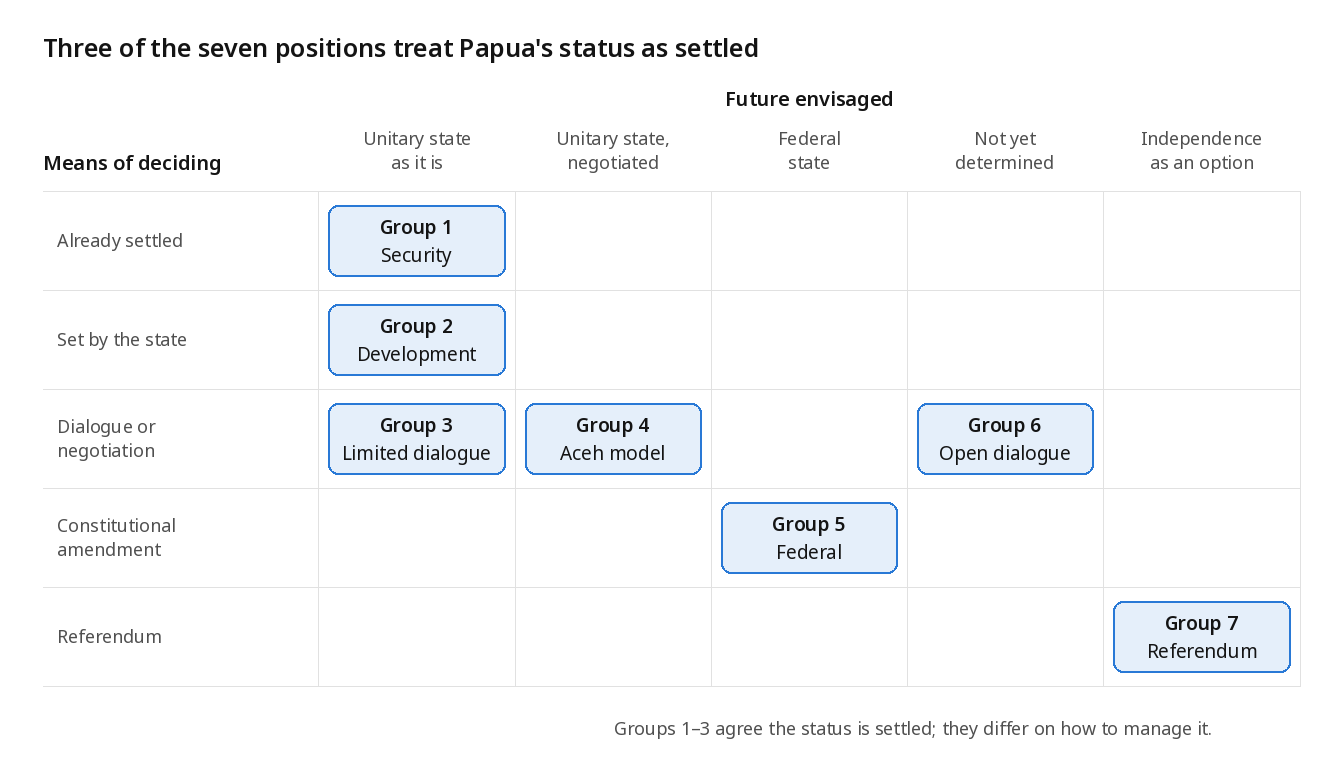
Figure 1. Mapping the seven groups of positions held by actors outside Papua according to the future envisaged and the means of deciding it
Source: compiled by the author.
5. Discussion
The map in section 4 reveals several patterns that can be discerned without judging which position is correct.
5.1 The state is largely uniform on status but diverse on means
Almost all the state institutions recorded fall within Groups 1, 2, or 3. The Ministry of Defence, the TNI, the Constitutional Court, the Ministry of Foreign Affairs, Lemhannas, presidents, and coordinating ministers all treat Papua's status as a settled matter. They differ in how Papua should be governed: some emphasise enforcement, others development, and others dialogue restricted to welfare issues. An institution often holds more than one emphasis simultaneously. Joko Widodo's administration, for example, prioritised development as the principal answer while allowing limited dialogue through its coordinating minister.
However, the state is not entirely monolithic. Komnas HAM, itself a state institution, is recorded in Group 6 because it advocates dialogue without making status a precondition. Even within Komnas HAM, this position has not remained constant: the Humanitarian Pause memorandum signed by the commissioners serving in 2017–2022 was withdrawn by the subsequent commissioners (Hukumonline, 2023). Researchers at state research institutions, from LIPI to BRIN, have also consistently belonged to the dialogue group.
5.2 Civil society clusters in the dialogue group
Most of the civil society organisations recorded fall within Group 6. This group crosses religious boundaries: Protestant, Catholic, Pentecostal, and Evangelical churches stand alongside figures from Nahdlatul Ulama and Muhammadiyah. It also includes human rights groups and academics. A notable feature is that almost none specifies the ultimate outcome it seeks. What they demand is a process: dialogue, an end to violence, and respect for human rights. Amnesty International Indonesia even explicitly states that it takes no position on the political status of any province (Amnesty International, 2021).
Thus, the principal dividing line in Indonesia is not between those who support dialogue and those who oppose it. The government, too, declares itself open to dialogue. The real dividing line is whether Papua's political status may be discussed. Group 3 closes that door from the outset, as reflected in the statement that the government has "closed the door to dialogue on a referendum" (Antara Jabar, 2019). Group 6 does not close it, although neither does it explicitly open it.
5.3 The self-determination group is small and faces risks
Group 7 is the smallest among actors outside Papua. Both actors recorded in it have faced legal proceedings. FRI-WP spokesperson Surya Anta Ginting was detained and tried in Jakarta following a demonstration in 2019, and his name appears on a list of Papuan political prisoners whose release was demanded (Front Rakyat Indonesia untuk West Papua & Aliansi Mahasiswa Papua, 2020). In the same year, Veronica Koman was named a suspect by the police, and several United Nations human rights experts called on the Indonesian government to protect her rights as a human rights defender (Office of the United Nations High Commissioner for Human Rights, 2019). These legal risks may help explain why actors outside Papua rarely express such a position publicly, although this study cannot measure the extent of their influence.
5.4 Positions shift over time and with office
This map also shows that positions are not always fixed. In 2018, while serving as vice-president, Jusuf Kalla questioned what else there was to discuss through dialogue (Industry.co.id, 2018); two years later, after leaving office, he declared himself ready to mediate (Antara, 2020). Amien Rais proposed a federal state in 1998 (Asia Pacific Solidarity Network, 1998), then in 2002 called for East Timor's separation not to be repeated in Papua (Asia Pacific Solidarity Network, 2002). The federal idea itself virtually disappeared from debate after 1999, when "NKRI" became a slogan affirming the unitary form of the state (Forum of Federations, n.d.). Even the official designation of armed groups changed twice in three years (Antara Papua Barat, 2024). Each placement on this map must therefore be read alongside the year of the statement.
5.5 Gaps in the map
Two gaps should be noted. First, political parties rarely state official positions on Papua's future. What is recorded generally consists of statements by their members or leaders, making it difficult to map parties' positions as institutions. Second, no national public opinion survey was found that specifically measured Indonesian public support for each position. This map therefore depicts the positions of actors who speak out, not the distribution of views among all citizens.
6. Conclusion
This article maps the positions of actors outside Papua on Papua's future and the means of deciding it. The mapping yields seven groups of positions: (1) final status affirmed through law and guarded by security measures; (2) final status addressed through development and special autonomy; (3) final status with dialogue that does not discuss status; (4) Aceh-style political negotiations within the framework of the unitary state; (5) changing the form of the state to a federation; (6) open-ended dialogue; and (7) self-determination through a referendum.
Actors are distributed unevenly across these groups. State institutions fall almost entirely within the first three groups, which all regard Papua's status as settled, with Komnas HAM and researchers at state research institutions as exceptions. Religious organisations, human rights groups, and academics cluster mostly in the open-ended dialogue group and generally do not specify the ultimate outcome they seek. The idea of a federal state surfaced early in the Reformasi era but is no longer pursued. Support for a referendum among actors outside Papua exists, but is small and carries legal risk.
The most important finding of this mapping is that the principal dividing line is not agreement or disagreement over dialogue, since almost all actors declare that they accept it. The dividing line concerns whether Papua's political status may be discussed. Further research could complement this map through a national public opinion survey, an examination of political parties' official positions, and a similar mapping of the views of Indigenous Papuans and Papuan organisations, allowing the two maps to be read alongside one another.
References
Amnesty International. (2021, 10 Agustus). Indonesia: Papuan protesters shot, beaten and racially abused by security forces – new research. https://www.amnesty.org/en/latest/news/2021/08/indonesia-papuan-protesters-shot-beaten-and-racially-abused-by-security-forces-new-research/
Antara. (2020, 15 November). Jusuf Kalla is ready to mediate govt's dialogue with Papuans. https://jateng.antaranews.com/berita/349656/jusuf-kalla-is-ready-to-mediate-govts-dialogue-with-papuans
Antara. (2026, 29 September). Indonesia tolak tudingan pelanggaran HAM sistematis di Papua. https://bali.antaranews.com/berita/414443/indonesia-tolak-tudingan-pelanggaran-ham-sistematis-di-papua
Antara Jabar. (2019). Wiranto: Dialog Papua terbuka namun tidak untuk referendum. https://jabar.antaranews.com/berita/109428/wiranto-dialog-papua-terbuka-namun-tidak-untuk-referendum
Antara Jogja. (2012, 29 Juni). OPM perlu kedepankan dialog. https://jogja.antaranews.com/berita/301570/opm-perlu-kedepankan-dialog
Antara Papua Barat. (2024). Babak baru upaya negara menghadapi OPM. https://papuabarat.antaranews.com/berita/43452/babak-baru-upaya-negara-menghadapi-opm
Asia Pacific Solidarity Network. (1998, 25 November). Autonomy demands add headaches. https://www.asia-pacific-solidarity.net/news/1998-11-25/autonomy-demands-add-headaches.html
Asia Pacific Solidarity Network. (2002, 20 Mei). Amien Rais vows never let separatists win again. https://www.asia-pacific-solidarity.net/news/2002-05-20/amien-rais-vows-never-let-separatists-win-again.html
Bertrand, J. (2004). Nationalism and ethnic conflict in Indonesia. Cambridge University Press.
Cassese, A. (1995). Self-determination of peoples: A legal reappraisal. Cambridge University Press.
Chauvel, R., & Bhakti, I. N. (2004). The Papua conflict: Jakarta's perceptions and policies (Policy Studies No. 5). East-West Center Washington.
CNN Indonesia. (2021, 15 Juni). Arahan Jokowi: Selesaikan masalah Papua tanpa senjata. https://www.cnnindonesia.com/nasional/20210615093052-20-654399/arahan-jokowi-selesaikan-masalah-papua-tanpa-senjata
CNN Indonesia. (2025, 7 Februari). Amnesti untuk tapol Papua tak berarti tanpa dialog. https://www.cnnindonesia.com/nasional/20250207074726-20-1195550/amnesti-untuk-tapol-papua-tak-berarti-tanpa-dialog
detikNews. (2019a, 29 Agustus). Komisi I DPR minta TNI tindak tegas separatis di Papua. https://news.detik.com/berita/d-4686205/komisi-i-dpr-minta-tni-tindak-tegas-separatis-di-papua
detikNews. (2019b, 3 September). Guru besar UI soal Papua: Isu rasisme tak bisa berujung referendum. https://news.detik.com/berita/d-4691765/guru-besar-ui-soal-papua-isu-rasisme-tak-bisa-berujung-referendum
Forum Akademisi untuk Papua Damai. (2024). Menakar peluang penyelesaian konflik dan pelanggaran HAM Papua secara damai pasca Pemilu 2024 [Kertas kebijakan]. Imparsial. https://imparsial.org/wp-content/uploads/2025/09/Kertas-Posisi-FAPD-Ind.-Final.pdf
Forum of Federations. (t.t.). Federalism vs. a unitary Indonesia. https://forumfed.org/?p=9962
Front Rakyat Indonesia untuk West Papua & Aliansi Mahasiswa Papua. (2020, 2 Januari). Release Papuan political prisoners, give Papuans the right to self-determination [Pernyataan bersama, terjemahan Indoleft]. https://www.indoleft.org/statements/2020-01-02/release-papuan-political-prisoners-give-papuans-the-right-to-self-determination.html
Hukumonline. (2021, 27 April). Sikat habis gerakan separatis dan teroris di Papua, Bamsoet: Saya siap bertanggung jawab. https://www.hukumonline.com/berita/a/sikat-habis-gerakan-separatis-dan-teroris-di-papua--bamsoet--saya-siap-bertanggung-jawab-lt608908d58e545/
Hukumonline. (2023, 9 Februari). 4 sikap Komnas HAM tentang jeda kemanusiaan di Papua. https://www.hukumonline.com/berita/a/4-sikap-komnas-ham-tentang-jeda-kemanusiaan-di-papua-lt63e4b72c0fc8c/
Industry.co.id. (2018, 11 Desember). Wapres tegaskan pemerintah tak pernah ambil kekayaan Papua. https://www.industry.co.id/read/46223/wapres-tegaskan-pemerintah-tak-pernah-ambil-kekayaan-papua
Instruksi Presiden Republik Indonesia Nomor 9 Tahun 2020 tentang Percepatan Pembangunan Kesejahteraan di Provinsi Papua dan Provinsi Papua Barat.
JawaPos.com. (2026, 16 Juli). FUKRI desak pemerintah evaluasi pendekatan militer untuk tangani konflik Papua. https://www.jawapos.com/nasional/2607160288/fukri-desak-pemerintah-evaluasi-pendekatan-militer-untuk-tangani-konflik-papua
Jones, S. (2014, 11 Maret). Obituary: A passion for peace in Papua. The Jakarta Post. https://www.thejakartapost.com/news/2014/03/11/obituary-a-passion-peace-papua
JPNN. (2020, 3 Desember). Agus Widjojo peringatkan Benny Wenda, tunggu saja. https://m.jpnn.com/news/agus-widjojo-peringatkan-benny-wenda-tunggu-saja
Kabar24. (2014, 8 September). RUU Otsus Papua diusulkan masuk prioritas. https://kabar24.bisnis.com/read/20140908/15/255881/ruu-otsus-papua-diusulkan-masuk-prioritas
Kabar24. (2020, 28 September). Diplomat muda RI minta Vanuatu berhenti berfantasi soal Papua. https://kabar24.bisnis.com/read/20200928/19/1297313/diplomat-muda-ri-minta-vanuatu-berhenti-berfantasi-soal-papua
Kabar24. (2025, 16 Desember). Pangkas biaya logistik, Prabowo minta proyek Jalan Trans Papua segera dituntaskan. https://kabar24.bisnis.com/read/20251216/15/1937331/pangkas-biaya-logistik-prabowo-minta-proyek-jalan-trans-papua-segera-dituntaskan
Kementerian Pertahanan. (t.t.). Menyapa masyarakat Papua, Menhan tegaskan Papua bagian integral Indonesia. https://www.kemhan.go.id/?p=18117
King, P. (2004). West Papua and Indonesia since Suharto: Independence, autonomy or chaos? UNSW Press.
Kompas.com. (2023, 12 Desember). Konflik Papua tak kunjung usai, Prabowo: Rumit, ada campur tangan asing. https://nasional.kompas.com/read/2023/12/12/20185781/konflik-papua-tak-kunjung-usai-prabowo-rumit-ada-campur-tangan-asing
Kompas.id. (2019, 12 September). Towards the Papua dialogue. https://www.kompas.id/baca/english/2019/09/12/towards-the-papua-dialogue
Krippendorff, K. (2004). Content analysis: An introduction to its methodology (Ed. ke-2). Sage.
McGibbon, R. (2004). Secessionist challenges in Aceh and Papua: Is special autonomy the solution? (Policy Studies No. 10). East-West Center Washington.
Medcom.id. (2019, 24 September). Legislator Papua minta pemerintah tiru penyelesaian konflik di Aceh. https://www.medcom.id/nasional/peristiwa/GbmXnpON-legislator-papua-minta-pemerintah-tiru-penyelesaian-konflik-di-aceh
Merahputih.com. (2023, 15 Februari). DPR ingatkan NKRI harga mati soal negosiasi KKB dengan Polri. https://www.merahputih.com/post/read/dpr-ingatkan-nkri-harga-mati-soal-negosiasi-kkb-dengan-polri
NU Online. (2019, 9 September). Pernyataan sikap para pemuka agama dan aktivis untuk Papua damai. https://nu.or.id/nasional/pernyataan-sikap-para-pemuka-agama-dan-aktivis-untuk-papua-damai-PlNPl
NU Online. (2021, 28 April). Peneliti konflik Papua: Pemerintah dan KKB harus buka dialog. https://nu.or.id/nasional/peneliti-konflik-papua-pemerintah-dan-kkb-harus-buka-dialog-VZRXN
NU Online. (2025, 1 Desember). Aksi 64 tahun deklarasi Papua Barat: Hentikan genosida, berikan hak menentukan nasib sendiri. https://www.nu.or.id/nasional/aksi-64-tahun-deklarasi-papua-barat-hentikan-genosida-berikan-hak-menentukan-nasib-sendiri-w4lYd
Office of the United Nations High Commissioner for Human Rights. (2019, 16 September). Indonesia must protect rights of Veronica Koman and others reporting on Papua and West Papua protests – UN experts. https://www.ecoi.net/de/dokument/2016423.html
Republika. (2019a, 31 Agustus). Konferensi Waligereja Indonesia imbau dialog sikapi Papua. https://news.republika.co.id/berita/px2z8e320/konferensi-waligereja-indonesia-imbau-dialog-sikapi-papua
Republika. (2019b, 3 September). Wiranto: Tak ada opsi referendum untuk Papua. https://news.republika.co.id/berita/px93b3377/wiranto-tak-ada-opsi-referendum-untuk-papua
Republika. (2021, 27 April). Amnesty respons Bamsoet soal musnahkan KKB, HAM kemudian. https://news.republika.co.id/berita/qs7cf2428/amnesty-respons-bamsoet-soal-musnahkan-kkb-ham-kemudian
Republika. (2025, 4 November). Kunjungi Bumi Cenderawasih, Gibran: Papua bukan tempat pengasingan, tapi bagian penting NKRI. https://news.republika.co.id/berita/t570ta487/kunjungi-bumi-cenderawasih-gibran-papua-bukan-tempat-pengasingan-tapi-bagian-penting-nkri
Reuters. (2025, 22 Januari). Jakarta plans pardons for Papuan prisoners, including separatists. Free Malaysia Today. https://www.freemalaysiatoday.com/category/world/2025/01/22/jakarta-plans-pardons-for-papuan-prisoners-including-separatists
RRI. (2026, 13 Juni). TNI ajak OPM yang masih di hutan kembali ke NKRI dan bangun Papua bersama. https://rri.co.id/regional/2490297/tni-ajak-opm-yang-masih-di-hutan-kembali-ke-nkri-dan-bangun-papua-bersama
Sahbani, A. (2021, 1 Mei). KKB dilabeli teroris, begini pandangan pakar hukum internasional. Hukumonline. https://www.hukumonline.com/berita/a/kkb-dilabeli-teroris--begini-pandangan-pakar-hukum-internasional-lt608db1ce734bb/
Sihaloho, R. A. H., Hanita, M., & Pamungkas, C. (2022). Narasi dialog damai Papua–Jakarta dalam bingkai ketahanan nasional dan implementasinya. Jurnal Masyarakat Indonesia, 48(1), 91–101.
Sindonews. (2026, 26 September). Komisi I DPR kecam keras pidato PM Solomon tentang Papua di Sidang Umum PBB. https://www.rctiplus.com/news/detail/sindonews/5481190/komisi-i-dpr-kecam-keras-pidato-pm-solomon-tentang-papua-di-sidang-umum-pbb
Tempo. (2019, 21 November). Veronica Koman: I will not run away. https://en.tempo.co/read/1275117/veronica-koman-i-will-not-run-away
The Jakarta Post. (2016, 29 November). Group supports referendum for West Papua. https://www.thejakartapost.com/news/2016/11/29/group-supports-referendum-for-west-papua.html
The Jakarta Post. (2020, 8 Januari). Court rejects judicial review of Papua referendum. https://www.thejakartapost.com/news/2020/01/08/court-rejects-judicial-review-papua-referendum.html
The Jakarta Post. (2023a, 7 Juli). Jokowi's Papua approach must do more than scratch an itch. https://www.thejakartapost.com/id/paper/2023/07/07/jokowis-papua-approach-must-do-more-than-scratch-an-itch
The Jakarta Post. (2023b, 12 November). Religious figures, activists call for dialogue to end violence in Papua. https://www.thejakartapost.com/indonesia/2023/11/12/religious-figures-activists-call-for-dialogue-to-end-violence-in-papua
Tirto.id. (2019). Menunggu dialog Jakarta-Papua: Referendum atau otsus? https://tirto.id/menunggu-dialog-jakarta-papua-referendum-atau-otsus-ehfv
Tirto.id. (2020). Mahfud: Tidak ada negosiasi soal kemerdekaan Papua. https://tirto.id/mahfud-tidak-ada-negoisasi-soal-kemerdekaan-papua-f5rc
Tirto.id. (2025). Rencana amnesti KKB Papua harus berlanjut pada dialog humanis. https://tirto.id/rencana-amnesti-kkb-papua-harus-berlanjut-pada-dialog-humanis-g7HD
UCA News. (2011, November). Papua priest welcomes discussion call. https://www.ucanews.com/news/papua-priest-welcomes-discussion-call/35154
Undang-Undang Republik Indonesia Nomor 2 Tahun 2021 tentang Perubahan Kedua atas Undang-Undang Nomor 21 Tahun 2001 tentang Otonomi Khusus bagi Provinsi Papua.
Warta Ekonomi. (t.t.). Kepala daerah se-Papua ditantang deklarasi setia NKRI, wani? https://wartaekonomi.co.id/read263633/kepala-daerah-se-papua-ditantang-deklarasi-setia-nkri-wani
Widjojo, M. S., Elisabeth, A., Al Rahab, A., Pamungkas, C., & Dewi, R. (2009). Papua road map: Negotiating the past, improving the present and securing the future. Yayasan Obor Indonesia, LIPI, & TIFA Foundation.